



蛍光標識サービス
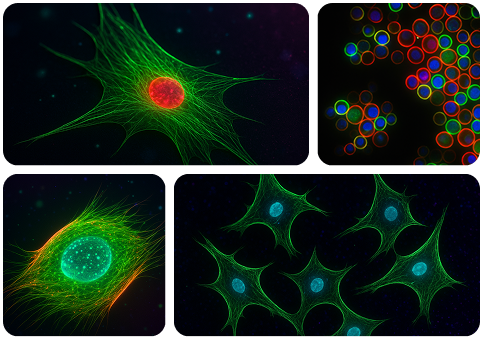
Fluorescent labeling technology refers to the covalent binding or physical adsorption of fluorescent substances on a chemical group of molecule to be studied, and the subsequent qualitative, and quantitative analyses of the labeled objects by observing fluorescence characteristics.
Fluorescent labeling has several advantages i.e. it does not cause radioactive contamination, easy to operate, and easy to observe under fluorescent microscope, etc. Fluorescent labelling has great potential in studying proteins, nucleic acids, cell biology and performing immuno-analyses. The application of fluorescent labeling has been deeply involved in many fields such as pharmacology, physiology, environmental science, and information sciences, etc., and has been widely used in the functional research of proteins and drug screening.
MedChemExpress (MCE) has an efficient, experienced and professional technical team who can chemically incorporate fluorescent labels on biomolecules, proteins, antibodies, and peptides. We can offer variety of labels and conjugates to choose from and multiple customization services less to microgram level. Furthermore, we can meet all relevant needs of customers regarding fluorescent labelling.
Custom Peptide Synthesis
-

Professional protein/organic chemistry technical team
-

Professional pre-sale and after-sale technical services
-

High quality label coupling custom services from micrograms to milligrams
-

Services to minimize the steric hindrance and reduce the intervention of marker activity
Service Process
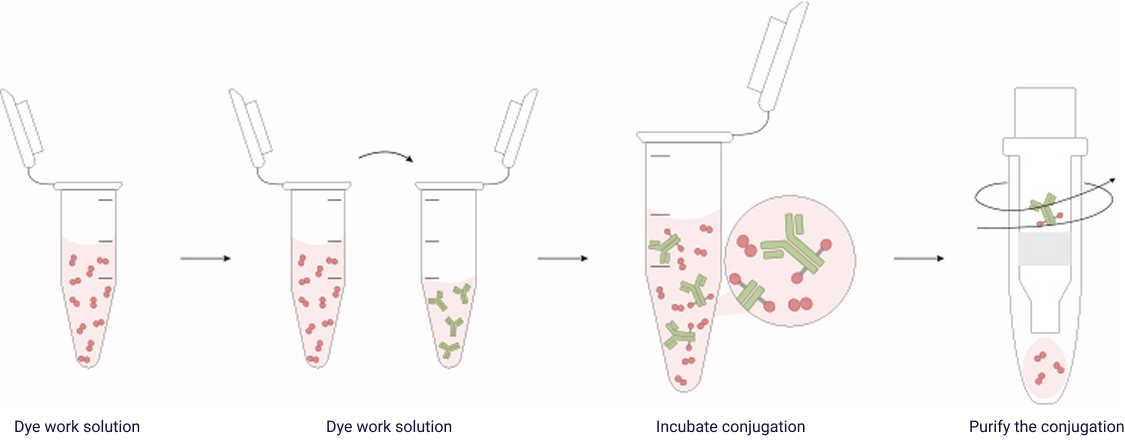
The process of antibody labeling
| Service Project | Service Requirements | Service Period | Service Products |
|---|---|---|---|
| Protein labeling | Protein more than 50 μg, purity more than 90%, concentration more than 1 mg/mL | 3-10 working days after receiving the sample | Labeled product and Labeling report |
| Antibody labeling | Antibody more than 50 μg, purity more than 90%, concentration more than 1 mg/mL | 3-10 working days after receiving the sample | |
| Peptides labeling | The minimum molecular weight of the peptide is not less than 3 kDa, and the number of amino acids is not less than 30 | 3-10 working days after receiving the sample | |
| Biomolecule labeling | The minimum starting scalar of biomolecule is not less than 10 mg, the minimum molecular weight is less than 3 kDa | More than 7 working days after receiving the sample, adjust according to sample situation and specific needs |
| Cat.No | Product | Optimal Excitation Wavelength(nm) | Optimal Emission Wavelength(nm) | Label Type |
|---|---|---|---|---|
| HY-66019 | FITC | 488 | 525 | Labeled product and Labeling report |
| HY-D0723 | 5(6)-TAMRA SE | 530 | 582 | |
| HY-D0826 | Cy2-SE (iodine) | 492 | 510 | |
| HY-112498 | Cy3 NHS ester | 550 | 570 | |
| HY-D0819A | CY5-SE (triethylamine salt) | 650 | 670 | |
| HY-D0824 | CY7-SE | 750 | 773 | |
| HY-D1085 | AMCA-X SE | 345 | 475 | |
| HY-N7131 | Coumarin 6 | 554 | 585 | |
| HY-D0042 | NBD-Cl | 464 | 512 | |
| HY-D0154 | TRITC | 596 | 620 | |
| HY-131030 | Janelia Fluor® 669, SE | 669 | 685 | |
| HY-130736 | Janelia Fluor® 549, SE | 549 | 635 | |
| HY-138658 | Janelia Fluor® 526, SE | 526 | 585 | |
| HY-B0511 | Biotin | / | / | |
| HY-138200 | Cy5 maleimide | 650 | 670 | Mercapto |
| HY-D1323 | Cyanine5.5 maleimide chloride | 678 | 705 | |
| HY-D1566 | Sulfo-Cy7.5 maleimide | 778 | 797 | |
| HY-D1540 | Cyanine5.5 amine | 678 | 705 | Carboxyl |
Each project needs to be evaluated separately to determine the corresponding lead time and price. For further information on pricing or technical details, please email [email protected] Or contact MedChemExpress (MCE) sales directly.
1. Fluorescent labeling service does not guarantee activity. Antibody labeling services do not affect antibody activity and more than 95% of protein labeling services do not affect protein activity.
2. Conjugation leads to depletion. The recovery of small molecule labeling usually varies from 5% to 60%. For 50-100 μg protein labeling service, recovery is over 90%, for 500 μg or more protein labeling service, recovery is over 98%.
3. There is a risk of failure for small molecule labeling, and a partial fee will be charged if failed.