



Alpha-Cypermethrin

Based on 1 Customer Validation
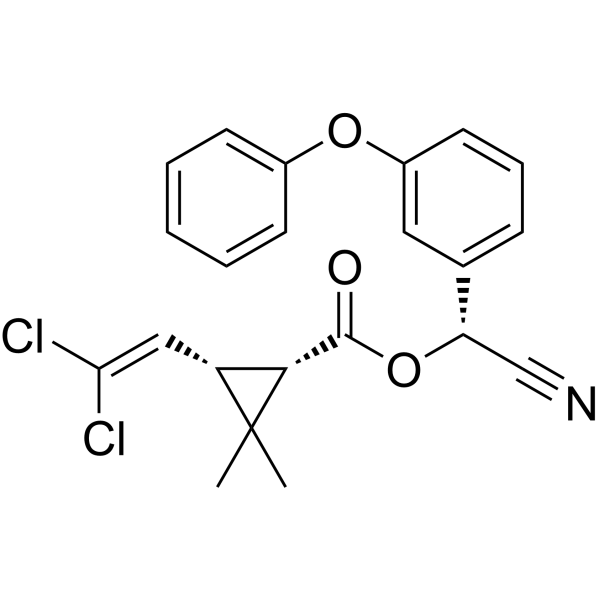
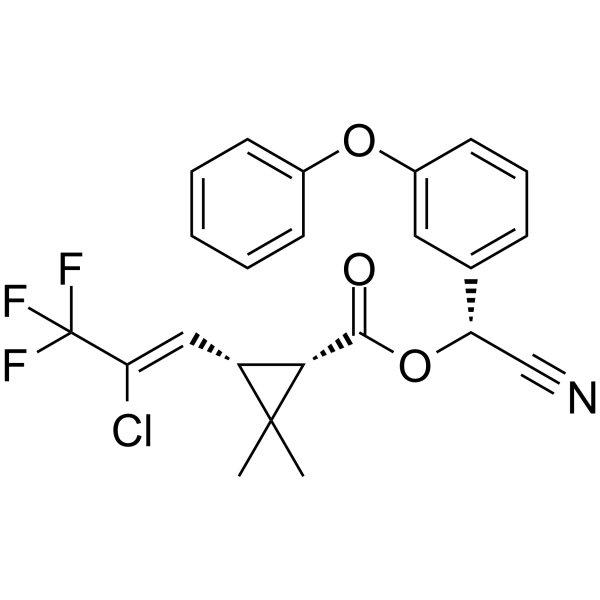
Alpha-Cypermethrin (FMC 45497; Fendona; WL 85871) is a type II pyrethroid insecticide. Alpha-Cypermethrin acts by delaying the inactivation of voltage-gated sodium channels, prolonging sodium tail currents, and triggering repetitive neural discharges. Alpha-Cypermethrin exhibits knockdown and lethal activity against target insects such as Musca domestica and Anopheles culicifacies. Alpha-Cypermethrin induces neurotoxicity in mammals, alters placental and fetal neurodevelopment, and causes acute mortality in fish. Alpha-Cypermethrin can be used in studies related to neurotoxicity, vector-borne diseases, and malaria.
연구목적의 판매만을 진행합니다. 환자를 대상으로 한 판매는 하지 않습니다.
- Purity : 99.66%
- CAS No.: 67375-30-8
- 화학식: C22H19Cl2NO3
- 분자량:416.30
-
보관:Powder -20°C, 3 years , 4°C, 2 years ; In solvent -80°C, 6 months , -20°C, 1 month

To place orders, for customer services and technical support, please contact: MedChemExpress USA
Tel: 609-228-6898 E-mail: [email protected] [email protected]


-
 Biological Activity
-
Chemical Information
- Protocol
- 순도&문서
- References
-
 Help & FAQs




Biological Activity
제품 설명
In Vitro
Alpha-Cypermethrin shows no mutagenicity in in vitro tests against Salmonella typhimurium, Escherichia coli, and Saccharomyces cerevisiae[2].
Alpha-Cypermethrin (48-96 h) exhibits low growth inhibitory activity against the freshwater alga Selenastrum capricornutum, with an EC50 value greater than 100 µg/litre[2].
Alpha-Cypermethrin (3 mg/litre) does not inhibit the growth of sewage bacteria in a closed in vitro system[2].
Polyamide nylon bed nets treated by immersion with Alpha-Cypermethrin (25 mg/m2) exhibit knockdown and killing activity against Anopheles culicifacies, making them suitable for vector control applications[6].
MedChemExpress (MCE) has not independently confirmed the accuracy of these methods. They are for reference only.
In Vivo
Alpha-cypermethrin (40-368 mg/kg; p.o.; single dose) exhibits moderate to high acute oral toxicity, low acute dermal toxicity, and moderate acute intraperitoneal toxicity when administered to Wistar rats with corn oil as the solvent, with its toxic symptoms consistent with those of cypermethrin-containing insecticides[2].
Alpha-cypermethrin (0.4 g/m3; inhalation; single 4 h exposure) shows low acute inhalation toxicity in Fischer-344 rats[2].
At low doses, Alpha-cypermethrin (25-800 mg/kg in feed; oral administration; daily; for 5 weeks) causes no obvious adverse effects in Wistar rats, but at high doses, it induces intoxication, growth retardation, alterations in blood biochemical parameters, and increased organ weights[2].
At low doses of alpha-cypermethrin (20-540 mg/kg in feed; p.o.; daily; for 13 weeks), no adverse effects are observed in Wistar rats; only slight growth effects occur at medium doses; while toxic symptoms, growth retardation and mild neurodegeneration appear at high doses[2].
For alpha-cypermethrin (dietary dose: 30-270 mg/kg; oral administration; daily; for 13 consecutive weeks), the no-observed-effect level (NOEL) is 90 mg/kg diet. At the high dose, dogs exhibit typical pyrethroid intoxication symptoms, but no detectable changes occur in physiological or pathological parameters[2].
Alpha-cypermethrin (semi-occlusive percutaneous application; single dose; 24 h) causes only mild irritation to rabbit skin[2].
Alpha-Cypermethrin (0.05% (v/v) in corn oil; 50% (m/m) in vaseline; guinea pig percutaneous GPMT with intradermal induction + topical application/topical challenge; single procedure; 7 d induction with 48 h application, 24 h after 14 d challenge) shows no skin sensitization in guinea pigs[2].
Exposure to Alpha-Cypermethrin (0.3-10 mg/kg/day; oral administration; daily dosing; for 11 consecutive days (gestational days 6-16)) causes dose-dependent fetal growth restriction, alterations in placental morphology and gene expression, as well as changes in microglia and transcriptome of the fetal dorsal forebrain in pregnant CD1 mice[4].
MedChemExpress (MCE) has not independently confirmed the accuracy of these methods. They are for reference only.
-
Animal Model:albino rats (adult male, 180-200 g)[1]
-
Dosage:14.5 mg/kg
-
Administration:p.o.; daily; 4 weeks
-
Result:Decreased GABA level to 0.6 mg/mL/g tissue.
Decreased acetylcholinesterase (AChE) activity to 48.2 mU/mg protein.
Decreased catalase (CAT) activity to 21 U/mg protein.
Decreased superoxide dismutase (SOD) activity to 33.7 U/mg protein.
Decreased glutathione peroxidase (GPx) activity to 33.4 mU/mg protein.
Increased malondialdehyde (MDA) level to 31.8 nmol/g tissue.
Disrupted cerebellar cortex structure, causing reduced numbers of Purkinje cells and granule cells, vacuolation in the granular layer, degeneration of Purkinje cell dendrites, and a loose molecular layer.
-
Animal Model:CD[2]
-
Dosage:35 mg/kg (5% in corn oil); 762 mg/kg (40% in DMSO); 798 mg/kg (50% aqueous suspension)
-
Administration:p.o.; single dose
-
Result:Induced clinical signs of intoxication including ataxia, abasia, gait abnormalities, choreoathetosis, "tip-toe" walk, increased salivation, lacrimation, piloerection, tremor, and clonic convulsions.
Caused most mortalities within the first 3 hours; surviving animals recovered within 7 days.
Exhibited LD50 values of 35 mg/kg for 5% in corn oil, 762 mg/kg for 40% in DMSO, and 798 mg/kg for 50% aqueous suspension.
-
Animal Model:Wistar[2]
-
Dosage:79 mg/kg (5% in corn oil); >4000 mg/kg (40% in DMSO); >5000 mg/kg (50% aqueous suspension); 40-80 mg/kg (10% in corn oil); 368 mg/kg (20% in corn oil); 500 mg/kg (25% in DMSO); 339 mg/kg (10% in corn oil)
-
Administration:p.o.; single dose; dermal; single 24-h exposure; i.p.; single dose
-
Result:Induced clinical signs including clonic convulsions, piloerection, salivation, and splayed hind-leg gait via oral administration in corn oil, with LD50 values of 79 mg/kg for 5% in corn oil, 40-80 mg/kg for 10% in corn oil, and 368 mg/kg for 20% in corn oil.
Exhibited far lower acute oral toxicity with LD50 values >4000 mg/kg for 40% in DMSO and >5000 mg/kg for 50% aqueous suspension.
Caused no mortality or intoxication signs via single 24-h dermal exposure to 500 mg/kg.
Induced characteristic pyrethroid intoxication signs including ataxia, abasia, choreoathetosis, gait abnormalities, "tip-toe" walk, salivation via intraperitoneal administration at 339 mg/kg, with an LD50 of 339 mg/kg.
-
Animal Model:Fischer-344[2]
-
Dosage:0.4 g/m3
-
Administration:inhalation; single 4-h exposure
-
Result:Showed no signs of intoxication during a 14-day post-exposure observation period.
Revealed no effects via macroscopic lung examination.
Exhibited an acute LC50 >0.4 g active ingredient/m3.
-
Animal Model:Wistar[2]
-
Dosage:25 mg/kg diet; 100 mg/kg diet; 200 mg/kg diet; 400 mg/kg diet; 800 mg/kg diet
-
Administration:p.o.; daily; 5 weeks
-
Result:Caused no effects at 200 mg/kg diet or lower.
Induced decreased food intake, decreased body weight, and increased blood urea levels in males, plus increased liver (males only) and kidney weights in both sexes at 400 mg/kg diet.
Caused intoxication signs including abnormal gait, hypersensitivity, decreased food intake, decreased body weight, decreased blood protein levels, increased blood urea levels, and increased liver and kidney weights in both sexes, plus sparse axonal degeneration in the sciatic nerve in one severely intoxicated male at 800 mg/kg diet.
-
Animal Model:Wistar[2]
-
Dosage:20 mg/kg diet; 60 mg/kg diet; 180 mg/kg diet; 540 mg/kg diet
-
Administration:p.o.; daily; 13 weeks
-
Result:Caused no effects at 60 mg/kg diet or lower.
Induced marginal decreased growth in males during week 1 and from week 10 onwards at 180 mg/kg diet.
Caused intoxication signs including abnormal gait with splayed hind limbs in 3 out of 20 males, decreased growth and food intake in both sexes, and sparse axonal degeneration in the sciatic nerve in two males at 540 mg/kg diet; no dose-related changes to haematology, clinical chemistry, or organ weights were observed.
-
Animal Model:Beagle[2]
-
Dosage:30 mg/kg diet; 90 mg/kg diet; 270 mg/kg diet
-
Administration:p.o.; daily; 13 weeks
-
Result:Caused no effects at 90 mg/kg diet or lower.
Induced intoxication signs including whole body tremors, head nodding, "lip-licking", subduedness, ataxia, agitation, and high-stepping gait in all animals, with increasing intensity over the study at 270 mg/kg diet; no dose-related changes to food consumption, body weight gain, organ weights, ophthalmoscopy, haematology, clinical chemistry, urinalysis, gross pathology, or histopathology were observed.
-
Animal Model:Guinea-pig[2]
-
Dosage:0.05% (v/v) in corn oil; 50% (m/m) in vaseline
-
Administration:intradermal injection; single dose; topical application; single dose; topical challenge; single dose
-
Result:Showed no skin sensitization reactions in test animals.
-
Animal Model:CD1-IGS (female, 7 to 9 weeks old, mated with GAD67-GFP+/− knock-in males on CD1 background, pregnant developmental toxicity model)[4]
-
Dosage:0.3 mg/kg/day; 3 mg/kg/day; 10 mg/kg/day
-
Administration:p.o.; daily; 11 days (gestational days 6-16)
-
Result:Reduced fetal body weight by 4.9%, 6.1%, and 10.0% relative to control for the 0.3, 3, and 10 mg/kg doses, respectively; the 10 mg/kg dose reduction was statistically significant.
Reduced fetal dorsal forebrain volume in a dose-dependent manner, with significant effects at 3 mg/kg and 10 mg/kg.
Significantly reduced placental labyrinth zone relative area, and significantly increased junctional zone relative area at 3 mg/kg and 10 mg/kg.
Reduced labyrinth zone thickness by 5.6%, 10.8%, and 15.7% relative to control for the 0.3, 3, and 10 mg/kg doses, respectively; the 10 mg/kg reduction was statistically significant.
Significantly increased junctional zone thickness at 10 mg/kg.
Reduced placental sinusoidal area by 7.7%, 11.0%, and 10.2% relative to control for the 0.3, 3, and 10 mg/kg doses, respectively; reductions at 3 mg/kg and 10 mg/kg were statistically significant.
Increased placental junctional zone glycogen cell number by 50.4%, 41.7%, and 74.1% relative to control for the 0.3, 3, and 10 mg/kg doses, respectively; the 10 mg/kg increase was statistically significant.
Reduced placental Lox gene expression by 56.2%, 67.8%, and 68.8% relative to control for the 0.3, 3, and 10 mg/kg doses, respectively, with all reductions statistically significant.
Increased placental Depp1 gene expression in a dose-dependent manner, with a statistically significant increase at 10 mg/kg.
Significantly increased placental junctional zone collagen content at 10 mg/kg.
Induced a dose-dependent shift of fetal dorsal forebrain microglia from ramified to ameboid morphology, with significant increases in ameboid microglia at all doses.
Significantly increased multivacuolated microglia at 3 mg/kg and 10 mg/kg.
Identified 1,018 differentially expressed genes in dorsal forebrain (3 mg/kg dose), with significant downregulation of cAMP-mediated signaling and synaptogenesis signaling pathway.
Clinical Trial
| NCT Number | Sponsor | Condition | Start Date |
Phase

|
|---|---|---|---|---|
| NCT01329991 | 2011-05 | PHASE1 |


Chemical Information
-
CAS No. 67375-30-8
-
Appearance Solid
-
분자량 416.30
-
화학식 C22H19Cl2NO3
-
Color White to off-white
-
SMILES
O=C([C@@H]1C(C)(C)[C@@H]1/C=C(Cl)\Cl)O[C@@H](C#N)C2=CC=CC(OC3=CC=CC=C3)=C2
-
Synonyms
FMC 45497; Fendona; WL 85871
-
선적
Room temperature in continental US; may vary elsewhere.
-
보관
Powder -20°C 3 years 4°C 2 years In solvent -80°C 6 months -20°C 1 month


순도&문서
-
Data Sheet (304 KB)
-
SDS (728 KB)
- English - EN (728 KB)
- Français - FR (728 KB)
- Deutsch - DE (728 KB)
- Norwegian - NO (728 KB)
- Español - ES (728 KB)
- Swedish - SV (728 KB)
- Italian - IT (728 KB)
- Korean - KR (728 KB)
- Portuguese - PT (728 KB)
-
Handling Instructions (2659 KB)
References
[2]. World Health Organization. Alpha-cypermethrin[M]. World Health Organization, 1992.
[3]. Abbas N, et al. Alpha-Cypermethrin Resistance in Musca domestica: Resistance Instability, Realized Heritability, Risk Assessment, and Insecticide Cross-Resistance. Insects. 2023 Feb 26;14(3):233. [Content Brief]

Calculators
Concentration (start) × Volume (start) = Concentration (final) × Volume (final)


Alpha-Cypermethrin Related Classifications
HY-B0874 Related Classifications
 Powered by Bioz
Keywords
- Alpha-Cypermethrin
- 67375-30-8
- FMC 45497
- Fendona
- WL 85871
- FMC45497
- FMC-45497
- WL85871
- WL 85871
- WL-85871
- Insecticide
- Sodium Channel
- Salmonella typhimurium
- male albino rats
- Culex spp
- Escherichia coli
- acetylcholinesterase
- Musca domestica
- Selenastrum capricornutum
- An. culicifacies
- sodium channel
- Saccharomyces cerevisiae
- Inhibitor
- inhibitor
- inhibit