



Cefotetan

Based on 1 Customer Validation
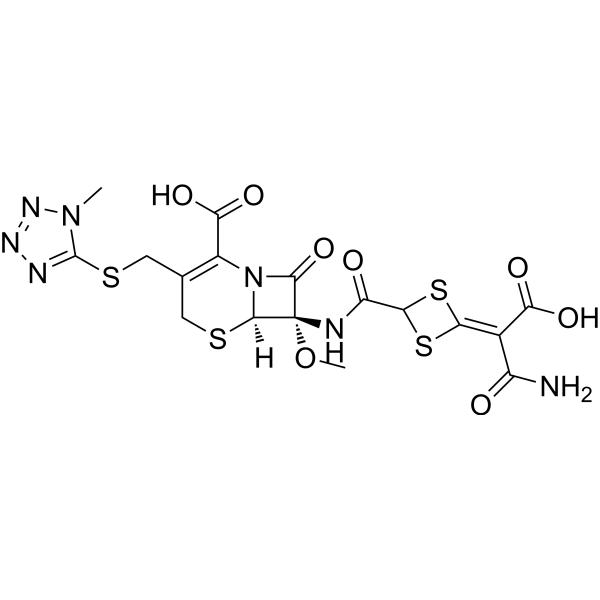
Cefotetan is a binding agent that targets human Raf1 kinase inhibitor protein (hRKIP). Cefotetan binds to hRKIP, reduces the binding space between hRKIP and Raf1 kinase, relieves hRKIP's inhibition of the Ras/Raf1/MEK/ERK signaling pathway, and enhances ERK phosphorylation. Cefotetan can be used to study diseases associated with dysregulated Ras/Raf1/MEK/ERK signaling pathways. Cefotetan is also a broad-spectrum antibacterial agent that disrupts cell wall synthesis by binding to bacterial penicillin-binding proteins (PBPs). It is used to study bacterial infections such as bone, skin, urinary tract, and lower respiratory tract.
연구목적의 판매만을 진행합니다. 환자를 대상으로 한 판매는 하지 않습니다.
- Purity : 98.52%
- CAS No.: 69712-56-7
- 화학식: C17H17N7O8S4
- 분자량:575.62
-
보관:Powder -20°C, 3 years , 4°C, 2 years ; In solvent -80°C, 2 years , -20°C, 1 year

To place orders, for customer services and technical support, please contact: MedChemExpress USA
Tel: 609-228-6898 E-mail: [email protected] [email protected]


-
 Biological Activity
-
Chemical Information
-
용액&용해도
- Protocol
- 순도&문서
- References
-
 Help & FAQs





Biological Activity
제품 설명
IC50 & Target
|
β-lactam |
Cellular Effect
|
Cell Line

|
Type | Value | Description | References |
|---|---|---|---|---|
| HEK293 | CC50 |
>32 μg/mL
Compound: Cefotetan
|
Cytotoxicity against HEK293 cells incubated for 20 hrs by resazurin dye based assay
Cytotoxicity against HEK293 cells incubated for 20 hrs by resazurin dye based assay
|
[PMID: 38112278] |
In Vitro
Cefotetan (20-80 μM; 30 min) significantly increases HEK293T and HeLa cells ERK phosphorylation levels, and this effect is more pronounced in cells overexpressing hRKIP[1].
Cefotetan is active against both Gram-positive bacteria (such as Staphylococci and Streptococci) and Gram-negative bacteria (such as Enterobacter and Haemophilus influenzae), and is highly stable against plasmid- and chromosome-mediated β-lactamases. 0.5 mg/L Cefotetan inhibits 75% of Enterobacter, 4 mg/L Cefotetan inhibits 90% of Enterobacter, and the MIC of Cefotetan against Neisseria gonorrhoeae is 0.06-2 mg/L[2].
MedChemExpress (MCE) has not independently confirmed the accuracy of these methods. They are for reference only.
-
Cell Line:HEK293T cells, HeLa cells, hRKIP-transferred HEK293T cells, hRKIP-transferred HeLa cells
-
Concentration:0 μM, 20 μM, 40 μM, 80 μM
-
Incubation Time:30 min
-
Result:Enhanced the phosphorylation level of ERK dose-dependently.
In hRKIP-transferred HEK293T cells, increased the phosphorylation level of ERK by approximately 300% compared with the control at 80 μM; in hRKIP-transferred HeLa cells, increased the phosphorylation level of ERK by approximately 250% under the same concentration.
In Vivo
MedChemExpress (MCE) has not independently confirmed the accuracy of these methods. They are for reference only.
-
Animal Model:Mice (ICR strain, male, 6-7 weeks old), rats (SD strain, male, 6-9 weeks old), rabbits (white rabbits, male, 3.0-3.5 kg), dogs (female beagle dogs, 9.0-14.0 kg), monkeys (female rhesus monkeys, 4.8-5.6 kg)[3]
-
Dosage:20 mg/kg
-
Administration:Intravenous injection, single dose
-
Result:Mice: 5 minutes after intravenous injection, the plasma concentration reached 52.3 μg/ml, with the highest renal concentration (58.5 μg/g), 24-hour urinary excretion rate of 67.2%, fecal excretion rate of 30.3%; after subcutaneous injection, the fecal excretion rate was 30.3%, and no active metabolites were detected in urine.
Rats: Plasma concentration increased with increasing dose (20 mg/kg group reached 66.5 μg/ml in 5 minutes), with the highest kidney concentration (100 mg/kg group reached 596 μg/g in 5 minutes), 24-hour urine excretion rate of 51.9%, bile excretion rate of 48.1%, and fecal excretion rate of 37.7%.
Rabbit: Plasma concentration of 83 μg/ml in 5 minutes, 74% in 24-hour urine excretion rate, 5.1% in bile excretion rate, and only 0.3% in feces.
Dog: Plasma concentration of 105 μg/ml in 20 mg/kg group in 5 minutes, with the highest kidney concentration (60.3 μg/g in 30 minutes), 52.8% in 24-hour urine excretion rate, 17.4% in bile excretion rate, and 13.3% in feces.
Monkey: 5-minute plasma concentration 129 μg/ml, 24-hour urine excretion rate 59.7%, bile excretion rate not clearly detected, fecal excretion rate 0.3%, plasma protein binding rate 87%.
Clinical Trial
| NCT Number | Sponsor | Condition | Start Date |
Phase
|
|---|---|---|---|---|
| NCT01329991 | Plexxikon| | 2011-05 | PHASE1 |


Chemical Information
-
CAS No. 69712-56-7
-
Appearance Solid
-
분자량 575.62
-
화학식 C17H17N7O8S4
-
Color White to off-white
-
SMILES
O=C(C(N12)=C(CSC3=NN=NN3C)CS[C@]2([H])[C@](OC)(NC(C(S/4)SC4=C(C(O)=O)/C(N)=O)=O)C1=O)O
-
선적
Room temperature in continental US; may vary elsewhere.
-
보관
Powder -20°C 3 years 4°C 2 years In solvent -80°C 2 years -20°C 1 year


용액&용해도
In Vitro:
DMSO : 175 mg/mL (304.02 mM; Need ultrasonic; Hygroscopic DMSO has a significant impact on the solubility of product, please use newly opened DMSO)
Please refer to the solubility information to select the appropriate solvent. Once prepared, please aliquot and store the solution to prevent product inactivation from repeated freeze-thaw cycles.
Storage method and period of stock solution: -80°C, 2 years; -20°C, 1 year. When stored at -80°C, please use it within 2 years. When stored at -20°C, please use it within 1 year.
Please refer to the solubility information to select the appropriate solvent. Once prepared, please aliquot and store the solution to prevent product inactivation from repeated freeze-thaw cycles.
Storage method and period of stock solution: -80°C, 2 years; -20°C, 1 year. When stored at -80°C, please use it within 2 years. When stored at -20°C, please use it within 1 year.
Concentration (start) × Volume (start) = Concentration (final) × Volume (final)
In Vivo:
Select the appropriate dissolution method based on your experimental animal and administration route.
- For the following dissolution methods, please ensure to first prepare a clear stock solution using an In Vitro approach and then sequentially add co-solvents:
- To ensure reliable experimental results, the clarified stock solution can be appropriately stored based on storage conditions. As for the working solution for In Vivo experiments, it is recommended to prepare freshly and use it on the same day.
- The percentages shown for the solvents indicate their volumetric ratio in the final prepared solution. If precipitation or phase separation occurs during preparation, heat and/or sonication can be used to aid dissolution.
Add each solvent one by one: 10% DMSO 40% PEG300 5% Tween-80 45% Saline
Solubility: ≥ 1.25 mg/mL (2.17 mM); Clear solution
This protocol yields a clear solution of ≥ 1.25 mg/mL (saturation unknown).
Taking 1 mL working solution as an example, add 100 μL DMSO stock solution (12.5 mg/mL) to 400 μL PEG300, and mix evenly; then add 50 μL Tween-80 and mix evenly; then add 450 μL Saline to adjust the volume to 1 mL.
Preparation of Saline: Dissolve 0.9 g sodium chloride in ddH₂O and dilute to 100 mL to obtain a clear Saline solution.
Add each solvent one by one: 10% DMSO 90% (20% SBE-β-CD in Saline)
Solubility: ≥ 1.25 mg/mL (2.17 mM); Clear solution
This protocol yields a clear solution of ≥ 1.25 mg/mL (saturation unknown).
Taking 1 mL working solution as an example, add 100 μL DMSO stock solution (12.5 mg/mL) to 900 μL 20% SBE-β-CD in Saline, and mix evenly.
Preparation of 20% SBE-β-CD in Saline (4°C, storage for one week): 2 g SBE-β-CD powder is dissolved in 10 mL Saline, completely dissolve until clear.
In Vivo Dissolution Calculator
Please enter the basic information of animal experiments:
-
-
-
-
Recommended: Prepare an additional quantity of animals to account for potential losses during experiments.
Please enter your animal formula composition:
-
%DMSO +
Recommended: Keep the proportion of DMSO in working solution below 2% if your animal is weak.
-
%+
-
+%Tween-80 + +
-
%Saline +
The co-solvents required include: DMSO, . All of co-solvents are available by MedChemExpress (MCE). , Tween 80. All of co-solvents are available by MedChemExpress (MCE).
Working solution concentration: 0.22 mg/mL
Method for preparing stock solution: mg drug dissolved in μL DMSO. Stock solution concentration: mg/mL.
1. Take μL DMSO stock solution;
2. Add μL .
μL , mix evenly;
3. Then add μL Tween 80, mix evenly;
4. Then add μL
Please ensure that the stock solution in the first step is dissolved to a clear state, and add co-solvents in sequence. You can use ultrasonic heating (ultrasonic cleaner, recommended frequency 20-40 kHz), vortexing, etc. to assist dissolution.


순도&문서
-
Data Sheet (280 KB)
-
SDS (394 KB)
- English - EN (394 KB)
- Français - FR (394 KB)
- Deutsch - DE (394 KB)
- Norwegian - NO (394 KB)
- Español - ES (394 KB)
- Swedish - SV (394 KB)
- Italian - IT (394 KB)
- Korean - KR (394 KB)
- Portuguese - PT (394 KB)
-
Handling Instructions (2659 KB)
References
[1]. Guo C, et al. Cefotetan-bound human RKIP involves in Ras/Raf1/MEK/ERK signaling pathway. Acta Biochim Biophys Sin (Shanghai). 2022 Dec 25;54(12):1917-1923. [Content Brief]
[2]. Phillips I, et al. Cefotetan: in-vitro antibacterial activity and susceptibility to beta-lactamases. J Antimicrob Chemother. 1983 Jan;11 Suppl:1-9. [Content Brief]


Complete Stock Solution Preparation Table
Please refer to the solubility information to select the appropriate solvent. Once prepared, please aliquot and store the solution to prevent product inactivation from repeated freeze-thaw cycles.
Storage method and period of stock solution: -80°C, 2 years; -20°C, 1 year. When stored at -80°C, please use it within 2 years. When stored at -20°C, please use it within 1 year.
| Optional Solvent | Concentration Solvent Mass | 1 mg | 5 mg | 10 mg | 25 mg |
|---|---|---|---|---|---|
| DMSO | 1 mM | 1.7373 mL | 8.6863 mL | 17.3726 mL | 43.4314 mL |
| 5 mM | 0.3475 mL | 1.7373 mL | 3.4745 mL | 8.6863 mL | |
| 10 mM | 0.1737 mL | 0.8686 mL | 1.7373 mL | 4.3431 mL | |
| 15 mM | 0.1158 mL | 0.5791 mL | 1.1582 mL | 2.8954 mL | |
| 20 mM | 0.0869 mL | 0.4343 mL | 0.8686 mL | 2.1716 mL | |
| 25 mM | 0.0695 mL | 0.3475 mL | 0.6949 mL | 1.7373 mL | |
| 30 mM | 0.0579 mL | 0.2895 mL | 0.5791 mL | 1.4477 mL | |
| 40 mM | 0.0434 mL | 0.2172 mL | 0.4343 mL | 1.0858 mL | |
| 50 mM | 0.0347 mL | 0.1737 mL | 0.3475 mL | 0.8686 mL | |
| 60 mM | 0.0290 mL | 0.1448 mL | 0.2895 mL | 0.7239 mL | |
| 80 mM | 0.0217 mL | 0.1086 mL | 0.2172 mL | 0.5429 mL | |
| 100 mM | 0.0174 mL | 0.0869 mL | 0.1737 mL | 0.4343 mL |


Cefotetan Related Classifications
HY-N6670 Related Classifications
 Powered by Bioz