



HDL-16

Based on 1 Customer Validation
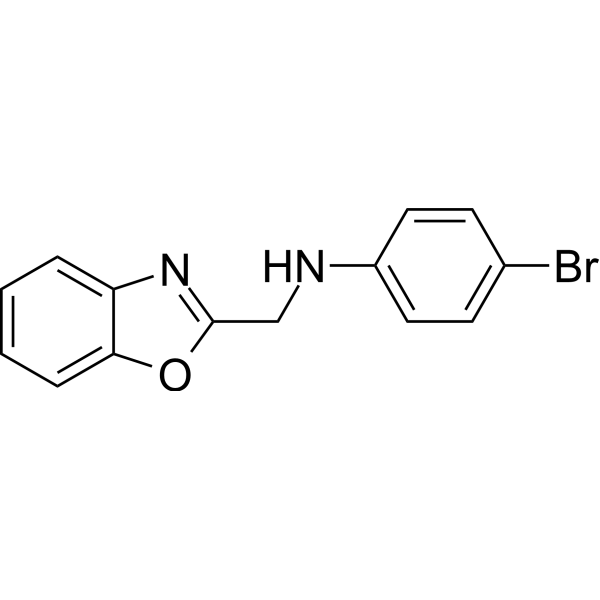
HDL-16 is a potent P2Y14R antagonist with an IC50 of 0.3095 nM. HDL-16 ameliorates DSS (HY-116282C)-induced colitis through suppressing necroptosis of intestinal epithelium cells (IECs) and protecting mucosal barrier function.
연구목적의 판매만을 진행합니다. 환자를 대상으로 한 판매는 하지 않습니다.
- Purity : 99.19%
- CAS No.: 2373280-36-3
- 화학식: C14H11BrN2O
- 분자량:303.15
-
보관:Powder -20°C, 3 years , 4°C, 2 years ; In solvent -80°C, 6 months , -20°C, 1 month

To place orders, for customer services and technical support, please contact: MedChemExpress USA
Tel: 609-228-6898 E-mail: [email protected] [email protected]


-
 Biological Activity
-
Chemical Information
-
용액&용해도
- Protocol
- 순도&문서
- References
-
 Help & FAQs


All P2Y Receptor Isoforms
More

Biological Activity
제품 설명
IC50 & Target
[1]|
P2Y14 Receptor 0.3095 nM (IC50) |
In Vitro
The N atom on benzoxazole ring of HDL-16 forms a hydrogen bond with Tyr102 residue, and the amine group also forms a hydrogen bond interaction with His184 residue in the binding pocket of P2Y14R[1].
HDL-16 has almost no cytotoxicity under the concentration of 10 μM in HT-29 cells[1].
HDL-16 can inhibit the necroptosis of HT-29 cells (with 20 ng/mL TNF‐α plus 20 μM z‐VAD‐fmk (HY-16658B) and Smac mimetic (BV6, 2 μM) for 8 h)[1].
MedChemExpress (MCE) has not independently confirmed the accuracy of these methods. They are for reference only. Further protocols information, click here.
In Vivo
MedChemExpress (MCE) has not independently confirmed the accuracy of these methods. They are for reference only.
-
Animal Model:Male, 7-8-week-old, P2Y14Rfl/fl Vil-cre (P2Y14R∆IEC), P2Y14Rfl/fl Lyz2-cre and WT mice with C57BL/6 J background[1]
-
Dosage:10 μM or 20 μM; 100 μL
-
Administration:Rectally administered; daily; 6 days
-
Result:With high-dose showed dramatically less body weight loss and lower Disease Activity Index (DAI) than Dextran sodium sulfate (DSS; 36-50 kDa; 3% w/v; drinking water for 7 days)-exposed mice.
With high-dose improved DSS-induced inflammatory infiltration and tissue damage.
With high-dose resulted in a prominently suppression in necroptosis of the IECs in DSS-treated mice.


Chemical Information
-
CAS No. 2373280-36-3
-
Appearance Solid
-
분자량 303.15
-
화학식 C14H11BrN2O
-
Color White to off-white
-
SMILES
BrC(C=C1)=CC=C1NCC2=NC3=CC=CC=C3O2
-
선적
Room temperature in continental US; may vary elsewhere.
-
보관
Powder -20°C 3 years 4°C 2 years In solvent -80°C 6 months -20°C 1 month


용액&용해도
In Vitro:
DMSO : 100 mg/mL (329.87 mM; Need ultrasonic; Hygroscopic DMSO has a significant impact on the solubility of product, please use newly opened DMSO)
Please refer to the solubility information to select the appropriate solvent. Once prepared, please aliquot and store the solution to prevent product inactivation from repeated freeze-thaw cycles.
Storage method and period of stock solution: -80°C, 6 months; -20°C, 1 month. When stored at -80°C, please use it within 6 months. When stored at -20°C, please use it within 1 month.
Please refer to the solubility information to select the appropriate solvent. Once prepared, please aliquot and store the solution to prevent product inactivation from repeated freeze-thaw cycles.
Storage method and period of stock solution: -80°C, 6 months; -20°C, 1 month. When stored at -80°C, please use it within 6 months. When stored at -20°C, please use it within 1 month.
Concentration (start) × Volume (start) = Concentration (final) × Volume (final)
In Vivo:
Select the appropriate dissolution method based on your experimental animal and administration route.
- For the following dissolution methods, please ensure to first prepare a clear stock solution using an In Vitro approach and then sequentially add co-solvents:
- To ensure reliable experimental results, the clarified stock solution can be appropriately stored based on storage conditions. As for the working solution for In Vivo experiments, it is recommended to prepare freshly and use it on the same day.
- The percentages shown for the solvents indicate their volumetric ratio in the final prepared solution. If precipitation or phase separation occurs during preparation, heat and/or sonication can be used to aid dissolution.
In Vivo Dissolution Calculator
Please enter the basic information of animal experiments:
-
-
-
-
Recommended: Prepare an additional quantity of animals to account for potential losses during experiments.
Please enter your animal formula composition:
-
%DMSO +
Recommended: Keep the proportion of DMSO in working solution below 2% if your animal is weak.
-
%+
-
+%Tween-80 + +
-
%Saline +
The co-solvents required include: DMSO, . All of co-solvents are available by MedChemExpress (MCE). , Tween 80. All of co-solvents are available by MedChemExpress (MCE).
Working solution concentration: 0.22 mg/mL
Method for preparing stock solution: mg drug dissolved in μL DMSO. Stock solution concentration: mg/mL.
1. Take μL DMSO stock solution;
2. Add μL .
μL , mix evenly;
3. Then add μL Tween 80, mix evenly;
4. Then add μL
Please ensure that the stock solution in the first step is dissolved to a clear state, and add co-solvents in sequence. You can use ultrasonic heating (ultrasonic cleaner, recommended frequency 20-40 kHz), vortexing, etc. to assist dissolution.

Protocol
-
Cell Cytotoxicity Assay
Cytotoxicity assays are usually based on the assessment of cell membrane damage, which can also be indirectly detected by measuring cell viability. Detection methods include MTT assay, CKK-8 assay, LDH assay and ATP assay, etc.
-
DSS-Induced Colitis
Dextran sulfate sodium (DSS)-induced colitis is generated by administering DSS in mouse drinking water, producing epithelial injury, barrier disruption, weight loss, diarrhea, fecal blood, colon shortening, histologic mucosal damage, and inflammatory mediator changes; the model is mainly used to study acute or chronic intestinal inflammation resembling selected features of ulcerative colitis. DSS injury is interpreted through clinical and tissue readouts rather than a single molecular endpoint: daily body weight, stool consistency, and bleeding are combined into a disease activity index, while colon length, histology, cytokines, myeloperoxidase activity, intestinal permeability, and tight-junction markers provide complementary measures of inflammation and barrier damage.
-
TNBS-Induced Colitis
TNBS-induced colitis is produced by intrarectal delivery of 2,4,6-trinitrobenzene sulfonic acid in ethanol, where ethanol disrupts the mucosal barrier and TNBS haptenates colonic proteins, generating immune-mediated colonic inflammation with weight loss, diarrhea, ulceration, transmural injury, inflammatory-cell infiltration, and cytokine responses. The model is used as an experimental intestinal inflammation model with Crohn’s disease–like features, especially when Th1-type responses, IL-12–dependent inflammation, chronic relapsing inflammation, or fibrosis-related endpoints are studied.


순도&문서
-
Data Sheet (272 KB)
-
SDS (251 KB)
- English - EN (251 KB)
- Français - FR (251 KB)
- Deutsch - DE (251 KB)
- Norwegian - NO (251 KB)
- Español - ES (251 KB)
- Swedish - SV (251 KB)
- Italian - IT (251 KB)
- Korean - KR (251 KB)
- Portuguese - PT (251 KB)
-
Handling Instructions (2659 KB)
References


Complete Stock Solution Preparation Table
Please refer to the solubility information to select the appropriate solvent. Once prepared, please aliquot and store the solution to prevent product inactivation from repeated freeze-thaw cycles.
Storage method and period of stock solution: -80°C, 6 months; -20°C, 1 month. When stored at -80°C, please use it within 6 months. When stored at -20°C, please use it within 1 month.
| Optional Solvent | Concentration Solvent Mass | 1 mg | 5 mg | 10 mg | 25 mg |
|---|---|---|---|---|---|
| DMSO | 1 mM | 3.2987 mL | 16.4935 mL | 32.9870 mL | 82.4674 mL |
| 5 mM | 0.6597 mL | 3.2987 mL | 6.5974 mL | 16.4935 mL | |
| 10 mM | 0.3299 mL | 1.6493 mL | 3.2987 mL | 8.2467 mL | |
| 15 mM | 0.2199 mL | 1.0996 mL | 2.1991 mL | 5.4978 mL | |
| 20 mM | 0.1649 mL | 0.8247 mL | 1.6493 mL | 4.1234 mL | |
| 25 mM | 0.1319 mL | 0.6597 mL | 1.3195 mL | 3.2987 mL | |
| 30 mM | 0.1100 mL | 0.5498 mL | 1.0996 mL | 2.7489 mL | |
| 40 mM | 0.0825 mL | 0.4123 mL | 0.8247 mL | 2.0617 mL | |
| 50 mM | 0.0660 mL | 0.3299 mL | 0.6597 mL | 1.6493 mL | |
| 60 mM | 0.0550 mL | 0.2749 mL | 0.5498 mL | 1.3745 mL | |
| 80 mM | 0.0412 mL | 0.2062 mL | 0.4123 mL | 1.0308 mL | |
| 100 mM | 0.0330 mL | 0.1649 mL | 0.3299 mL | 0.8247 mL |


HDL-16 Related Classifications
HY-161343 Related Classifications
 Powered by Bioz