



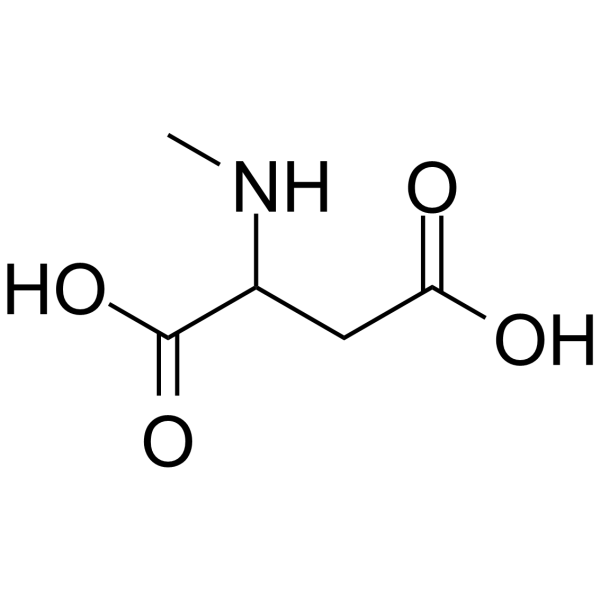
N-Methyl-DL-aspartic acid

Based on 1 Customer Validation
N-Methyl-DL-aspartic acid acts as an agonist for N-methyl-D-aspartic acid receptors and D-isomer-specific aspartate receptors. N-Methyl-DL-aspartic acid activates hypothalamic neurons that regulate gonadotropin-releasing hormone secretion, and stimulates prepubertal male rhesus monkeys to produce sustained intermittent gonadotropin-releasing hormone secretion and pulsatile luteinizing hormone secretion. N-Methyl-DL-aspartic acid activates excitatory effects mediated by N-methyl-D-aspartic acid receptors. N-Methyl-DL-aspartic acid exhibits convulsant effects, inducing clonic convulsions with loss of righting reflex, generalized tonic-clonic seizures or persistent clonic seizures. N-Methyl-DL-aspartic acid causes precocious puberty. N-Methyl-DL-aspartic acid can be used in studies related to convulsions and seizures.
For research use only. We do not sell to patients.
- Purity : 99.02%
- CAS No.: 17833-53-3
- Formula: C5H9NO4
- Molecular Weight:147.13
-
Storage:Powder -20°C, 3 years , 4°C, 2 years ; In solvent -80°C, 6 months , -20°C, 1 month

To place orders, for customer services and technical support, please contact: MedChemExpress USA
Tel: 609-228-6898 E-mail: [email protected] [email protected]


-
 Biological Activity
-
Chemical Information
-
Solvent & Solubility
- Purity & Documentation
- References
-
 Help & FAQs



All iGluR Isoforms
More

Biological Activity
Description
IC50 & Target
[1]|
NMDA Receptor |
In Vivo
N-Methyl-DL-aspartic acid (50-105 mg/kg; i.v.) induces dose-dependent severe clonic convulsions in male NMRI mice, with an ED97 of 105 mg/kg and 89% mortality at this dose[1].
N-Methyl-DL-aspartic acid (4.5-6.5 mg/kg per pulse; i.v.; 1 pulse every 1 hour; 50 hours) sustains pulsatile LH secretion (mean amplitude 30.8 ng/mL) in GnRH-primed, castrated prepubertal male rhesus monkeys, mimicking adult-like hypothalamic GnRH drive[3].
N-Methyl-DL-aspartic acid (4.5-6.5 mg/kg per pulse; i.v.; 1 pulse every 2 hours; 52 hours) sustains pulsatile LH secretion with an exaggerated mean amplitude of 61.5 ng/mL in GnRH-primed, castrated prepubertal male rhesus monkeys[3].
MedChemExpress (MCE) has not independently confirmed the accuracy of these methods. They are for reference only.
-
Animal Model:NMRI (male, 25-30 g)[1]
-
Dosage:200 mg/kg; 300 mg/kg; 340 mg/kg (ED97); 350 mg/kg
-
Administration:s.c.
-
Result:Recorded 1 out of 8 mice convulsed at 200 mg/kg.
Observed myoclonic jerks, mild salivation, tail biting, and occasional clonic seizures starting ~30 minutes post-injection at 300 mg/kg.
Noted clonic seizures with reduced latency, 27 out of 28 mice convulsed, and 8 out of 28 mice died within 60 minutes at 340 mg/kg (ED97).
Recorded all mice displaying clonic convulsions, with mortality reaching 30% at 350 mg/kg.
-
Animal Model:Prepubertal male rhesus monkeys (12-18 months old at catheterization, body weight 2.0-2.6 kg, experiments completed prior to 21 months of age, bilaterally orchidectomized, GnRH-primed)[3]
-
Dosage:4.5-6.5 mg/kg per pulse
-
Administration:i.v.; 1 pulse every 1 hour; 50 hours
-
Result:Produced rapid, relatively consistent increments in plasma LH concentration, with a mean LH response amplitude of 30.8 ng/mL.
Declined to undetectable plasma LH concentrations in 3 of 4 animals 22 hours after the final injection, with mean levels consistently lower than during treatment.
-
Animal Model:Prepubertal male rhesus monkeys (12-18 months old at catheterization, body weight 2.0-2.6 kg, experiments completed prior to 21 months of age, bilaterally orchidectomized, GnRH-primed)[3]
-
Dosage:4.5-6.5 mg/kg per pulse
-
Administration:i.v.; 1 pulse every 2 hours; 52 hours
-
Result:Produced rapid, relatively consistent increments in plasma LH concentration, with a mean LH response amplitude of 61.5 ng/mL, which was greater than the 35.5 ng/mL amplitude observed during GnRH priming.
Declined to undetectable plasma LH concentrations in all animals 22 hours after the final injection.


Chemical Information
-
CAS No. 17833-53-3
-
Appearance Solid
-
Molecular Weight 147.13
-
Formula C5H9NO4
-
Color White to off-white
-
SMILES
O=C(O)CC(C(O)=O)NC
-
Shipping
Room temperature in continental US; may vary elsewhere.
-
Storage
Powder -20°C 3 years 4°C 2 years In solvent -80°C 6 months -20°C 1 month


Solvent & Solubility
In Vitro:
H2O : 16.67 mg/mL (113.30 mM; Need ultrasonic)
DMSO : 4.17 mg/mL (28.34 mM; ultrasonic and warming and heat to 60°C; Hygroscopic DMSO has a significant impact on the solubility of product, please use newly opened DMSO)
Please refer to the solubility information to select the appropriate solvent. Once prepared, please aliquot and store the solution to prevent product inactivation from repeated freeze-thaw cycles.
Storage method and period of stock solution: -80°C, 6 months; -20°C, 1 month. When stored at -80°C, please use it within 6 months. When stored at -20°C, please use it within 1 month.
* Note: If you choose water as the stock solution, please dilute it to the working solution, then filter and sterilize it with a 0.22 μm filter before use.
Please refer to the solubility information to select the appropriate solvent. Once prepared, please aliquot and store the solution to prevent product inactivation from repeated freeze-thaw cycles.
Storage method and period of stock solution: -80°C, 6 months; -20°C, 1 month. When stored at -80°C, please use it within 6 months. When stored at -20°C, please use it within 1 month.
* Note: If you choose water as the stock solution, please dilute it to the working solution, then filter and sterilize it with a 0.22 μm filter before use.
Concentration (start) × Volume (start) = Concentration (final) × Volume (final)
In Vivo:
Select the appropriate dissolution method based on your experimental animal and administration route.
- For the following dissolution methods, please ensure to first prepare a clear stock solution using an In Vitro approach and then sequentially add co-solvents:
- To ensure reliable experimental results, the clarified stock solution can be appropriately stored based on storage conditions. As for the working solution for In Vivo experiments, it is recommended to prepare freshly and use it on the same day.
- The percentages shown for the solvents indicate their volumetric ratio in the final prepared solution. If precipitation or phase separation occurs during preparation, heat and/or sonication can be used to aid dissolution.
Add each solvent one by one: 10% DMSO 40% PEG300 5% Tween-80 45% Saline
Solubility: ≥ 0.42 mg/mL (2.85 mM); Clear solution
This protocol yields a clear solution of ≥ 0.42 mg/mL (saturation unknown).
Taking 1 mL working solution as an example, add 100 μL DMSO stock solution (4.2 mg/mL) to 400 μL PEG300, and mix evenly; then add 50 μL Tween-80 and mix evenly; then add 450 μL Saline to adjust the volume to 1 mL.
Preparation of Saline: Dissolve 0.9 g sodium chloride in ddH₂O and dilute to 100 mL to obtain a clear Saline solution.
Add each solvent one by one: 10% DMSO 90% (20% SBE-β-CD in Saline)
Solubility: ≥ 0.42 mg/mL (2.85 mM); Clear solution
This protocol yields a clear solution of ≥ 0.42 mg/mL (saturation unknown).
Taking 1 mL working solution as an example, add 100 μL DMSO stock solution (4.2 mg/mL) to 900 μL 20% SBE-β-CD in Saline, and mix evenly.
Preparation of 20% SBE-β-CD in Saline (4°C, storage for one week): 2 g SBE-β-CD powder is dissolved in 10 mL Saline, completely dissolve until clear.
For the following dissolution methods, please prepare the working solution directly:
It is recommended to prepare fresh solutions and use them promptly within a short period of time.
The percentages shown for the solvents indicate their volumetric ratio in the final prepared solution. If precipitation or phase separation occurs during preparation, heat and/or sonication can be used to aid dissolution.
Add each solvent one by one: PBS
Solubility: 16.67 mg/mL (113.30 mM); Clear solution; Need ultrasonic
In Vivo Dissolution Calculator
Please enter the basic information of animal experiments:
-
-
-
-
Recommended: Prepare an additional quantity of animals to account for potential losses during experiments.
Working solution concentration: 0.22 mg/mL
This product has good water solubility, please refer to the measured solubility data in water/PBS/Saline for details.


Purity & Documentation
-
Data Sheet (277 KB)
-
SDS (393 KB)
- English - EN (393 KB)
- Français - FR (393 KB)
- Deutsch - DE (393 KB)
- Norwegian - NO (393 KB)
- Español - ES (393 KB)
- Swedish - SV (393 KB)
- Italian - IT (393 KB)
- Korean - KR (393 KB)
- Portuguese - PT (393 KB)
-
Handling Instructions (2659 KB)
References
[1]. Czuczwar SJ, et al. Antagonism of N-methyl-D,L-aspartic acid-induced convulsions by antiepileptic drugs and other agents. European journal of pharmacology. 1985 Feb 05;108(3):273-80. [Content Brief]
[2]. Lauretti GR, et al. The activity of opioid analgesics in seizure models utilizing N-methyl-DL-aspartic acid, kainic acid, bicuculline and pentylenetetrazole. Neuropharmacology. 1994 Feb;33(2):155-60. [Content Brief]
[3]. Gay VL, et al. Sustained intermittent release of gonadotropin-releasing hormone in the prepubertal male rhesus monkey induced by N-methyl-DL-aspartic acid. Neuroendocrinology. 1988 Aug;48(2):147-52. [Content Brief]


Complete Stock Solution Preparation Table
Please refer to the solubility information to select the appropriate solvent. Once prepared, please aliquot and store the solution to prevent product inactivation from repeated freeze-thaw cycles.
Storage method and period of stock solution: -80°C, 6 months; -20°C, 1 month. When stored at -80°C, please use it within 6 months. When stored at -20°C, please use it within 1 month.
| Optional Solvent | Concentration Solvent Mass | 1 mg | 5 mg | 10 mg | 25 mg |
|---|---|---|---|---|---|
| DMSO / H2O | 1 mM | 6.7967 mL | 33.9836 mL | 67.9671 mL | 169.9178 mL |
| 5 mM | 1.3593 mL | 6.7967 mL | 13.5934 mL | 33.9836 mL | |
| 10 mM | 0.6797 mL | 3.3984 mL | 6.7967 mL | 16.9918 mL | |
| 15 mM | 0.4531 mL | 2.2656 mL | 4.5311 mL | 11.3279 mL | |
| 20 mM | 0.3398 mL | 1.6992 mL | 3.3984 mL | 8.4959 mL | |
| 25 mM | 0.2719 mL | 1.3593 mL | 2.7187 mL | 6.7967 mL | |
| H2O | 30 mM | 0.2266 mL | 1.1328 mL | 2.2656 mL | 5.6639 mL |
| 40 mM | 0.1699 mL | 0.8496 mL | 1.6992 mL | 4.2479 mL | |
| 50 mM | 0.1359 mL | 0.6797 mL | 1.3593 mL | 3.3984 mL | |
| 60 mM | 0.1133 mL | 0.5664 mL | 1.1328 mL | 2.8320 mL | |
| 80 mM | 0.0850 mL | 0.4248 mL | 0.8496 mL | 2.1240 mL | |
| 100 mM | 0.0680 mL | 0.3398 mL | 0.6797 mL | 1.6992 mL |
* Note: If you choose water as the stock solution, please dilute it to the working solution, then filter and sterilize it with a 0.22 μm filter before use.


N-Methyl-DL-aspartic acid Related Classifications
HY-W017500 Related Classifications
 Powered by Bioz