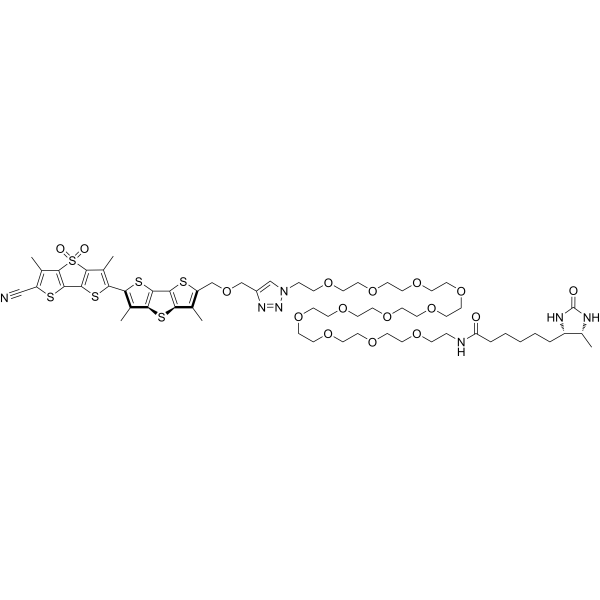
Membrane Dyes

- Formula: C32H36Cl2N2
- Molecular Weight: 519.55
IR-775 chloride is a cyanine dye with near-infrared absorption (Ex/Em = 775/795 nm). IR-775 chloride acts as a photosensitizer or photothermal agent, and induces apoptosis via generating ROS or exerting photothermal effects upon irradiation; its combination with 2-methoxyestradiol (HY-12033) inhibits SOD2 to enhance photodynamic therapy (PDT) efficacy, and its liposomal encapsulation enables phytotherapy-photothermal therapy (PTT) synergy. IR-775 chloride is applicable for investigating PDT/PTT and near-infrared fluorescence imaging in ovarian cancer and breast cancer.
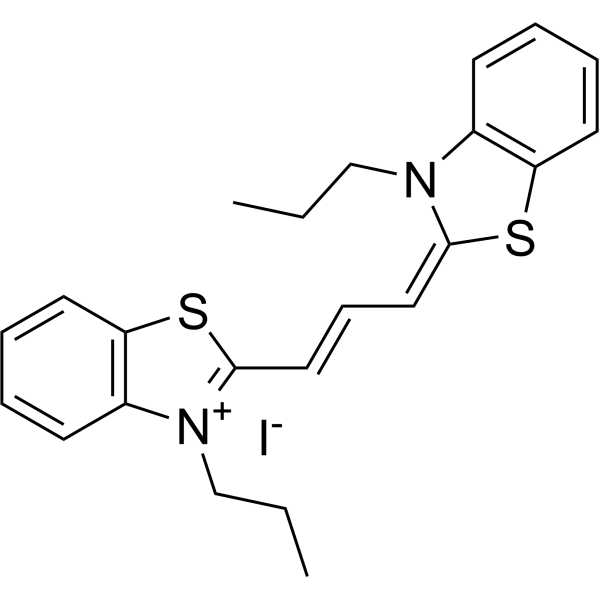
- Formula: C23H25IN2S2
- Molecular Weight: 520.49
3,3'-Dipropylthiacarbocyanine (iodide) is a multifunctional dye. Dyes are important tools in biological experiments. They can help researchers observe and analyze cell structures, track biomolecules, evaluate cell functions, distinguish cell types, detect biomolecules, study tissue pathology and monitor microorganisms. Their applications range from basic scientific research to clinical A wide range of diagnostics. Dyes are also widely used in traditional fields such as textile dyeing, as well as in emerging fields such as functional textile processing, food pigments and dye-sensitized solar cells.

- Formula: C62H101F3N2O5S
- Molecular Weight: 1043.54
Neuro-DiO trifluoromethanesulfonate is a green Fluorescent carbocyanine dye and also a vascular labeling agent. Neuro-DiO trifluoromethanesulfonate can be used for confocal microscopy imaging of cerebral blood vessels in mice (Mus musculus).
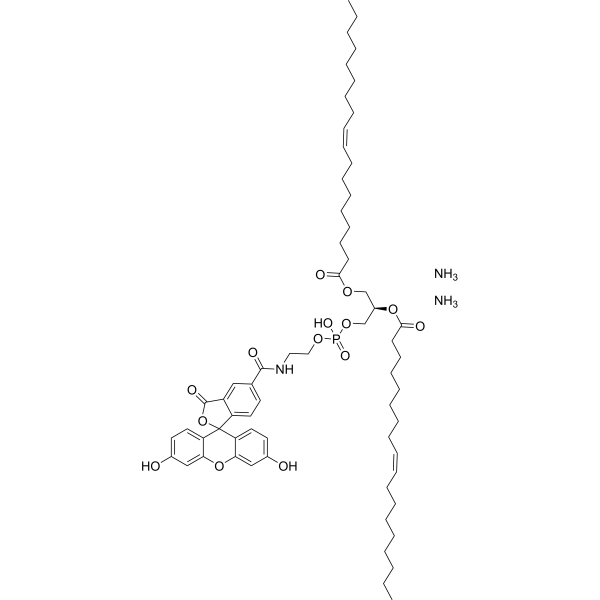
- Formula: C62H94N3O14P
- Molecular Weight: 1136.40
18:1 PE CF (1,2-dioleoyl-sn-glycero-3-phosphoethanolamine-N-(carboxyfluorescein) (ammonium)) is a pH-sensitive fluorescent indicator. 18:1 PE CF exhibits changes in fluorescence intensity in response to pH variations and reflects the electrostatic states of cationic liposomes and lipoplexes. 18:1 PE CF supports real-time visualization of pH distribution and membrane deformation in giant unilamellar vesicles and is suitable for steady-state fluorescence testing in large unilamellar vesicle membranes. 18:1 PE CF is capable of monitoring the surface electrical potential of cationic liposomes and lipoplexes and can effectively label lipid bilayers and nanomicelles. 18:1 PE CF can be used for the research of the investigation of lung cancer (Ex = 495 nm; Em = 520 nm).

- Formula: C22H33IN4O3
- Molecular Weight: 528.43

- Formula: C72H119N11O8S2
- Molecular Weight: 1330.91
LRhod-PM is a photo-activated plasma membrane fluorescent probe based on a self-initiating photo-oxidation cascade mechanism. LRhod-PM, a non-fluorescent reduced rhodamine, is oxidized to the fluorescent form Rhod-PM upon visible light irradiation. LRhod-PM has maximum excitation and emission wavelengths of 560 nm and 585 nm, respectively. LRhod-PM enables wash-free labeling of the plasma membrane of living cells, including fine structures such as filopodia and tunneling nanotubes. LRhod-PM can be used in studies related to single-molecule localization super-resolution imaging of living cells.

- Formula: C152H285N8O58P
- Molecular Weight: 3183.88
DSPE-PEG45-BG is a SNAP-tag reactive phospholipid-anchored molecule that enables targeted localization and spatiotemporal controlled immobilization of proteins on phospholipid membranes. DSPE-PEG45-BG can be applied to any SNAP-tag fusion protein.

- Formula: C47H74N2O6S
- Molecular Weight: 795.17
DiOC14 (3) (hydroxyethanesulfonate) is a water-soluble lipophilic carbocyanine green fluorescent membrane dye used as a fluorescent probe for living cell membranes and lipid bilayers. DiOC14 (3) (hydroxyethanesulfonate) acts as a lipophilic tracer that integrates into cell membranes, with its fluorescence generated upon membrane integration independent of enzymatic hydrolysis, pH, or membrane potential. The Ex/Em of DiOC14 (3) (hydroxyethanesulfonate) is 477/525 nm.

- Formula: C89H138N8O22
- Molecular Weight: 1672.09
Mem-RhoNox is a fluorescent probe used to detect labile Fe (II) on the plasma membrane surface and inside endosomes during iron uptake in live cells. Mem-RhoNox can anchor to the extracellular surface of the plasma membrane; upon contact with Fe (II), its N-oxide group undergoes a deoxygenation reaction, converting weakly fluorescent Mem-RhoNox into strongly fluorescent Mem-Rhodamine. During transferrin-mediated endocytosis, Mem-RhoNox enters endosomes together with the transferrin-transferrin receptor complex, and reacts with Fe (II) released by transferrin to enable detection of endosomal Fe (II).

- Formula: C65H106N10O8S2
- Molecular Weight: 1219.73
Mem-pH is a ratiometric fluorescent probe used for measuring vesicular pH. Mem-pH inserts into the plasma membrane bilayer and localizes to the vesicular lumen, switching between its basic and acidic forms via protonation during vesicular acidification to enable ratiometric pH readout. In aqueous media, Mem-pH forms non-emissive aggregates through aggregation-induced quenching, and then depolymerizes and recovers its fluorescent activity upon binding to the plasma membrane. The excitation/emission wavelengths of the basic form of Mem-pH are 405/450-550 nm, while those of the acidic form are 488/500-700 nm.

- Formula: C29H43Br2N3O2
- Molecular Weight: 625.48
SGC3 is a fluorescent dye with lipophilic properties. SGC3 can be used to study synaptic vesicle recycling and "kiss-and-run" exocytosis by monitoring dye efflux through nanoscale fusion pores, and its detection mechanism relies on its own lipophilic properties. SGC3 generates fluorescence when bound to lipid membranes, and a decrease in fluorescence intensity can be detected when SGC3 leaves vesicles and exists in a free state in solution.

- Formula: C33H51Br2N3O2
- Molecular Weight: 681.58
SGC5 is a fluorescence enhancer and membrane dissociator with millisecond-scale membrane dissociation kinetics, with an emission spectrum of 500-650 nm. SGC5 produces strong fluorescence upon binding to lipid membranes, exhibits fast partitioning dissociation kinetics at higher temperatures, and is unaffected by pH or cholesterol. SGC5 does not belong to the FM dye family and shows the highest membrane-bound fluorescence intensity among the tested styryl/FM dyes. SGC5 can be used to study synaptic vesicle cycling in neurons.

- Formula: C61H99IN2
- Molecular Weight: 987.36
DiD is a long-chain carbocyanine dye. Carbocyanine dyes are widely used as Di to label cells, organelles, liposomes, viruses and lipoproteins (Ex/Em = 633/665 nm) .


- Formula: C60H89F3N2O3S
- Molecular Weight: 975.42
RAPID DiI is a cyanine dye with orange-red fluorescenc (EX≈550 nm; Em≈565 nm). RAPID DiI is a lipophilic dye that labels cell membranes by inserting its two long hydrocarbon (C18 carbon) chains into the lipid bilayer. RAPID DiI is weakly fluorescent until incorporated into membranes. RAPID DiI diffuses laterally to stain the entire cell, allowing it to be used as an anterograde and retrograde tracer of neurons.

- Formula: C54H77F3N2O5S
- Molecular Weight: 923.26
RAPID DiO (Dilinoleyl DiO) is a cyanine dye with green fluorescence (EX≈490 nm; Em≈505 nm). RAPID DiO is a lipophilic dye that labels cell membranes by inserting its two long hydrocarbon (C18 carbon) chains into the lipid bilayer. RAPID DiO is weakly fluorescent until incorporated into membranes. RAPID DiO diffuses laterally to stain the entire cell, allowing it to be used as an anterograde and retrograde tracer of neurons.


- Formula: C56H65N3O8
- Molecular Weight: 908.13

- Formula: C61H99ClN2O4
- Molecular Weight: 959.90
DiD perchlorate (solution)is a long-chain carbocyanine dye. Carbocyanine dyes are widely used as Di to label cells, organelles, liposomes, viruses and lipoproteins.
Solvent and concentration: DMSO: 5 mM