



Oxybutynin chloride (Standard)
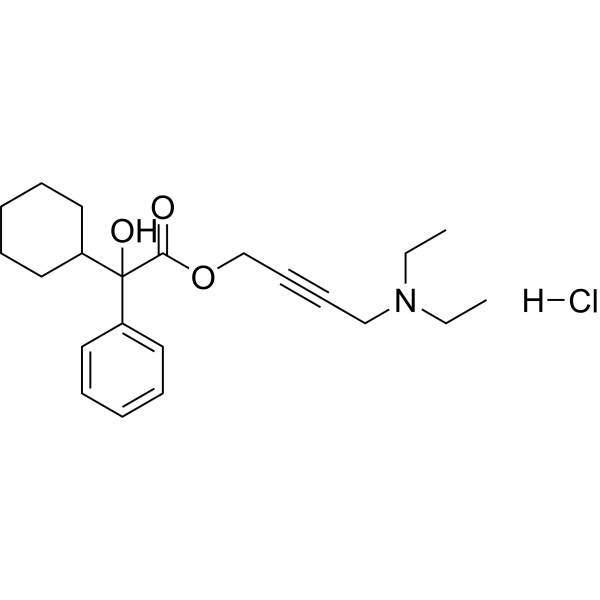
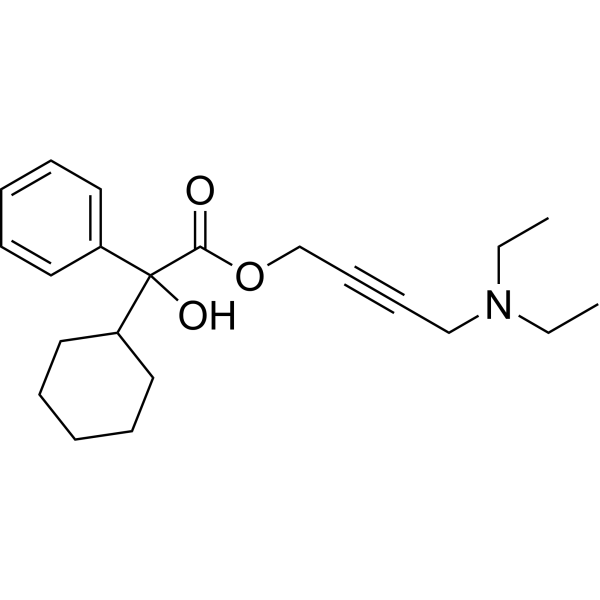
Oxybutynin (chloride) (Standard) is the analytical standard of Oxybutynin (chloride). This product is intended for research and analytical applications. Oxybutynin chloride is an oral active and competitive mAChR antagonist with Kis of 14.3 and 5.55 nM for specific [3H]NMS binding in the mouse bladder and cerebral cortex, respectively. Oxybutynin chloride inhibits vascular Kv channels in a manner independent of anticholinergic effect, with an IC50 value of 11.51 μM. Oxybutynin chloride reduces muscle spasm in the bladder and urinary tract, can be used in study of overactive bladder syndrome (OAB). Oxybutynin (chloride) is a click chemistry reagent, it contains an Alkyne group and can undergo copper-catalyzed azide-alkyne cycloaddition (CuAAc) with molecules containing Azide groups.
For research use only. We do not sell to patients.
- Purity : 95%
- CAS No.: 1508-65-2
- Formula: C22H32ClNO3
- Molecular Weight:393.95
-
Storage:
Please store the product under the recommended conditions in the Certificate of Analysis.

To place orders, for customer services and technical support, please contact: MedChemExpress USA
Tel: 609-228-6898 E-mail: [email protected] [email protected]


-
 Product Information
-
Chemical Information
- Purity & Documentation
-
 Help & FAQs




Product Information
Information
Application
The compound is the grade of analytical standard, which is the reference standard supplied assay. It is commonly used in qualitative, quantitative and methodological research experiments in HPLC, GC and MS.


Chemical Information
-
CAS No. 1508-65-2
-
Molecular Weight 393.95
-
Formula C22H32ClNO3
-
SMILES
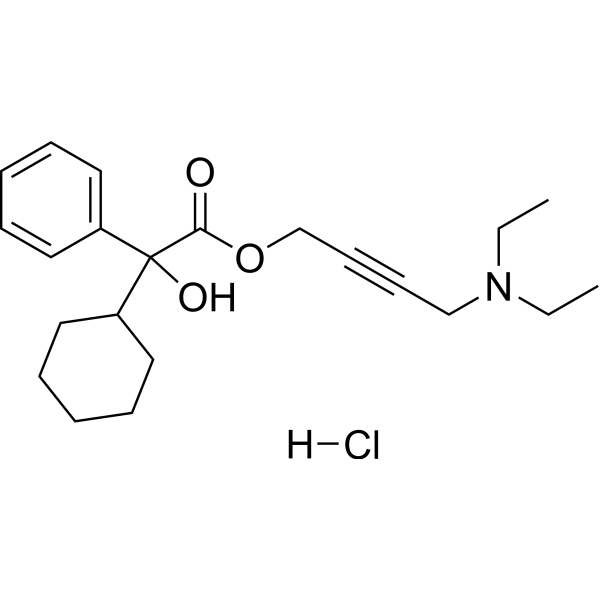
O=C(C(O)(C1=CC=CC=C1)C2CCCCC2)OCC#CCN(CC)CC.[H]Cl
-
Shipping
Room temperature in continental US; may vary elsewhere.
-
Storage
Please store the product under the recommended conditions in the Certificate of Analysis.


Purity & Documentation
References
[1]. Li H, et al. The anticholinergic drug oxybutynin inhibits voltage-dependent K+ channels in coronary arterial smooth muscle cells. Clin Exp Pharmacol Physiol. 2019 Nov;46(11):1030-1036. [Content Brief]
[2]. Oki T, et al. Comparative evaluation of central muscarinic receptor binding activity by oxybutynin, tolterodine and darifenacin used to treat overactive bladder. J Urol. 2007 Feb;177(2):766-70. [Content Brief]

Calculators
Concentration (start) × Volume (start) = Concentration (final) × Volume (final)


Oxybutynin chloride (Standard) Related Classifications
HY-B0267AR Related Classifications
 Powered by Bioz