



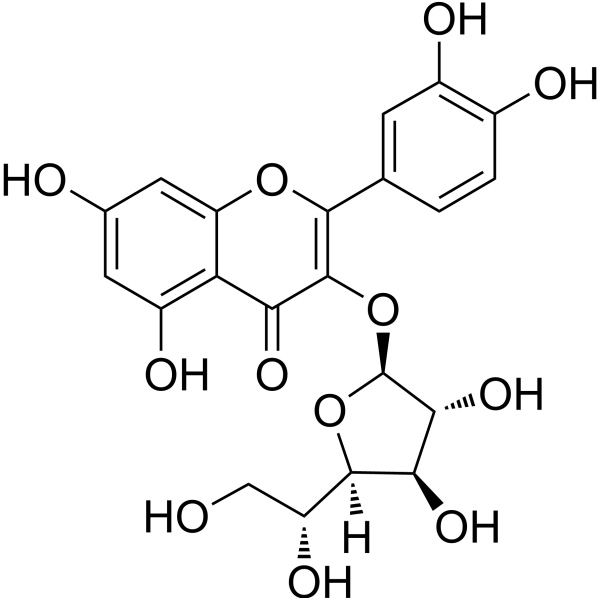
Quercetin 3-O-β-D-glucofuranoside
Based on 5 publication(s) in Google Scholar
Quercetin 3-O-β-D-glucofuranoside is an effective antioxidant and an eosinophilic inflammation suppressor.
For research use only. We do not sell to patients.
- Purity : 99.57%
- CAS No.: 21637-25-2
- Formula: C21H20O12
- Molecular Weight:464.38
-
Storage:Powder -20°C, 3 years , 4°C, 2 years ; In solvent -80°C, 6 months , -20°C, 1 month

To place orders, for customer services and technical support, please contact: MedChemExpress USA
Tel: 609-228-6898 E-mail: [email protected] [email protected]


-
 Biological Activity
-
Chemical Information
-
Solvent & Solubility
- Protocol
- Purity & Documentation
- References
-
 Help & FAQs




Publications Citing Use of MedChemExpress (MCE) Quercetin 3-O-β-D-glucofuranoside
More

Biological Activity
Description
In Vitro
Quercetin 3-O-β-D-glucofuranoside occurs widely in plants. 10 μM of Quercetin 3-O-β-D-glucofuranoside partially but significantly blunt the negative effect of H2O2 on RGC-5 cells, as the viability of cells in the presence of H2O2 is increased from approximately 63% to 83% and 90% at 10 and 50 μM, respectively. Indeed, 50 μM Quercetin 3-O-β-D-glucofuranoside is more effective as a neuroprotectant than the same concentration of EGCG[1].
MedChemExpress (MCE) has not independently confirmed the accuracy of these methods. They are for reference only.
In Vivo
MedChemExpress (MCE) has not independently confirmed the accuracy of these methods. They are for reference only.


Chemical Information
-
CAS No. 21637-25-2
-
Appearance Solid
-
Molecular Weight 464.38
-
Formula C21H20O12
-
Color Off-white to yellow
-
SMILES
O=C1C(O[C@@H]2O[C@@]([C@H](O)CO)([H])[C@H](O)[C@H]2O)=C(C3=CC(O)=C(O)C=C3)OC4=CC(O)=CC(O)=C14
-
Structure Classification
-
Shipping
Room temperature in continental US; may vary elsewhere.
-
Storage
Powder -20°C 3 years 4°C 2 years In solvent -80°C 6 months -20°C 1 month


Publications (5)
-
Journal Impact Factor
-
Most Recent
-
Food Chem
Discovery of novel ascorbic acid derivatives and other metabolites in fruit of Rosa roxburghii Tratt through untargeted metabolomics and feature-based molecular networking. [Abstract]2023 Mar 30;405(Pt A):134807. PMID: 36370576 -
Biochim Biophys Acta Mol Basis Dis
Isoquercitrin attenuates the osteoclast-mediated bone loss in rheumatoid arthritis via the Nrf2/ROS/NF-κB pathway. [Abstract]2024 Feb;1870(2):166977. PMID: 38065271 -
J Biochem Mol Toxicol
Isoquercitrin promotes ferroptosis and oxidative stress in nasopharyngeal carcinoma via the AMPK/NF-κB pathway. [Abstract]2024 Jan;38(1):e23542. PMID: 37712196 -
-
Vet Microbiol
The Chinese medicine monomer Schisandrin C inhibits PRRSV infection by regulating the OGT-PI3K/AKT/mTOR signaling pathway. [Abstract]2026 May:316:110992. PMID: 41865607


Solvent & Solubility
In Vitro:
DMSO : 125 mg/mL (269.18 mM; Need ultrasonic; Hygroscopic DMSO has a significant impact on the solubility of product, please use newly opened DMSO)
Please refer to the solubility information to select the appropriate solvent. Once prepared, please aliquot and store the solution to prevent product inactivation from repeated freeze-thaw cycles.
Storage method and period of stock solution: -80°C, 6 months; -20°C, 1 month. When stored at -80°C, please use it within 6 months. When stored at -20°C, please use it within 1 month.
Please refer to the solubility information to select the appropriate solvent. Once prepared, please aliquot and store the solution to prevent product inactivation from repeated freeze-thaw cycles.
Storage method and period of stock solution: -80°C, 6 months; -20°C, 1 month. When stored at -80°C, please use it within 6 months. When stored at -20°C, please use it within 1 month.
Concentration (start) × Volume (start) = Concentration (final) × Volume (final)
In Vivo:
Select the appropriate dissolution method based on your experimental animal and administration route.
- For the following dissolution methods, please ensure to first prepare a clear stock solution using an In Vitro approach and then sequentially add co-solvents:
- To ensure reliable experimental results, the clarified stock solution can be appropriately stored based on storage conditions. As for the working solution for In Vivo experiments, it is recommended to prepare freshly and use it on the same day.
- The percentages shown for the solvents indicate their volumetric ratio in the final prepared solution. If precipitation or phase separation occurs during preparation, heat and/or sonication can be used to aid dissolution.
Add each solvent one by one: 10% DMSO 40% PEG300 5% Tween-80 45% Saline
Solubility: ≥ 2.08 mg/mL (4.48 mM); Clear solution
This protocol yields a clear solution of ≥ 2.08 mg/mL (saturation unknown).
Taking 1 mL working solution as an example, add 100 μL DMSO stock solution (20.8 mg/mL) to 400 μL PEG300, and mix evenly; then add 50 μL Tween-80 and mix evenly; then add 450 μL Saline to adjust the volume to 1 mL.
Preparation of Saline: Dissolve 0.9 g sodium chloride in ddH₂O and dilute to 100 mL to obtain a clear Saline solution.
Add each solvent one by one: 10% DMSO 90% (20% SBE-β-CD in Saline)
Solubility: ≥ 2.08 mg/mL (4.48 mM); Clear solution
This protocol yields a clear solution of ≥ 2.08 mg/mL (saturation unknown).
Taking 1 mL working solution as an example, add 100 μL DMSO stock solution (20.8 mg/mL) to 900 μL 20% SBE-β-CD in Saline, and mix evenly.
Preparation of 20% SBE-β-CD in Saline (4°C, storage for one week): 2 g SBE-β-CD powder is dissolved in 10 mL Saline, completely dissolve until clear.
In Vivo Dissolution Calculator
Please enter the basic information of animal experiments:
-
-
-
-
Recommended: Prepare an additional quantity of animals to account for potential losses during experiments.
Please enter your animal formula composition:
-
%DMSO +
Recommended: Keep the proportion of DMSO in working solution below 2% if your animal is weak.
-
%+
-
+%Tween-80 + +
-
%Saline +
The co-solvents required include: DMSO, . All of co-solvents are available by MedChemExpress (MCE). , Tween 80. All of co-solvents are available by MedChemExpress (MCE).
Working solution concentration: 0.22 mg/mL
Method for preparing stock solution: mg drug dissolved in μL DMSO. Stock solution concentration: mg/mL.
1. Take μL DMSO stock solution;
2. Add μL .
μL , mix evenly;
3. Then add μL Tween 80, mix evenly;
4. Then add μL
Please ensure that the stock solution in the first step is dissolved to a clear state, and add co-solvents in sequence. You can use ultrasonic heating (ultrasonic cleaner, recommended frequency 20-40 kHz), vortexing, etc. to assist dissolution.

Protocol
Animal Administration[2]
Mice[2]
BALB/c mice are immunized (ovalbumin/aluminum hydroxide, s.c.), followed by two intranasal ovalbumin challenges. From day 18 to day 22 after the first immunization, the mice receive daily gavages of Isoquercitrin (15 mg/kg) or quercetin (10 mg/kg). Dexamethasone (1 mg/kg, s. c.) is administered as a positive control. Leucocytes are analyzed in bronchoalveolar lavage fluid (BALF), blood and pulmonary parenchyma at 24 h after the last ovalbumin challenge. Interleukin-5 (IL-5) is analyzed in BALF and lung homogenates[2].
MedChemExpress (MCE) has not independently confirmed the accuracy of these methods. They are for reference only.


Purity & Documentation
-
Data Sheet (284 KB)
-
SDS (393 KB)
- English - EN (393 KB)
- Français - FR (393 KB)
- Deutsch - DE (393 KB)
- Norwegian - NO (393 KB)
- Español - ES (393 KB)
- Swedish - SV (393 KB)
- Italian - IT (393 KB)
- Korean - KR (393 KB)
- Portuguese - PT (393 KB)
-
Handling Instructions (2659 KB)
References
[1]. Jung SH, et al. Isoquercitrin is the most effective antioxidant in the plant Thuja orientalis and able to counteract oxidative-induced damage to a transformed cell line (RGC-5 cells). Neurochem Int. 2010 Dec;57(7):713-21. [Content Brief]
[2]. Rogerio AP, et al. Anti-inflammatory activity of quercetin and isoquercitrin in experimental murine allergic asthma. Inflamm Res. 2007 Oct;56(10):402-8. [Content Brief]


Complete Stock Solution Preparation Table
Please refer to the solubility information to select the appropriate solvent. Once prepared, please aliquot and store the solution to prevent product inactivation from repeated freeze-thaw cycles.
Storage method and period of stock solution: -80°C, 6 months; -20°C, 1 month. When stored at -80°C, please use it within 6 months. When stored at -20°C, please use it within 1 month.
| Optional Solvent | Concentration Solvent Mass | 1 mg | 5 mg | 10 mg | 25 mg |
|---|---|---|---|---|---|
| DMSO | 1 mM | 2.1534 mL | 10.7670 mL | 21.5341 mL | 53.8352 mL |
| 5 mM | 0.4307 mL | 2.1534 mL | 4.3068 mL | 10.7670 mL | |
| 10 mM | 0.2153 mL | 1.0767 mL | 2.1534 mL | 5.3835 mL | |
| 15 mM | 0.1436 mL | 0.7178 mL | 1.4356 mL | 3.5890 mL | |
| 20 mM | 0.1077 mL | 0.5384 mL | 1.0767 mL | 2.6918 mL | |
| 25 mM | 0.0861 mL | 0.4307 mL | 0.8614 mL | 2.1534 mL | |
| 30 mM | 0.0718 mL | 0.3589 mL | 0.7178 mL | 1.7945 mL | |
| 40 mM | 0.0538 mL | 0.2692 mL | 0.5384 mL | 1.3459 mL | |
| 50 mM | 0.0431 mL | 0.2153 mL | 0.4307 mL | 1.0767 mL | |
| 60 mM | 0.0359 mL | 0.1795 mL | 0.3589 mL | 0.8973 mL | |
| 80 mM | 0.0269 mL | 0.1346 mL | 0.2692 mL | 0.6729 mL | |
| 100 mM | 0.0215 mL | 0.1077 mL | 0.2153 mL | 0.5384 mL |


Quercetin 3-O-β-D-glucofuranoside Related Classifications
HY-N0768 Related Classifications
 Powered by Bioz