



Amelotin Protein, Human (HEK293, Fc)

Based on 1 Customer Validation
Amelotin Protein is a key promoter of calcium phosphate mineralization, crucial in amelogenesis maturation. It plays a vital role in forming the compact and mineralized aprismatic enamel surface layer, emphasizing its crucial involvement in orchestrating molecular events for robust enamel structure during tooth maturation. Amelotin Protein, Human (HEK293, Fc) is the recombinant human-derived Amelotin, expressed by HEK293, with C-mFc labeled tag. The total length of Amelotin Protein, Human (HEK293, Fc) is 193 a.a..
- Species: Human
- Source: HEK293
-
Storage:Stored at -20°C for 2 years from date of receipt. After reconstitution, it is stable at 4°C for 1 week or -20°C for longer (with carrier protein). It is recommended to freeze aliquots at -20°C or -80°C for extended storage.


To place orders, for customer services and technical support, please contact: MedChemExpress USA
Tel: 609-228-6898 E-mail: [email protected] [email protected]


-
 Biological Activity
-
Technical Parameters
-
Product Properties
- Documentation
- Help & FAQs




Biological Activity
Description
Amelotin Protein is a key promoter of calcium phosphate mineralization, crucial in amelogenesis maturation. It plays a vital role in forming the compact and mineralized aprismatic enamel surface layer, emphasizing its crucial involvement in orchestrating molecular events for robust enamel structure during tooth maturation. Amelotin Protein, Human (HEK293, Fc) is the recombinant human-derived Amelotin, expressed by HEK293, with C-mFc labeled tag. The total length of Amelotin Protein, Human (HEK293, Fc) is 193 a.a..
Background
Amelotin emerges as a key promoter of calcium phosphate mineralization, playing a pivotal role in the intricate process of amelogenesis during the maturation stage. Specifically, Amelotin's contribution is vital in the formation of the compact and mineralized aprismatic enamel surface layer. This underscores its crucial involvement in orchestrating the intricate molecular events that lead to the development of a robust and mineralized enamel structure during tooth maturation.
MCE Validation Data
-
Purity - SDS-PAGE
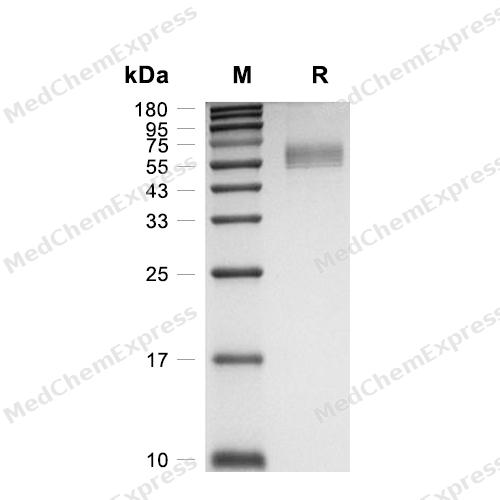
Purity - SDS-PAGE


Technical Parameters
-
Species Human
-
Source HEK293
-
Tag C-mFc
-
Accession
Q6UX39-1 (L17-Q209)
-
Molecular Construction
-
N-term
-
Amelotin (M1-Q209)
Accession # Q6UX39 -
mFc
-
C-term
-
-
Protein Length
Full Length of Isoform-1
-
Synonyms
AMTN; UNQ689; Amelotin; AI3B; RSTI689
-
AA Sequence
LPQLKPALGLPPTKLAPDQGTLPNQQQSNQVFPSLSLIPLTQMLTLGPDLHLLNPAAGMTPGTQTHPLTLGGLNVQQQLHPHVLPIFVTQLGAQGTILSSEELPQIFTSLIIHSLFPGGILPTSQAGANPDVQDGSLPAGGAGVNPATQGTPAGRLPTPSGTDDDFAVTTPAGIQRSTHAIEEATTESANGIQ
-
Predicted Molecular Mass
45.5 kDa
-
Molecular Weight
Approximately 55-75 kDa, based on SDS-PAGE under reducing conditions.
-
Glycosylation
Yes
-
Purity
≥ 95%, as determined by reducing SDS-PAGE.


Product Properties
Lyophilized powder.
Lyophilized from a 0.22 μm filtered solution of PBS, pH 7.4.
<1 EU/μg, determined by LAL method.
It is not recommended to reconstitute to a concentration less than 100 μg/mL in ddH2O. For long term storage it is recommended to add a carrier protein (0.1% BSA, 5% HSA, 10% FBS or 5% Trehalose).
Stored at -20°C for 2 years from date of receipt. After reconstitution, it is stable at 4°C for 1 week or -20°C for longer (with carrier protein). It is recommended to freeze aliquots at -20°C or -80°C for extended storage.
Room temperature in continental US; may vary elsewhere.


Documentation
-
Data Sheet (235 KB)
-
SDS (251 KB)
- English - EN (251 KB)
- Français - FR (251 KB)
- Deutsch - DE (251 KB)
- Norwegian - NO (251 KB)
- Español - ES (251 KB)
- Swedish - SV (251 KB)
- Italian - IT (251 KB)
- Korean - KR (251 KB)
- Portuguese - PT (251 KB)
-
Handling Instructions (2659 KB)

Calculators
Concentration (start) × Volume (start) = Concentration (final) × Volume (final)


 Powered by Bioz

