



CIB2 Protein, Human (His)

Based on 1 Customer Validation
CIB2 protein: Calcium and integrin-binding protein involved in intracellular calcium regulation, auditory hair cell mechanotransduction, and maintenance of stereocilia bundle morphology. CIB2 Protein, Human (His) is the recombinant human-derived CIB2 protein, expressed by E. coli , with N-His labeled tag.
- Species: Human
- Source: E. coli
-
Storage:Stored at -20°C for 2 years from date of receipt. After reconstitution, it is stable at 4°C for 1 week or -20°C for longer (with carrier protein). It is recommended to freeze aliquots at -20°C or -80°C for extended storage.


To place orders, for customer services and technical support, please contact: MedChemExpress USA
Tel: 609-228-6898 E-mail: [email protected] [email protected]


-
 Biological Activity
-
Technical Parameters
-
Product Properties
- Documentation
- Help & FAQs




Biological Activity
Description
CIB2 protein: Calcium and integrin-binding protein involved in intracellular calcium regulation, auditory hair cell mechanotransduction, and maintenance of stereocilia bundle morphology. CIB2 Protein, Human (His) is the recombinant human-derived CIB2 protein, expressed by E. coli , with N-His labeled tag.
Background
CIB2 protein, a calcium- and integrin-binding protein, plays a crucial role in intracellular calcium homeostasis and functions as an auxiliary subunit of the sensory mechanoelectrical transduction (MET) channel in hair cells. Its essentiality for mechanoelectrical transduction currents in auditory hair cells underscores its significance in hearing. CIB2 regulates the function of hair cell mechanotransduction by influencing the distribution of transmembrane channel-like proteins TMC1 and TMC2 and by modulating the activity of MET channels in hair cells. Moreover, it is indispensable for maintaining the morphology and function of auditory hair cell stereocilia bundles and ensuring the survival of hair cells in the cochlea. Additionally, CIB2 plays a critical role in the maintenance and function of photoreceptor cells. Its involvement in intracellular calcium homeostasis is manifested through its ability to decrease ATP-induced calcium release. CIB2 exists as a monomer or homodimer and interacts with various proteins, including WHRN, MYO7A, ITGA2B, ITGA7, TMC1, and TMC2, with these interactions often being calcium and magnesium-dependent.
MCE Validation Data
-
Purity - SDS-PAGE
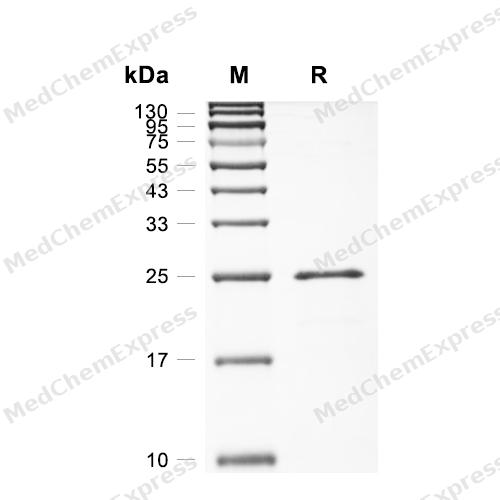
Purity - SDS-PAGE


Technical Parameters
-
Species Human
-
Source E. coli
-
Tag N-6*His
-
Accession
O75838-1 (M1-I187)
-
Molecular Construction
-
N-term
-
His
-
CIB2 (M1-I187)
Accession # O75838 -
C-term
-
-
Protein Length
Full Length of Isoform-1
-
Synonyms
CIB2; DNA-Dependent Protein Kinase Catalytic Subunit-Interacting Protein 2; Prev. DFNB48; Deafness, Autosomal Recessive 48; Prev. USH1J; Kinase Interacting Protein 2; KIP2; Kinase-Interacting Protein 2; Calcium And Integrin-Binding Family Member 2; KIP 2;
-
AA Sequence
MGNKQTIFTEEQLDNYQDCTFFNKKDILKLHSRFYELAPNLVPMDYRKSPIVHVPMSLIIQMPELRENPFKERIVAAFSEDGEGNLTFNDFVDMFSVLCESAPRELKANYAFKIYDFNTDNFICKEDLELTLARLTKSELDEEEVVLVCDKVIEEADLDGDGKLGFADFEDMIAKAPDFLSTFHIRI
-
Molecular Weight
Approximately 27 kDa, based on SDS-PAGE under reducing conditions.
-
Purity
≥ 95%, as determined by reducing SDS-PAGE.


Product Properties
Lyophilized powder.
Lyophilized from a 0.22 μm filtered solution of 50 mM Tris-HCl, 200 mM NaCl, 500 mM arginine, pH 8.0.
Note: For SPR assay, please replace the buffer. Primary amine components (e.g., Tris, imidazole) can affect protein-coupled chips.
<1 EU/μg, determined by LAL method.
It is not recommended to reconstitute to a concentration less than 100 μg/mL in ddH2O. For long term storage it is recommended to add a carrier protein (0.1% BSA, 5% HSA, 10% FBS or 5% Trehalose).
Stored at -20°C for 2 years from date of receipt. After reconstitution, it is stable at 4°C for 1 week or -20°C for longer (with carrier protein). It is recommended to freeze aliquots at -20°C or -80°C for extended storage.
Room temperature in continental US; may vary elsewhere.


Documentation
-
Data Sheet (236 KB)
-
SDS (251 KB)
- English - EN (251 KB)
- Français - FR (251 KB)
- Deutsch - DE (251 KB)
- Norwegian - NO (251 KB)
- Español - ES (251 KB)
- Swedish - SV (251 KB)
- Italian - IT (251 KB)
- Korean - KR (251 KB)
- Portuguese - PT (251 KB)
-
Handling Instructions (2659 KB)

Calculators
Concentration (start) × Volume (start) = Concentration (final) × Volume (final)


 Powered by Bioz

