



CSF1R Protein, Rat (HEK293, C-His)

Based on 1 Customer Validation
CSF1R Protein is a cell surface receptor with high a affinity for a variety of polypeptide growth factors, cytokines, and hormones. CSF1R Protein participate in PLCG2/PKA/UCP2 signaling pathway to reduce oxidative stress and neuronal apoptosis in rat models with neonatal HIE. The blocking of the CSF1R signal is associated with tumorigenesis. CSF1R Protein, Rat (HEK293, C-His) is the recombinant rat-derived CSF1R, expressed by HEK293, with C-10*His labeled tag. The total length of CSF1R Protein, Rat (HEK293, C-His) is 491 a.a..
- Species: Rat
- Source: HEK293
-
Storage:Stored at -20°C for 2 years from date of receipt. After reconstitution, it is stable at 4°C for 1 week or -20°C for longer (with carrier protein). It is recommended to freeze aliquots at -20°C or -80°C for extended storage.


To place orders, for customer services and technical support, please contact: MedChemExpress USA
Tel: 609-228-6898 E-mail: [email protected] [email protected]


-
 Biological Activity
-
Technical Parameters
-
Product Properties
- Documentation
- References
- Help & FAQs




Biological Activity
Description
CSF1R Protein is a cell surface receptor with high a affinity for a variety of polypeptide growth factors, cytokines, and hormones. CSF1R Protein participate in PLCG2/PKA/UCP2 signaling pathway to reduce oxidative stress and neuronal apoptosis in rat models with neonatal HIE. The blocking of the CSF1R signal is associated with tumorigenesis. CSF1R Protein, Rat (HEK293, C-His) is the recombinant rat-derived CSF1R, expressed by HEK293, with C-10*His labeled tag. The total length of CSF1R Protein, Rat (HEK293, C-His) is 491 a.a..
Background
Receptor protein-tyrosine kinase is a cell surface receptor with a high affinity for a variety of polypeptide growth factors, cytokines, and hormones. Homologous with human CSF1R (colony-stimulating factor 1 receptor). CSF1R has macrophage colony-stimulating factor receptor activity, protein homodimerization activity and protein phosphatase binding activity. CSF1R is involved in the positive regulation of osteoclast differentiation and bone resorption. CSF1R participates in PLCG2/PKA/UCP2 signaling pathway to reduce oxidative stress and neuronal apoptosis in rat models with neonatal HIE. The blocking of the CSF1R signal can inhibit tumor-infiltrating myeloid cells and improve the therapeutic effect of radiotherapy for prostate cancer. In INS-1E beta-cells, Erk1/2 phosphorylation is activated by construction of the CSF1R/IRR receptor[1][2][3][4].
Verified Bioactivity
1.This product does not contain protein kinase domain.
2.Measured by its ability to inhibit the M-CSF-induced proliferation of M-NFS-60 mouse myelogenous leukemia lymphoblast cells. The ED50 for this effect is 0.2793 µg/mL in the presence of 10 ng/mL mouse M-CSF, corresponding to a specific activity is 3.58×10³ units/mg.
MCE Validation Data
-
Purity - SDS-PAGE
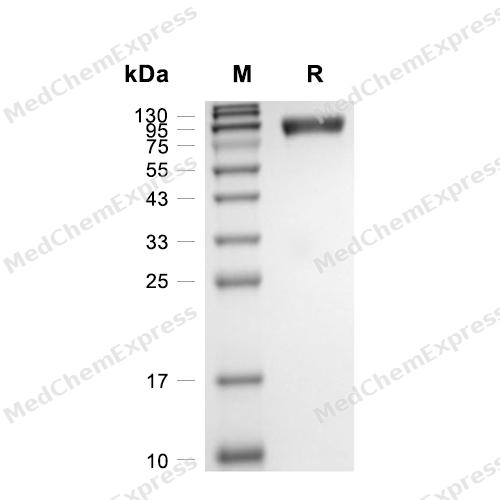
Purity - SDS-PAGE
-
Bioactivity - Cell-Based Assay
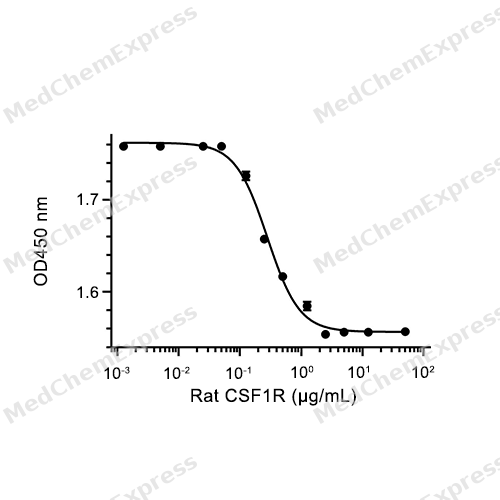
Bioactivity - Cell-Based Assay


Technical Parameters
-
Species Rat
-
Source HEK293
-
Tag C-10*His
-
Accession
D4ACA7 (A64-E554)
-
Gene ID307403
-
Protein Length
Partial
-
Synonyms
CSF1R; CSF-1R; Prev. FMS; Macrophage Colony Stimulating Factor I Receptor; C-FMS; Colony Stimulating Factor Receptor; CD115; Receptor Protein-Tyrosine Kinase; CSFR; FMS Proto-Oncogene; McDonough Feline Sarcoma Viral (V-Fms) Oncogene Homolog; BANDDOS; Macr
-
AA Sequence
APVIEPSGPELVVEPGATVTLRCVSNGSVEWDGPISPYWTLDSESPGSILITKNATFKNTGTYRCTELEDPMRGSTAIHLYVKDPVRPWNLLAQEVTVFEGQEAVLPCLITDPTLKDSVSLVREWGRPVSRKTVYSFLPWRGFIIHKAKFLDSHTYMCKAVVNARESTSIGIRLKVNRAHPGPPHIILEPTKLVRIRGEAAQIVCSATHSEVEFNVILKRGDTKLEIPINSDFQDNAYKKVLTLNLNAVDFQDAGIYSCVANNAAGSNTATMNFQVVESAYLNLTSEQSLLQEVSVGENLDLTVIADAYPGLQRYNWTYLGPFFEDPHNLEFRTQWTTYSYSFKLHLNRVKPLEAGRYSLMAQNKAGWNNLTFELTLRYPPEVSVTWIPVNGSDVLLCDVSGYPQPNVTWMECRGHTDRCDEAQASQVWDDTQPEVLSQKPFHRVILQSQLPIGTLKHNMTYVCRAHNNVGNSSQFFRAISLGQSKQLPDE
-
Predicted Molecular Mass
55 kDa
-
Molecular Weight
Approximately 75-100 kDa, based on SDS-PAGE under reducing conditions.
-
Purity
≥ 95%, as determined by reducing SDS-PAGE.


Product Properties
Lyophilized powder.
Lyophilized from a 0.22 μm filtered solution of PBS, pH 7.4.
<1 EU/μg, determined by LAL method.
It is not recommended to reconstitute to a concentration less than 100 μg/mL in ddH2O. For long term storage it is recommended to add a carrier protein (0.1% BSA, 5% HSA, 10% FBS or 5% Trehalose).
Stored at -20°C for 2 years from date of receipt. After reconstitution, it is stable at 4°C for 1 week or -20°C for longer (with carrier protein). It is recommended to freeze aliquots at -20°C or -80°C for extended storage.
Room temperature in continental US; may vary elsewhere.


Documentation
-
Data Sheet (266 KB)
-
SDS (251 KB)
- English - EN (251 KB)
- Français - FR (251 KB)
- Deutsch - DE (251 KB)
- Norwegian - NO (251 KB)
- Español - ES (251 KB)
- Swedish - SV (251 KB)
- Italian - IT (251 KB)
- Korean - KR (251 KB)
- Portuguese - PT (251 KB)
-
Handling Instructions (2659 KB)


References
[1]. Zwick E, et al. Receptor tyrosine kinase signalling as a target for cancer intervention strategies. Endocr Relat Cancer. 2001 Sep;8(3):161-73. [Content Brief]
[2]. Hu X,et al. Rh-CSF1 Attenuates Oxidative Stress and Neuronal Apoptosis via the CSF1R/PLCG2/PKA/UCP2 Signaling Pathway in a Rat Model of Neonatal HIE. Oxid Med Cell Longev. 2020 Oct 7;2020:6801587. [Content Brief]
[3]. Xu J, et al. CSF1R signaling blockade stanches tumor-infiltrating myeloid cells and improves the efficacy of radiotherapy in prostate cancer. Cancer Res. 2013 May 1;73(9):2782-94. [Content Brief]
[4]. Keshvari S, et al. CSF1R-dependent macrophages control postnatal somatic growth and organ maturation. PLoS Genet. 2021 Jun 3;17(6):e1009605. [Content Brief]

Calculators
Concentration (start) × Volume (start) = Concentration (final) × Volume (final)


 Powered by Bioz

