



Cyclophilin A Protein, Mouse
Based on 2 publication(s) in Google Scholar
Cyclophilin A protein catalyzes the isomerization of proline imide peptide bonds in oligopeptides. Cyclophilin A Protein, Mouse is the recombinant mouse-derived Cyclophilin A protein, expressed by E. coli , with tag free.
- Species: Mouse
- Source: E. coli
-
Storage:Stored at -20°C for 2 years from date of receipt. After reconstitution, it is stable at 4°C for 1 week or -20°C for longer (with carrier protein). It is recommended to freeze aliquots at -20°C or -80°C for extended storage.


To place orders, for customer services and technical support, please contact: MedChemExpress USA
Tel: 609-228-6898 E-mail: [email protected] [email protected]


-
 Biological Activity
-
Technical Parameters
-
Product Properties
- Documentation
- Help & FAQs


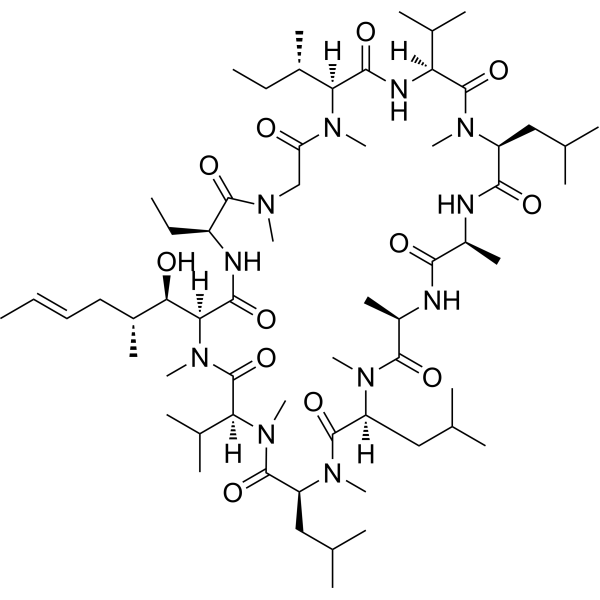


Biological Activity
Description
Cyclophilin A protein catalyzes the isomerization of proline imide peptide bonds in oligopeptides. Cyclophilin A Protein, Mouse is the recombinant mouse-derived Cyclophilin A protein, expressed by E. coli , with tag free.
Background
Cyclophilin A catalyzes the cis-trans isomerization of proline imidic peptide bonds, exerting a potent chemotactic effect on leukocytes through the activation of its membrane receptor BSG/CD147 and initiating a signaling cascade culminating in MAPK/ERK activation. This protein activates endothelial cells (ECs) in a pro-inflammatory manner by stimulating NF-kappa-B and MAP-kinase signaling, inducing the expression of adhesion molecules like SELE and VCAM1. Moreover, Cyclophilin A induces apoptosis in ECs by promoting FOXO1-dependent expression of CCL2 and BCL2L11. In response to oxidative stress, it initiates both proapoptotic and antiapoptotic signaling pathways in ECs through NF-kappa-B activation, AKT1 up-regulation, and BCL2 induction. It negatively regulates MAP3K5/ASK1 kinase activity and is essential for the assembly of TARDBP in heterogeneous nuclear ribonucleoprotein complexes, thereby influencing TARDBP binding to RNA and the expression of HDAC6, ATG7, and VCP, crucial for protein aggregate clearance. Cyclophilin A also plays a pivotal role in platelet activation and aggregation, regulates calcium mobilization, integrin ITGA2B:ITGB3 bidirectional signaling, and binds heparan sulfate glycosaminoglycans.
Verified Bioactivity
Measured by its ability to inhibit calcineurin phosphatase activity in the presence of Cyclosporin A. The IC50 for inhibition of calcineurin activity is 530.199 nM that incubate at 37 ºC for 60 minutes.
MCE Validation Data
-
Purity - SDS-PAGE
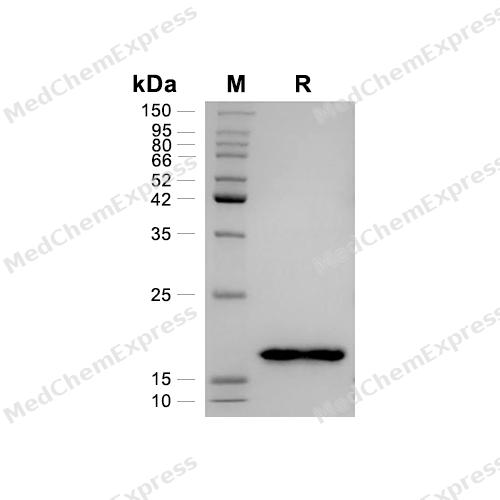
Purity - SDS-PAGE

Assay Procedure
Materials
Assay buffer: 20 mM Tris, 10 mM MgCl2, 0.1 mM CaCl2, 1 mg/mL BSA, pH 7.5
Test protein:Cyclophilin A Protein, Mouse (HY-P70007A, CYPA)
Calcineurin Protein, Human
Calmodulin Protein, Human (HY-P7710)
Substrate: Serine/Threonine Phosphatase Substrate I, 10 mM stock solution in deionized water
Cyclosporin A, 1 mM stock solution in DMSO
Malachite Green Phosphate Assay Kit
Procedure
1. Dilute Calcineurin to 1.17 μg/mL, Calmodulin to 16.8 μg/mL, and Cyclosporin A to 30 μM in the assay buffer.
2. Dilute Human CYPA to the following concentrations: 20000, 10000, 5000, 2500, 1250, 625, 313, 156, 78, 39, and 20 nM.
3. Add the following to the microplate wells:
Sample group: 5 μL of Human CYPA dilution, 5 μL Calmodulin, 5 μL of Cyclosporin A, 25 μL of Calcineurin.
Control group: 5 μL of assay buffer, 5 μL Calmodulin, 5 μL of Cyclosporin A, 25 μL of Calcineurin.
4. Seal the plate, mix by tapping, and incubate at room temperature for 1 hour.
5. After incubation, remove the seal and add 10 μL of 1 mM substrate. The total volume should be 50 μL.
6. Re-seal the plate and incubate with shaking at 37°C for 1 hour. Adjust the volume to 200 μL with assay buffer.
7. Add 70 μL of chromogenic reagent to each well, gently mix by pipetting up and down, and allow to stand at room temperature for 30 minutes.
8. Measure at 630 nm (absorbance) in endpoint mode.
9. Determine the 50% inhibitory concentration (IC50).


Publications (2)
-
Journal Impact Factor
-
Most Recent
-
ACS Appl Mater Interfaces
Chemical Plasma Membrane Perforation Generated by a Microfluidic Probe for Single-Cell Intracellular Protein Delivery. [Abstract]2024 May 8;16(18):22958-22965. PMID: 38666624 -
Anal Sci
Development of a frontal analysis capillary electrophoresis coupled with time-of-flight mass spectrometry for determining the equilibrium dissociation constant between cyclophilin A and cyclosporin A. [Abstract]2025 Jul;41(7):1061-1072. PMID: 40389781


Technical Parameters
-
Species Mouse
-
Source E. coli
-
Tag Tag Free
-
Accession
P17742 (M1-L164)
-
Molecular Construction
-
N-term
-
Cyclophilin A (M1-L164)
Accession # P17742 -
C-term
-
-
Protein Length
Full Length
-
Synonyms
PPIA; Epididymis Secretory Sperm Binding Protein Li 69p; Peptidylprolyl Isomerase A; Peptidylprolyl Isomerase A (Cyclophilin A); CYPA; Peptidyl-Prolyl Cis-Trans Isomerase; Peptidyl-Prolyl Cis-Trans Isomerase A; T Cell Cyclophilin; Cyclosporin A-Binding Pr
-
AA Sequence
MVNPTVFFDITADDEPLGRVSFELFADKVPKTAENFRALSTGEKGFGYKGSSFHRIIPGFMCQGGDFTRHNGTGGRSIYGEKFEDENFILKHTGPGILSMANAGPNTNGSQFFICTAKTEWLDGKHVVFGKVKEGMNIVEAMERFGSRNGKTSKKITISDCGQL
-
Predicted Molecular Mass
18 kDa
-
Molecular Weight
Approximately 18 kDa, based on SDS-PAGE under reducing conditions.
-
Purity
≥ 95%, as determined by reducing SDS-PAGE.


Product Properties
Lyophilized powder.
Lyophilized from a 0.22 μm filtered solution of 20 mM PB, 150 mM NaCl, pH 7.4.
<1 EU/μg, determined by LAL method.
It is not recommended to reconstitute to a concentration less than 100 μg/mL in ddH2O. For long term storage it is recommended to add a carrier protein (0.1% BSA, 5% HSA, 10% FBS or 5% Trehalose).
Stored at -20°C for 2 years from date of receipt. After reconstitution, it is stable at 4°C for 1 week or -20°C for longer (with carrier protein). It is recommended to freeze aliquots at -20°C or -80°C for extended storage.
Room temperature in continental US; may vary elsewhere.


Documentation
-
Data Sheet (236 KB)
-
SDS (252 KB)
- English - EN (252 KB)
- Français - FR (252 KB)
- Deutsch - DE (252 KB)
- Norwegian - NO (252 KB)
- Español - ES (252 KB)
- Swedish - SV (252 KB)
- Italian - IT (252 KB)
- Korean - KR (252 KB)
- Portuguese - PT (252 KB)
-
Handling Instructions (2659 KB)

Calculators
Concentration (start) × Volume (start) = Concentration (final) × Volume (final)


 Powered by Bioz

