



DARS Protein, Human (His)

Based on 1 Customer Validation
DARS Protein, a central player, catalyzes the reversible transfer of the terminal phosphate group between ATP and AMP, maintaining cellular energy homeostasis. It also exhibits nucleoside diphosphate kinase activity, producing various nucleoside triphosphates. At a low rate, DARS participates in thiamine triphosphate synthesis from thiamine diphosphate and ADP, showcasing its multifaceted role in nucleotide metabolism. DARS Protein, Human (His) is the recombinant human-derived DARS protein, expressed by E. coli , with N-His labeled tag.
- Species: Human
- Source: E. coli


To place orders, for customer services and technical support, please contact: MedChemExpress USA
Tel: 609-228-6898 E-mail: [email protected] [email protected]


-
 Biological Activity
-
Technical Parameters
-
Product Properties
- Documentation
- Help & FAQs




Biological Activity
Description
DARS Protein, a central player, catalyzes the reversible transfer of the terminal phosphate group between ATP and AMP, maintaining cellular energy homeostasis. It also exhibits nucleoside diphosphate kinase activity, producing various nucleoside triphosphates. At a low rate, DARS participates in thiamine triphosphate synthesis from thiamine diphosphate and ADP, showcasing its multifaceted role in nucleotide metabolism. DARS Protein, Human (His) is the recombinant human-derived DARS protein, expressed by E. coli , with N-His labeled tag.
Background
Adenylate Kinase 1 (AK1) protein plays a pivotal role in cellular energy homeostasis by catalyzing the reversible transfer of the terminal phosphate group between ATP and AMP. Additionally, it exhibits nucleoside diphosphate kinase activity, enabling the production of various nucleoside triphosphates, including ATP, CTP, GTP, UTP, dATP, dCTP, dGTP, and dTTP, from their corresponding diphosphate substrates, using either ATP or GTP as a phosphate donor. Furthermore, AK1, though at a very low rate, participates in the synthesis of thiamine triphosphate (ThTP) from thiamine diphosphate (ThDP) and ADP, showcasing its multifaceted enzymatic activities in nucleotide metabolism.
Verified Bioactivity
The enzyme activity of this recombinant protein is testing in progress, we cannot offer a guarantee yet.
MCE Validation Data
-
Purity - SDS-PAGE
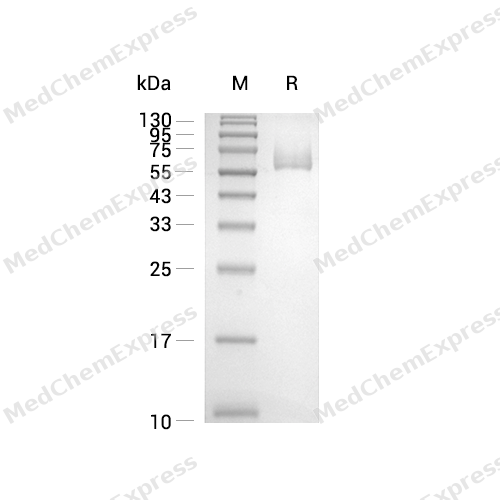
Purity - SDS-PAGE


Technical Parameters
-
Species Human
-
Source E. coli
-
Tag N-His
-
Accession
P14868 (M1-P501)
-
Molecular Construction
-
N-term
-
His
-
DARS (M1-P501)
Accession # P14868 -
C-term
-
-
Protein Length
Full Length
-
Synonyms
DARS1; Aspartate TRNA Ligase 1, Cytoplasmic; Prev. DARS; Aspartyl-TRNA Synthetase, Cytoplasmic; Aspartate--TRNA Ligase, Cytoplasmic; Testicular Tissue Protein Li 192; Aspartyl-TRNA Synthetase; HBSL; Cell Proliferation-Inducing Gene 40 Protein; Aspartyl-TR
-
AA Sequence
MPSASASRKSQEKPREIMDAAEDYAKERYGISSMIQSQEKPDRVLVRVRDLTIQKADEVVWVRARVHTSRAKGKQCFLVLRQQQFNVQALVAVGDHASKQMVKFAANINKESIVDVEGVVRKVNQKIGSCTQQDVELHVQKIYVISLAEPRLPLQLDDAVRPEAEGEEEGRATVNQDTRLDNRVIDLRTSTSQAVFRLQSGICHLFRETLINKGFVEIQTPKIISAASEGGANVFTVSYFKNNAYLAQSPQLYKQMCICADFEKVFSIGPVFRAEDSNTHRHLTEFVGLDIEMAFNYHYHEVMEEIADTMVQIFKGLQERFQTEIQTVNKQFPCEPFKFLEPTLRLEYCEALAMLREAGVEMGDEDDLSTPNEKLLGHLVKEKYDTDFYILDKYPLAVRPFYTMPDPRNPKQSNSYDMFMRGEEILSGAQRIHDPQLLTERALHHGIDLEKIKAYIDSFRFGAPPHAGGGIGLERVTMLFLGLHNVRQTSMFPRDPKRLTP
-
Predicted Molecular Mass
59 kDa
-
Molecular Weight
Approximately 56-70 kDa, based on SDS-PAGE under reducing conditions.
-
Purity
≥ 90%, as determined by reducing SDS-PAGE.


Product Properties
Solution
Supplied as a 0.22 μm filtered solution of 50 mM Tris, 100 mM NaCl, 10% glycerol, pH 8.0.
Note: For SPR assay, please replace the buffer. Primary amine components (e.g., Tris, imidazole) can affect protein-coupled chips.
<1 EU/μg, determined by LAL method.
Shipping with dry ice.


Documentation
-
Data Sheet (237 KB)
-
SDS (251 KB)
- English - EN (251 KB)
- Français - FR (251 KB)
- Deutsch - DE (251 KB)
- Norwegian - NO (251 KB)
- Español - ES (251 KB)
- Swedish - SV (251 KB)
- Italian - IT (251 KB)
- Korean - KR (251 KB)
- Portuguese - PT (251 KB)
-
Handling Instructions (2659 KB)

Calculators
Concentration (start) × Volume (start) = Concentration (final) × Volume (final)


 Powered by Bioz

