



IFNAR1 Protein, Mouse (HEK293, His)
Based on 1 Customer Validation
IFNAR1, one of the subunit of IFN-α/β receptor, is a type I IFN receptor. IFNAR1 forms the heterodimeric receptor with IFNAR2. IFNAR1 mediates IFN-induced STAT signaling by interacting with tyrosine kinase 2 (Tyk2). Upon activation by these IFNs, IFNAR1 and IFNAR2 undergo a conformational change to promote a cascade of downstream signaling events, including the phosphorylation of Tyk2 and JAK1, STAT1 and STAT2. IFNAR1 Protein, Mouse (HEK293, His) is a recombinant mouse IFNAR1 (M1-T429) with C-terminal His tag, which is produced in HEK293 cells.
- Species: Mouse
- Source: HEK293
-
Storage:Stored at -20°C for 2 years from date of receipt. After reconstitution, it is stable at 4°C for 1 week or -20°C for longer (with carrier protein). It is recommended to freeze aliquots at -20°C or -80°C for extended storage.


To place orders, for customer services and technical support, please contact: MedChemExpress USA
Tel: 609-228-6898 E-mail: [email protected] [email protected]


-
 Biological Activity
-
Technical Parameters
-
Product Properties
- Documentation
- References
- Help & FAQs




Biological Activity
Description
IFNAR1, one of the subunit of IFN-α/β receptor, is a type I IFN receptor. IFNAR1 forms the heterodimeric receptor with IFNAR2. IFNAR1 mediates IFN-induced STAT signaling by interacting with tyrosine kinase 2 (Tyk2)[1][2]. Upon activation by these IFNs, IFNAR1 and IFNAR2 undergo a conformational change to promote a cascade of downstream signaling events, including the phosphorylation of Tyk2 and JAK1, STAT1 and STAT2[3]. IFNAR1 Protein, Mouse (HEK293, His) is a recombinant mouse IFNAR1 (M1-T429) with C-terminal His tag, which is produced in HEK293 cells.
Background
IFNAR1, one of the subunit of IFN-α/β receptor, is a type I IFN receptor. IFNAR1 is expressed on peripheral blood B cells and monocytes, and mediates differentiation and activation of these cells[4].
IFNAR1 interacts with tyrosine kinase 2 (Tyk2), and the interaction is able to stabilize IFNAR1 on the plasma membrane[1]. Besides, IFNAR1 associates with TYK2 and initiates type I IFN-induced STAT signaling, but the activation needs IFNAR2 as a platform[2]. IFN-α/-β can induce association of the IFNAR1 and IFNAR2, and makes JAK1 and TYK2 form a functional signaling unit[1]. Upon activation by these IFNs, IFNAR1 and IFNAR2 undergo a conformational change to promote a cascade of downstream signaling events. The signaling events includes the phosphorylation of Tyk2 and JAK1, the signal transducers and activators of transcription STAT1 and STAT2, and the formation of the IFN-stimulated gene factor 3 (ISGF3) complex which consists of phosphorylated STAT1 and STAT2 and IRF9[3]. The lack of IFNAR1 in mice makes mice highly susceptible to bacteria and parasites infection, IFNAR1-deficiency in mice also accelerates tumor growth[5][6].
The sequence of amino acids in IFNAR1 differs in different species. Human IFNAR1 shares <50% aa sequence identity with mouse.
IFNAR1 mediates IFN-induced STAT signaling by interacting with tyrosine kinase 2 (Tyk2)[1].
Verified Bioactivity
Mouse IFN-alpha / beta R1 immobilized on CM5 Chip can bind Mouse IFN-alpha 1 with an affinity constant of 0.649 μM as determined in a SPR assay.
MCE Validation Data
-
Bioactivity - SPR
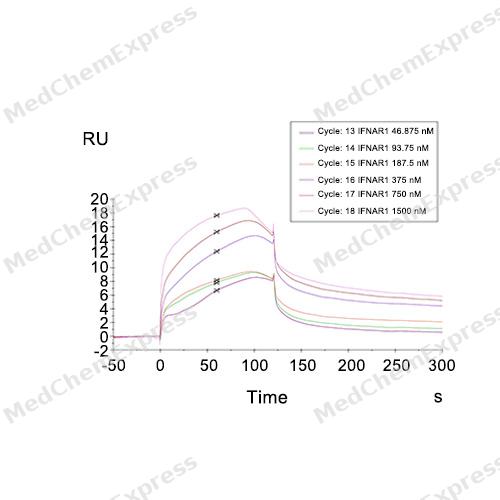
Bioactivity - SPR


Technical Parameters
-
Species Mouse
-
Source HEK293
-
Tag C-His
-
Accession
P33896/NP_034638.2(E27-T429)
-
Molecular Construction
-
N-term
-
IFNAR1 (E27-T429)
Accession # P33896 -
His
-
C-term
-
-
Protein Length
Extracellular Domain
-
Synonyms
IFNAR1; IFNalpha/Beta Receptor 1; Prev. IFNAR; Interferon-Alpha/Beta Receptor Alpha Chain; Interferon Alpha/Beta Receptor 1; Alpha-Type Antiviral Protein; Type I Interferon Receptor 1; Beta-Type Antiviral Protein; IFN-Alpha/Beta Receptor 1; Interferon-Bet
-
AA Sequence
ENLKPPENIDVYIIDDNYTLKWSSHGESMGSVTFSAEYRTKDEAKWLKVPECQHTTTTKCEFSLLDTNVYIKTQFRVRAEEGNSTSSWNEVDPFIPFYTAHMSPPEVRLEAEDKAILVHISPPGQDGNMWALEKPSFSYTIRIWQKSSSDKKTINSTYYVEKIPELLPETTYCLEVKAIHPSLKKHSNYSTVQCISTTVANKMPVPGNLQVDAQGKSYVLKWDYIASADVLFRAQWLPGYSKSSSGSRSDKWKPIPTCANVQTTHCVFSQDTVYTGTFFLHVQASEGNHTSFWSEEKFIDSQKHILPPPPVITVTAMSDTLLVYVNCQDSTCDGLNYEIIFWENTSNTKISMEKDGPEFTLKNLQPLTVYCVQARVLFRALLNKTSNFSEKLCEKTRPGSFST
-
Molecular Weight
Approximately 55-66 kDa, based on SDS-PAGE under reducing conditions, due to the glycosylation.
-
Glycosylation
Yes
-
Purity
≥ 95%, as determined by reducing SDS-PAGE.


Product Properties
Lyophilized powder.
Lyophilized from a 0.2 μm filtered solution of PBS, pH 7.4.
<1 EU/μg, determined by LAL method.
It is not recommended to reconstitute to a concentration less than 100 μg/mL in ddH2O.
Stored at -20°C for 2 years from date of receipt. After reconstitution, it is stable at 4°C for 1 week or -20°C for longer (with carrier protein). It is recommended to freeze aliquots at -20°C or -80°C for extended storage.
Room temperature in continental US; may vary elsewhere.


Documentation
-
Data Sheet (266 KB)
-
SDS (251 KB)
- English - EN (251 KB)
- Français - FR (251 KB)
- Deutsch - DE (251 KB)
- Norwegian - NO (251 KB)
- Español - ES (251 KB)
- Swedish - SV (251 KB)
- Italian - IT (251 KB)
- Korean - KR (251 KB)
- Portuguese - PT (251 KB)
-
Handling Instructions (2659 KB)


References
[1]. Zanin N, et al. Interferon Receptor Trafficking and Signaling: Journey to the Cross Roads. Front Immunol. 2021 Jan 20;11:615603. [Content Brief]
[2]. Shemesh M, et al. IFNAR1 and IFNAR2 play distinct roles in initiating type I interferon-induced JAK-STAT signaling and activating STATs. Sci Signal. 2021 Nov 23;14(710):eabe4627. [Content Brief]
[4]. Pogue SL, et al. The receptor for type I IFNs is highly expressed on peripheral blood B cells and monocytes and mediates a distinct profile of differentiation and activation of these cells. J Interferon Cytokine Res. 2004 Feb;24(2):131-9. [Content Brief]
[5]. Meyts I, et al. Viral infections in humans and mice with genetic deficiencies of the type I IFN response pathway. Eur J Immunol. 2021 May;51(5):1039-1061. [Content Brief]
[6]. Fujita M, et al. Role of type 1 IFNs in antiglioma immunosurveillance--using mouse studies to guide examination of novel prognostic markers in humans. Clin Cancer Res. 2010 Jul 1;16(13):3409-19. [Content Brief]
[7]. Tochizawa S, et al. Functional expression of human type I interferon receptors in the mouse liver. Biochem Biophys Res Commun. 2006 Jul 21;346(1):61-6. [Content Brief]

Calculators
Concentration (start) × Volume (start) = Concentration (final) × Volume (final)


 Powered by Bioz

