



Profilin-4 Protein, Human (His)

Based on 1 Customer Validation
The profilin-4 protein is critical for male fertility and plays an important role in manchette development and acrosome biogenesis during spermatogenesis. It has binding affinity for a variety of phospholipids, including PtdIns(3)P, PtdIns(4,5)P2, PtdIns(4)P, and PA. Profilin-4 Protein, Human (His) is the recombinant human-derived Profilin-4 protein, expressed by E. coli , with N-His labeled tag.
- Species: Human
- Source: E. coli
-
Storage:Stored at -20°C for 2 years from date of receipt. After reconstitution, it is stable at 4°C for 1 week or -20°C for longer (with carrier protein). It is recommended to freeze aliquots at -20°C or -80°C for extended storage.


To place orders, for customer services and technical support, please contact: MedChemExpress USA
Tel: 609-228-6898 E-mail: [email protected] [email protected]


-
 Biological Activity
-
Technical Parameters
-
Product Properties
- Documentation
- Help & FAQs




Biological Activity
Description
The profilin-4 protein is critical for male fertility and plays an important role in manchette development and acrosome biogenesis during spermatogenesis. It has binding affinity for a variety of phospholipids, including PtdIns(3)P, PtdIns(4,5)P2, PtdIns(4)P, and PA. Profilin-4 Protein, Human (His) is the recombinant human-derived Profilin-4 protein, expressed by E. coli , with N-His labeled tag.
Background
Profilin-4 protein plays a crucial role in male fertility, being essential for manchette development and acrosome biogenesis during spermiogenesis. This protein exhibits binding affinity in vitro to various phospholipids, including phosphatidylinositol 3-phosphate (PtdIns(3)P), phosphatidylinositol 4,5-bisphosphate (PtdIns(4,5)P2), phosphatidylinositol 4-phosphate (PtdIns(4)P), and phosphatidic acid (PA). Notably, unlike other members of the profilin family, Profilin-4 does not bind to actin in vitro. These distinctive properties underscore its specialized functions in the intricate processes of male reproductive physiology, particularly in the development of manchette and acrosome during sperm maturation.
MCE Validation Data
-
Purity - SDS-PAGE
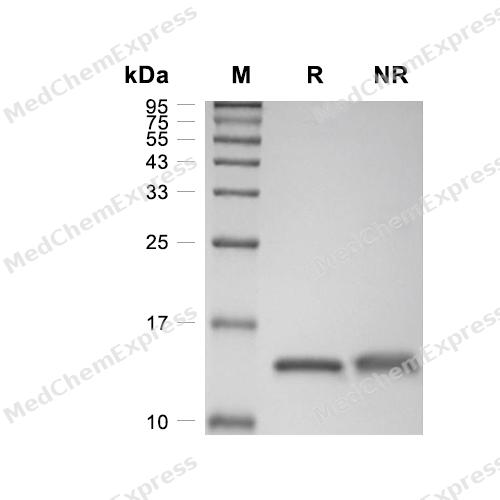
Purity - SDS-PAGE


Technical Parameters
-
Species Human
-
Source E. coli
-
Tag N-6*His
-
Accession
Q8NHR9 (M1-S129)
-
Molecular Construction
-
N-term
-
His
-
Profilin-4 (M1-S129)
Accession # Q8NHR9 -
C-term
-
-
Protein Length
Full Length
-
Synonyms
PFN4; Profilin-4; Profilin Family Member 4; Profilin Family, Member 4; Profilin IV
-
AA Sequence
MSHLQSLLLDTLLGTKHVDSAALIKIQERSLCVASPGFNVTPSDVRTLVNGFAKNPLQARREGLYFKGKDYRCVRADEYSLYAKNENTGVVVVKTHLYLLVATYTEGMYPSICVEATESLGDYLRKKGS
-
Molecular Weight
Approximately 14 kDa, based on SDS-PAGE under reducing conditions.
-
Purity
≥ 95%, as determined by reducing SDS-PAGE.


Product Properties
Lyophilized powder.
Lyophilized from a 0.22 μm filtered solution of 50 mM Tris-HCl, 300 mM NaCl, pH 7.4.
Note: For SPR assay, please replace the buffer. Primary amine components (e.g., Tris, imidazole) can affect protein-coupled chips.
<1 EU/μg, determined by LAL method.
It is not recommended to reconstitute to a concentration less than 100 μg/mL in ddH2O. For long term storage it is recommended to add a carrier protein (0.1% BSA, 5% HSA, 10% FBS or 5% Trehalose).
Stored at -20°C for 2 years from date of receipt. After reconstitution, it is stable at 4°C for 1 week or -20°C for longer (with carrier protein). It is recommended to freeze aliquots at -20°C or -80°C for extended storage.
Room temperature in continental US; may vary elsewhere.


Documentation
-
Data Sheet (235 KB)
-
SDS (251 KB)
- English - EN (251 KB)
- Français - FR (251 KB)
- Deutsch - DE (251 KB)
- Norwegian - NO (251 KB)
- Español - ES (251 KB)
- Swedish - SV (251 KB)
- Italian - IT (251 KB)
- Korean - KR (251 KB)
- Portuguese - PT (251 KB)
-
Handling Instructions (2659 KB)

Calculators
Concentration (start) × Volume (start) = Concentration (final) × Volume (final)


 Powered by Bioz

