



Progranulin/PGRN Protein, Human (HEK293, C-His)
Based on 1 publication(s) in Google Scholar
Progranulin (PGRN, encoded by the GRN gene) plays a key role in the development, survival, function, and maintenance of neurons and microglia in the mammalian brain. It regulates lysosomal biogenesis, inflammation, repair, stress response, and aging. Progranulin/PGRN Protein, Human (HEK293, C-His) is the recombinant human-derived Progranulin/PGRN protein, expressed by HEK293 , with C-10*His labeled tag.
- Species: Human
- Source: HEK293
-
Storage:Stored at -20°C for 2 years from date of receipt. After reconstitution, it is stable at 4°C for 1 week or -20°C for longer (with carrier protein). It is recommended to freeze aliquots at -20°C or -80°C for extended storage.


To place orders, for customer services and technical support, please contact: MedChemExpress USA
Tel: 609-228-6898 E-mail: [email protected] [email protected]


-
 Biological Activity
-
Technical Parameters
-
Product Properties
- Documentation
- Help & FAQs




Biological Activity
Description
Progranulin (PGRN, encoded by the GRN gene) plays a key role in the development, survival, function, and maintenance of neurons and microglia in the mammalian brain. It regulates lysosomal biogenesis, inflammation, repair, stress response, and aging. Progranulin/PGRN Protein, Human (HEK293, C-His) is the recombinant human-derived Progranulin/PGRN protein, expressed by HEK293 , with C-10*His labeled tag.
Background
The Progranulin/PGRN Protein represents an 88 kDa precursor protein, also known as proepithelin and PC cell-derived growth factor, from which a family of secreted, glycosylated peptides called granulins is cleaved. This cleavage yields mature granulins, further processed into active 6 kDa peptides, including granulin A, granulin B, granulin C, and so forth. Epithelins 1 and 2 are synonymous with granulins A and B, respectively. The granulin family, with its 7.5 repeats of a highly conserved 12-cysteine granulin/epithelin motif, plays a crucial role in regulating cell growth, with various members acting as inhibitors, stimulators, or having dual actions on cell growth. Ubiquitously expressed, Progranulin/PGRN exhibits elevated levels in the bone marrow (RPKM 141.7), lung (RPKM 139.8), and 25 other tissues, emphasizing its potential significance in diverse physiological processes across multiple organs.
Verified Bioactivity
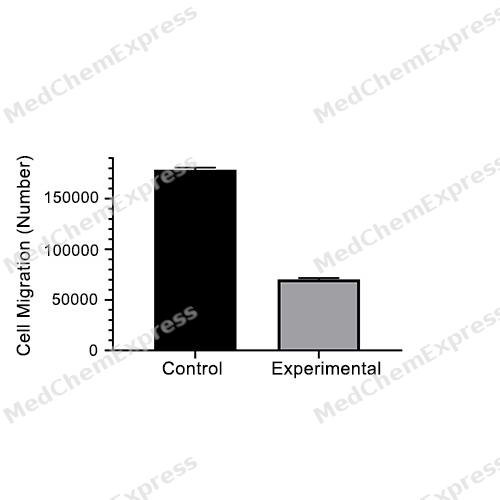
Measured by its ability to inhibit THP-1 human acute monocyte migration in the presence of 10 ng/mL MCP-1.
MCE Validation Data
-
Purity - SDS-PAGE
Purity - SDS-PAGE
-
Bioactivity - Cell-Based Assay
Bioactivity - Cell-Based Assay


Publications (1)
-
Journal Impact Factor
-
Most Recent
-
Sci Rep
2025 May 25;15(1):18189. PMID: 40415096


Technical Parameters
-
Species Human
-
Source HEK293
-
Tag C-10*His
-
Accession
NP_002078.1/P28799 (T18-L593)
-
Molecular Construction
-
N-term
-
PGRN (T18-L593)
Accession # NP_002078.1 -
10*His
-
C-term
-
-
Protein Length
Full Length of Mature Protein
-
Synonyms
GRN; Glycoprotein 88; Granulin Precursor; GP88; Progranulin; PEPI; PCDGF; Epithelin Precursor; PGRN; Granulin-Epithelin; Proepithelin; Epithelin; Acrogranin; Granulins; CLN11; FTD2; PC Cell-Derived Growth Factor; GEP; Glycoprotein Of 88 Kda
-
AA Sequence
TRCPDGQFCPVACCLDPGGASYSCCRPLLDKWPTTLSRHLGGPCQVDAHCSAGHSCIFTVSGTSSCCPFPEAVACGDGHHCCPRGFHCSADGRSCFQRSGNNSVGAIQCPDSQFECPDFSTCCVMVDGSWGCCPMPQASCCEDRVHCCPHGAFCDLVHTRCITPTGTHPLAKKLPAQRTNRAVALSSSVMCPDARSRCPDGSTCCELPSGKYGCCPMPNATCCSDHLHCCPQDTVCDLIQSKCLSKENATTDLLTKLPAHTVGDVKCDMEVSCPDGYTCCRLQSGAWGCCPFTQAVCCEDHIHCCPAGFTCDTQKGTCEQGPHQVPWMEKAPAHLSLPDPQALKRDVPCDNVSSCPSSDTCCQLTSGEWGCCPIPEAVCCSDHQHCCPQGYTCVAEGQCQRGSEIVAGLEKMPARRASLSHPRDIGCDQHTSCPVGQTCCPSLGGSWACCQLPHAVCCEDRQHCCPAGYTCNVKARSCEKEVVSAQPATFLARSPHVGVKDVECGEGHFCHDNQTCCRDNRQGWACCPYRQGVCCADRRHCCPAGFRCAARGTKCLRREAPRWDAPLRDPALRQLL
-
Molecular Weight
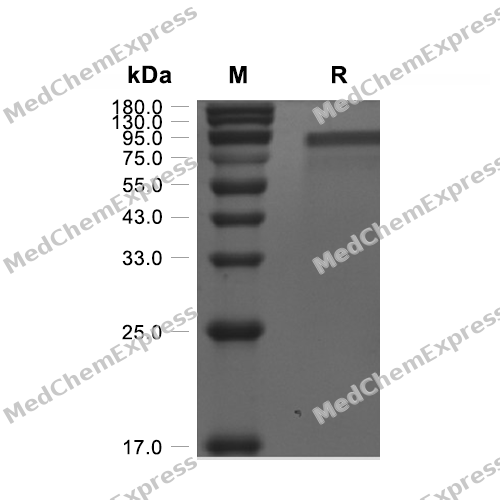
Approximately 80-95 kDa, based on SDS-PAGE under reducing conditions, due to the glycosylation.
-
Glycosylation
Yes
-
Purity
≥ 95%, as determined by reducing SDS-PAGE.


Product Properties
Lyophilized powder.
1.Lyophilized from a 0.22 μm filtered solution of PBS, pH 7.4.
2.Lyophilized from a 0.22 μm filtered solution of PBS, pH 7.4, 5% trehalose, 5% mannitol, 0.01% Tween 80.
Please refer to the lot-specific COA for specific buffer information.
<1 EU/μg, determined by LAL method.
It is not recommended to reconstitute to a concentration less than 100 μg/mL in ddH2O. For long term storage it is recommended to add a carrier protein (0.1% BSA, 5% HSA, 10% FBS or 5% Trehalose).
Stored at -20°C for 2 years from date of receipt. After reconstitution, it is stable at 4°C for 1 week or -20°C for longer (with carrier protein). It is recommended to freeze aliquots at -20°C or -80°C for extended storage.
Room temperature in continental US; may vary elsewhere.


Documentation
-
Data Sheet (239 KB)
-
SDS (252 KB)
- English - EN (252 KB)
- Français - FR (252 KB)
- Deutsch - DE (252 KB)
- Norwegian - NO (252 KB)
- Español - ES (252 KB)
- Swedish - SV (252 KB)
- Italian - IT (252 KB)
- Korean - KR (252 KB)
- Portuguese - PT (252 KB)
-
Handling Instructions (2659 KB)

Calculators
Concentration (start) × Volume (start) = Concentration (final) × Volume (final)


 Powered by Bioz

