



PRTN3 Protein, Human (HEK293, His, solution)
Based on 1 publication(s) in Google Scholar
PRTN3 is a serine protease that broadly targets elastin, fibronectin, laminin, vitronectin, and collagen types I, III, and IV in vitro, playing a crucial role in extracellular matrix degradation. It modulates endothelial cell barrier function by cleaving and activating the receptor F2RL1/PAR-2 and enhances vascular integrity during neutrophil transendothelial migration. PRTN3 Protein, Human (HEK293, His, solution) is the recombinant human-derived PRTN3 protein, expressed by HEK293 , with C-6*His labeled tag.
- Species: Human
- Source: HEK293
-
Storage:Stored at -80°C for 1 year from date of receipt. It is stable at -20°C for 3 months after opening. It is recommended to freeze aliquots at -80°C for extended storage. Avoid repeated freeze-thaw cycles.


To place orders, for customer services and technical support, please contact: MedChemExpress USA
Tel: 609-228-6898 E-mail: [email protected] [email protected]


-
 Biological Activity
-
Technical Parameters
-
Product Properties
- Documentation
- Help & FAQs




Biological Activity
Description
PRTN3 is a serine protease that broadly targets elastin, fibronectin, laminin, vitronectin, and collagen types I, III, and IV in vitro, playing a crucial role in extracellular matrix degradation. It modulates endothelial cell barrier function by cleaving and activating the receptor F2RL1/PAR-2 and enhances vascular integrity during neutrophil transendothelial migration. PRTN3 Protein, Human (HEK293, His, solution) is the recombinant human-derived PRTN3 protein, expressed by HEK293 , with C-6*His labeled tag.
Background
PRTN3, a serine protease, exhibits a broad substrate specificity, targeting elastin, fibronectin, laminin, vitronectin, and collagen types I, III, and IV in vitro. Its enzymatic activity plays a crucial role in the degradation of these extracellular matrix components. Additionally, PRTN3 takes part in the modulation of endothelial cell barrier function by cleaving and activating the receptor F2RL1/PAR-2, thereby enhancing vascular integrity during neutrophil transendothelial migration. Notably, its potential involvement in neutrophil transendothelial migration is suggested, particularly when associated with CD177, emphasizing its significance in immune-related processes.
MCE Validation Data
-
Purity - SDS-PAGE
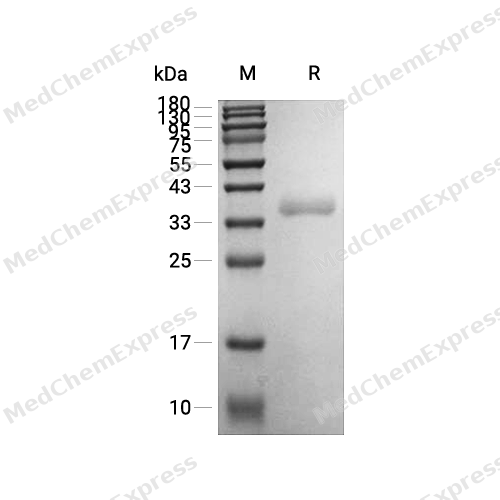
Purity - SDS-PAGE


Publications (1)
-
Journal Impact Factor
-
Most Recent
-
Molecules
Identification of Marrubiin as a Cathepsin C Inhibitor for Treating Rheumatoid Arthritis. [Abstract]2025 Oct 23;30(21):4170. PMID: 41226133


Technical Parameters
-
Species Human
-
Source HEK293
-
Tag C-6*His
-
Accession
P24158 (A26-R249)
-
Molecular Construction
-
N-term
-
PRTN3 (A26-R249)
Accession # P24158 -
6*His
-
C-term
-
-
Protein Length
Full Length of Myeloblastin Chain
-
Synonyms
PRTN3; Neutrophil Proteinase 4; Proteinase 3; Leukocyte Proteinase 3; AGP7; Wegener Autoantigen; PR-3; C-ANCA Antigen; P29; NP-4; Myeloblastin; MBN; C-ANCA; PR3; ACPA; Azurophil Granule Protein 7; MBT; CANCA; Wegener Granulomatosis Autoantigen; NP4; Serin
-
AA Sequence
AEIVGGHEAQPHSRPYMASLQMRGNPGSHFCGGTLIHPSFVLTAAHCLRDIPQRLVNVVLGAHNVRTQEPTQQHFSVAQVFLNNYDAENKLNDVLLIQLSSPANLSASVATVQLPQQDQPVPHGTQCLAMGWGRVGAHDPPAQVLQELNVTVVTFFCRPHNICTFVPRRKAGICFGDSGGPLICDGIIQGIDSFVIWGCATRLFPDFFTRVALYVDWIRSTLRR
-
Predicted Molecular Mass
25.6 kDa
-
Molecular Weight
Approximately 34 kDa, based on SDS-PAGE under reducing conditions.
-
Glycosylation
Yes
-
Purity
≥ 95%, as determined by reducing SDS-PAGE.


Product Properties
Solution
Supplied as a 0.22 μm filtered solution of 10 mM Tris-HCl, 150 mM NaCl, 10% Glycerol, pH 8.0.
Note: For SPR assay, please replace the buffer. Primary amine components (e.g., Tris, imidazole) can affect protein-coupled chips.
<1 EU/μg, determined by LAL method.
Stored at -80°C for 1 year from date of receipt. It is stable at -20°C for 3 months after opening. It is recommended to freeze aliquots at -80°C for extended storage. Avoid repeated freeze-thaw cycles.
Shipping with dry ice.


Documentation
-
Data Sheet (236 KB)
-
SDS (252 KB)
- English - EN (252 KB)
- Français - FR (252 KB)
- Deutsch - DE (252 KB)
- Norwegian - NO (252 KB)
- Español - ES (252 KB)
- Swedish - SV (252 KB)
- Italian - IT (252 KB)
- Korean - KR (252 KB)
- Portuguese - PT (252 KB)
-
Handling Instructions (2659 KB)

Calculators
Concentration (start) × Volume (start) = Concentration (final) × Volume (final)


 Powered by Bioz

