



PTHrP Protein, Human (His)

Based on 1 Customer Validation
The PTHrP protein is a key neuroendocrine peptide that regulates multiple cellular processes, including growth, development, migration, differentiation, and survival. It plays an integral role in epithelial calcium transport and key developmental events such as endochondral bone development, mammary gland, and tooth formation. PTHrP Protein, Human (His) is the recombinant human-derived PTHrP protein, expressed by E. coli , with N-6*His labeled tag.
- Species: Human
- Source: E. coli
-
Storage:Stored at -20°C for 2 years from date of receipt. After reconstitution, it is stable at 4°C for 1 week or -20°C for longer (with carrier protein). It is recommended to freeze aliquots at -20°C or -80°C for extended storage.


To place orders, for customer services and technical support, please contact: MedChemExpress USA
Tel: 609-228-6898 E-mail: [email protected] [email protected]


-
 Biological Activity
-
Technical Parameters
-
Product Properties
- Documentation
- Help & FAQs




Biological Activity
Description
The PTHrP protein is a key neuroendocrine peptide that regulates multiple cellular processes, including growth, development, migration, differentiation, and survival. It plays an integral role in epithelial calcium transport and key developmental events such as endochondral bone development, mammary gland, and tooth formation. PTHrP Protein, Human (His) is the recombinant human-derived PTHrP protein, expressed by E. coli , with N-6*His labeled tag.
Background
Parathyroid hormone-related protein (PTHrP) emerges as a pivotal neuroendocrine peptide that orchestrates diverse cellular processes, encompassing growth, development, migration, differentiation, and survival, along with its integral role in epithelial calcium ion transport. Its regulatory influence extends to critical developmental events, such as endochondral bone development and the intricate interactions shaping mammary gland and tooth formation. PTHrP's indispensable contribution to skeletal homeostasis underscores its significance in maintaining bone integrity. Within the mammary context, PTHrP plays a multifaceted role, driving mesenchymal differentiation, promoting bud outgrowth, and modulating responsiveness to bone morphogenetic proteins (BMPs), thus intricately shaping mammary tissue architecture. Additionally, PTHrP influences colon cancer cell behavior, enhancing migration and invasion through integrin alpha-6/beta-1-dependent mechanisms. Notably, osteostatin, a derivative of PTHrP, exhibits potent inhibitory effects on osteoclastic bone resorption, emphasizing its role in bone metabolism regulation.
Verified Bioactivity
Measured by its binding ability in a functional ELISA. Immobilized Human PTH1R at 2μg/mL (100μl/well) on the plate can bind Biotinylated Human PTHrP. The ED50 for this effect is 0.0979 μg/mL.
MCE Validation Data
-
Purity - SDS-PAGE
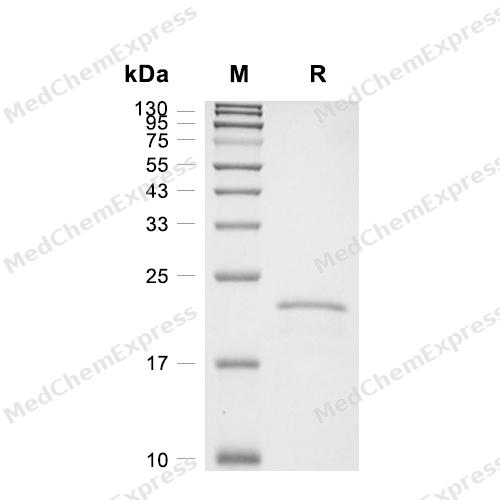
Purity - SDS-PAGE


Technical Parameters
-
Species Human
-
Source E. coli
-
Tag N-6*His
-
Accession
P12272 (A37-R175)
-
Gene ID5744
-
Molecular Construction
-
N-term
-
6*His
-
PTHrP (A37-R175)
Accession # P12272 -
C-term
-
-
Protein Length
Full Length of Parathyroid hormone-related protein Chain
-
Synonyms
PTHLH; Osteostatin; Parathyroid Hormone Like Hormone; PTHrP; PTHRP; Parathyroid Hormone-Related Protein Preproprotein; PLP; Parathyroid Hormone-Like Related Protein; Parathyroid Hormone-Related Protein; Parathyroid Hormone-Like Protein; PTH-RP; PTH-Relate
-
AA Sequence
AVSEHQLLHDKGKSIQDLRRRFFLHHLIAEIHTAEIRATSEVSPNSKPSPNTKNHPVRFGSDDEGRYLTQETNKVETYKEQPLKTPGKKKKGKPGKRKEQEKKKRRTRSAWLDSGVTGSGLEGDHLSDTSTTSLELDSR
-
Molecular Weight
Approximately 20 kDa, based on SDS-PAGE under reducing conditions.
-
Purity
≥ 90%, as determined by reducing SDS-PAGE.


Product Properties
Lyophilized powder
Lyophilized from a 0.22 μm filtered solution of PBS, pH 7.4, 8% trehalose.
<1 EU/μg, determined by LAL method.
It is not recommended to reconstitute to a concentration less than 100 μg/mL in ddH2O.
Stored at -20°C for 2 years from date of receipt. After reconstitution, it is stable at 4°C for 1 week or -20°C for longer (with carrier protein). It is recommended to freeze aliquots at -20°C or -80°C for extended storage.
Room temperature in continental US; may vary elsewhere.


Documentation
-
Data Sheet (236 KB)
-
SDS (252 KB)
- English - EN (252 KB)
- Français - FR (252 KB)
- Deutsch - DE (252 KB)
- Norwegian - NO (252 KB)
- Español - ES (252 KB)
- Swedish - SV (252 KB)
- Italian - IT (252 KB)
- Korean - KR (252 KB)
- Portuguese - PT (252 KB)
-
Handling Instructions (2659 KB)

Calculators
Concentration (start) × Volume (start) = Concentration (final) × Volume (final)


 Powered by Bioz

