



ROM1 Protein, Human (His)

Based on 1 Customer Validation
ROM1 protein is involved in rod outer segment (ROS) morphogenesis, and may work with PRPH2 to maintain the structure of the curved intervertebral disc and organize ROS, thus affecting the intervertebral disc diameter. In addition, ROM1 is involved in protecting the retinal outer nuclear layer. ROM1 Protein, Human (His) is the recombinant human-derived ROM1 protein, expressed by E. coli , with N-His labeled tag.
- Species: Human
- Source: E. coli
-
Storage:Stored at -20°C for 2 years from date of receipt. After reconstitution, it is stable at 4°C for 1 week or -20°C for longer (with carrier protein). It is recommended to freeze aliquots at -20°C or -80°C for extended storage.


To place orders, for customer services and technical support, please contact: MedChemExpress USA
Tel: 609-228-6898 E-mail: [email protected] [email protected]


-
 Biological Activity
-
Technical Parameters
-
Product Properties
- Documentation
- Help & FAQs




Biological Activity
Description
ROM1 protein is involved in rod outer segment (ROS) morphogenesis, and may work with PRPH2 to maintain the structure of the curved intervertebral disc and organize ROS, thus affecting the intervertebral disc diameter. In addition, ROM1 is involved in protecting the retinal outer nuclear layer. ROM1 Protein, Human (His) is the recombinant human-derived ROM1 protein, expressed by E. coli , with N-His labeled tag.
Background
ROM1 protein is implicated in rod outer segment (ROS) morphogenesis and, in collaboration with PRPH2, contributes to maintaining the structure of curved disks within the ROS. Additionally, it plays a vital role in organizing the ROS and preserving the diameter of its disks. Beyond its role in the visual system, ROM1 is involved in maintaining the outer nuclear layer of the retina. It forms homodimers and homotetramers, with the latter participating in higher-order complex formation through intermolecular disulfide bonds. ROM1 also forms heterotetramers with PRPH2 and interacts with proteins such as STX3 and SNAP25, suggesting its involvement in complex cellular processes.
MCE Validation Data
-
Purity - SDS-PAGE
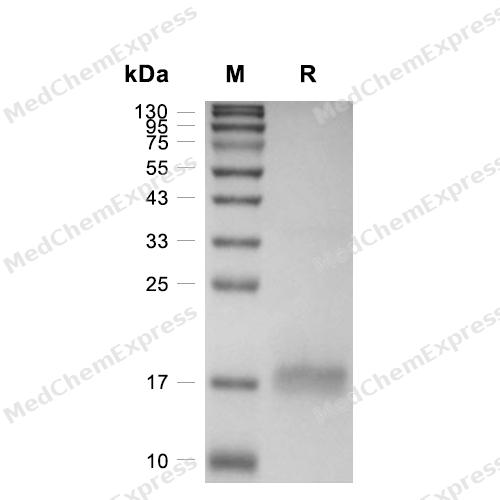
Purity - SDS-PAGE


Technical Parameters
-
Species Human
-
Source E. coli
-
Tag N-6*His
-
Accession
Q03395 (P126-D263)
-
Molecular Construction
-
N-term
-
His
-
ROM1 (P126-D263)
Accession # Q03395 -
C-term
-
-
Protein Length
Lumenal Domain
-
Synonyms
ROM1; Tetraspanin-23; Retinal Outer Segment Membrane Protein 1; ROSP1; TSPAN23; Tspan-23; ROM; RP7; Rod Outer Segment Membrane Protein 1
-
AA Sequence
PGSLDEALEEGLVTALAHYKDTEVPGHCQAKRLVDELQLRYHCCGRHGYKDWFGVQWVSSRYLDPGDRDVADRIQSNVEGLYLTDGVPFSCCNPHSPRPCLQNRLSDSYAHPLFDPRQPNQNLWAQGCHEVLLEHLQD
-
Molecular Weight
Approximately 18 kDa
-
Purity
≥ 95%, as determined by reducing SDS-PAGE.


Product Properties
Lyophilized powder.
Lyophilized from a 0.22 μm filtered solution of PBS, pH 7.4.
<1 EU/μg, determined by LAL method.
It is not recommended to reconstitute to a concentration less than 100 μg/mL in ddH2O. For long term storage it is recommended to add a carrier protein (0.1% BSA, 5% HSA, 10% FBS or 5% Trehalose).
Stored at -20°C for 2 years from date of receipt. After reconstitution, it is stable at 4°C for 1 week or -20°C for longer (with carrier protein). It is recommended to freeze aliquots at -20°C or -80°C for extended storage.
Room temperature in continental US; may vary elsewhere.


Documentation
-
Data Sheet (235 KB)
-
SDS (251 KB)
- English - EN (251 KB)
- Français - FR (251 KB)
- Deutsch - DE (251 KB)
- Norwegian - NO (251 KB)
- Español - ES (251 KB)
- Swedish - SV (251 KB)
- Italian - IT (251 KB)
- Korean - KR (251 KB)
- Portuguese - PT (251 KB)
-
Handling Instructions (2659 KB)

Calculators
Concentration (start) × Volume (start) = Concentration (final) × Volume (final)


 Powered by Bioz

