



SCF Protein, Canine

Based on 1 Customer Validation
SCF protein critically promotes mast cell proliferation, enhancing both myeloid and lymphoid hematopoietic progenitor proliferation in bone marrow. Additionally, SCF facilitates cell-cell adhesion and synergizes with other cytokines, potentially interleukins. As a homodimer, SCF is connected non-covalently, contributing to hematopoietic processes and immune responses. SCF Protein, Canine is the recombinant canine-derived SCF protein, expressed by E. coli , with tag free.
- Species: Canine
- Source: E. coli
-
Storage:Stored at -20°C for 2 years from date of receipt. After reconstitution, it is stable at 4°C for 1 week or -20°C for longer (with carrier protein). It is recommended to freeze aliquots at -20°C or -80°C for extended storage.


To place orders, for customer services and technical support, please contact: MedChemExpress USA
Tel: 609-228-6898 E-mail: [email protected] [email protected]


-
 Biological Activity
-
Technical Parameters
-
Product Properties
- Documentation
- Help & FAQs




Biological Activity
Description
SCF protein critically promotes mast cell proliferation, enhancing both myeloid and lymphoid hematopoietic progenitor proliferation in bone marrow. Additionally, SCF facilitates cell-cell adhesion and synergizes with other cytokines, potentially interleukins. As a homodimer, SCF is connected non-covalently, contributing to hematopoietic processes and immune responses. SCF Protein, Canine is the recombinant canine-derived SCF protein, expressed by E. coli , with tag free.
Background
The SCF Protein plays a critical role in promoting the proliferation of mast cells. It has the capacity to enhance the proliferation of both myeloid and lymphoid hematopoietic progenitors when cultured in the bone marrow. Additionally, SCF facilitates cell-cell adhesion. It acts synergistically with other cytokines, likely including interleukins. SCF exists as a homodimer, connected via non-covalent interactions.
Verified Bioactivity
Measured in a cell proliferation assay using TF-1 human erythroleukemic cells. The ED50 for this effect is 1.679 ng/mL.
MCE Validation Data
-
Purity - SDS-PAGE
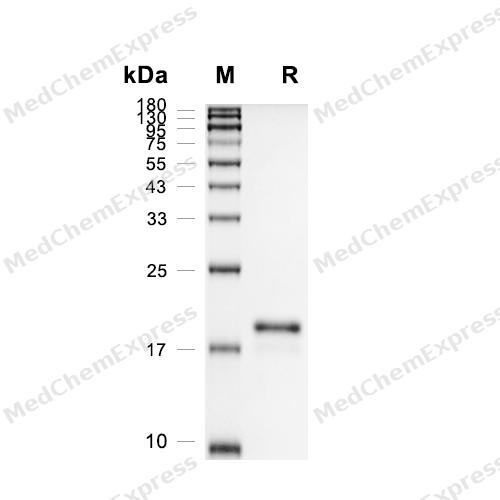
Purity - SDS-PAGE
-
Bioactivity - Cell-Based Assay
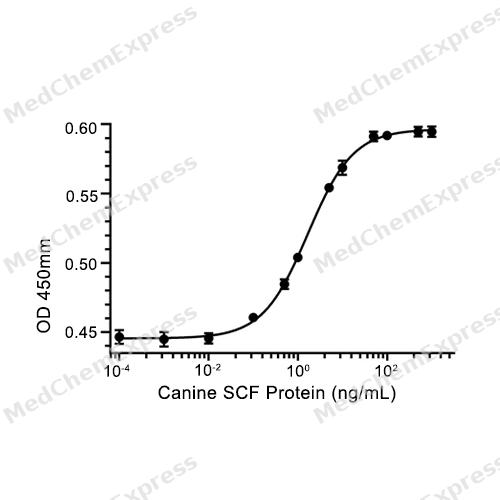
Bioactivity - Cell-Based Assay


Technical Parameters
-
Species Canine
-
Source E. coli
-
Tag Tag Free
-
Accession
Q06220 (K26-A190)
-
Molecular Construction
-
N-term
-
SCF (K26-A190)
Accession # Q06220 -
C-term
-
-
Protein Length
Full Length of Soluble KIT ligand Chain
-
Synonyms
KITLG; SLF; Prev. MGF; Familial Progressive Hyperpigmentation 2; SCF; Steel Factor; Mast Cell Growth Factor; C-Kit Ligand; Stem Cell Factor; Kit Ligand; DFNA69; SHEP7; Kitl; DCUA; KL-1; FPHH; FPH2; WS2F; KIT Ligand; SF
-
AA Sequence
KGICGKRVTDDVKDVTKLVANLPKDYKIALKYVPGMDVLPSHCWISVMVEQLSVSLTDLLDKFSNISEGLSNYSIIDKLVKIVDDLVECTEGYSFENVKKAPKSPELRLFTPEEFFRIFNRSIDAFKDLETVASKSSECVVSSTLSPDKDSRVSVTKPFMLPPVA
-
Predicted Molecular Mass
18.4 kDa
-
Molecular Weight
Approximately 19 kDa, based on SDS-PAGE under reducing conditions.
-
Purity
≥ 95%, as determined by reducing SDS-PAGE.


Product Properties
Lyophilized powder.
Lyophilized from a 0.22 μm filtered solution of PBS, pH 7.4.
<1 EU/μg, determined by LAL method.
It is not recommended to reconstitute to a concentration less than 100 μg/mL in ddH2O. For long term storage it is recommended to add a carrier protein (0.1% BSA, 5% HSA, 10% FBS or 5% Trehalose).
Stored at -20°C for 2 years from date of receipt. After reconstitution, it is stable at 4°C for 1 week or -20°C for longer (with carrier protein). It is recommended to freeze aliquots at -20°C or -80°C for extended storage.
Room temperature in continental US; may vary elsewhere.


Documentation
-
Data Sheet (235 KB)
-
SDS (251 KB)
- English - EN (251 KB)
- Français - FR (251 KB)
- Deutsch - DE (251 KB)
- Norwegian - NO (251 KB)
- Español - ES (251 KB)
- Swedish - SV (251 KB)
- Italian - IT (251 KB)
- Korean - KR (251 KB)
- Portuguese - PT (251 KB)
-
Handling Instructions (2659 KB)

Calculators
Concentration (start) × Volume (start) = Concentration (final) × Volume (final)


 Powered by Bioz

