



TCPTP Protein, Human (sf9)
Based on 1 Customer Validation
TCPTP is a non-receptor tyrosine-specific phosphatase that critically regulates various kinases (INSR, EGFR, JAK, Src) affecting hematopoiesis, inflammation, cell proliferation, and glucose homeostasis. In the immune system, TCPTP regulates T cell receptor signaling and inhibits cytokine pathways (IL2, interferon). TCPTP Protein, Human (sf9) is the recombinant human-derived TCPTP protein, expressed by Sf9 insect cells , with tag free.
- Species: Human
- Source: Sf9 insect cells
-
Storage:Stored at -20°C for 2 years from date of receipt. After reconstitution, it is stable at 4°C for 1 week or -20°C for longer (with carrier protein). It is recommended to freeze aliquots at -20°C or -80°C for extended storage.


To place orders, for customer services and technical support, please contact: MedChemExpress USA
Tel: 609-228-6898 E-mail: [email protected] [email protected]


-
 Biological Activity
-
Technical Parameters
-
Product Properties
- Documentation
- Help & FAQs




Biological Activity
Description
TCPTP is a non-receptor tyrosine-specific phosphatase that critically regulates various kinases (INSR, EGFR, JAK, Src) affecting hematopoiesis, inflammation, cell proliferation, and glucose homeostasis. In the immune system, TCPTP regulates T cell receptor signaling and inhibits cytokine pathways (IL2, interferon). TCPTP Protein, Human (sf9) is the recombinant human-derived TCPTP protein, expressed by Sf9 insect cells , with tag free.
Background
TCPTP, a non-receptor type tyrosine-specific phosphatase, acts as a crucial regulator by dephosphorylating various receptor and non-receptor protein tyrosine kinases, including INSR, EGFR, CSF1R, PDGFR, JAK1, JAK2, JAK3, Src family kinases, STAT1, STAT3, and STAT6, either in the nucleus or the cytoplasm. This phosphatase exerts negative control over diverse signaling pathways and biological processes such as hematopoiesis, inflammatory response, cell proliferation and differentiation, and glucose homeostasis. In the immune system, TCPTP plays a multifaceted role, influencing T-cell receptor signaling by dephosphorylating FYN and LCK to regulate T-cell differentiation and activation. Additionally, it negatively modulates cytokine-mediated signaling, including IL2, interferon, IL6, and IL4 pathways. Beyond immune regulation, TCPTP participates in anchorage-dependent, negative regulation of EGF-stimulated cell growth and PDGF receptor-beta signaling, thus influencing cell proliferation. Moreover, it plays a vital role in glucose homeostasis, negatively regulating the insulin receptor signaling pathway and controlling gluconeogenesis and liver glucose production through the IL6 signaling pathway. TCPTP's broad impact underscores its significance in diverse cellular processes, and it may also have DNA binding capabilities.
Verified Bioactivity
Measured by its ability to dephosphorylate a tyrosine residue in a peptide containing the EGFR Y992 phosphorylation site(HY-P0320A). The specific activity is 38.4771 μmol/min/mg.
MCE Validation Data
-
Purity - SDS-PAGE
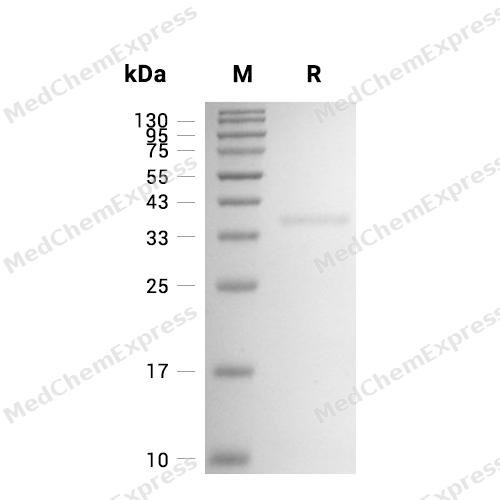
Purity - SDS-PAGE


Technical Parameters
-
Species Human
-
Source Sf9 insect cells
-
Tag Tag Free
-
Accession
P17706-1 (M1-N314)
-
Gene ID5771
-
Molecular Construction
-
N-term
-
TCPTP (M1-N314)
Accession # P17706-1 -
C-term
-
-
Protein Length
Partial
-
Synonyms
PTPN2; TC48; Prev. PTPT; Tyrosine-Protein Phosphatase Non-Receptor Type; TCPTP; T-Cell Protein Tyrosine Phosphatase; TCELLPTP; T-Cell Protein-Tyrosine Phosphatase; TC-PTP; Protein-Tyrosine-Phosphatase; TC45; PTN2; Protein Tyrosine Phosphatase Non-Receptor
-
AA Sequence
MPTTIEREFEELDTQRRWQPLYLEIRNESHDYPHRVAKFPENRNRNRYRDVSPYDHSRVKLQNAENDYINASLVDIEEAQRSYILTQGPLPNTCCHFWLMVWQQKTKAVVMLNRIVEKESVKCAQYWPTDDQEMLFKETGFSVKLLSEDVKSYYTVHLLQLENINSGETRTISHFHYTTWPDFGVPESPASFLNFLFKVRESGSLNPDHGPAVIHCSAGIGRSGTFSLVDTCLVLMEKGDDINIKQVLLNMRKYRMGLIQTPDQLRFSYMAIIEGAKCIKGDSSIQKRWKELSKEDLSPAFDHSPNKIMTEKYN
-
Predicted Molecular Mass
36.6 kDa
-
Molecular Weight
Approximately 37 kDa, based on SDS-PAGE under reducing conditions.
-
Purity
≥ 95%, as determined by reducing SDS-PAGE.


Product Properties
Lyophilized powder.
Lyophilized from a 0.22 μm filtered solution of 20 mM Tris-HCl, 500 mM NaCl, pH 8.0.
Note: For SPR assay, please replace the buffer. Primary amine components (e.g., Tris, imidazole) can affect protein-coupled chips.
<1 EU/μg, determined by LAL method.
It is not recommended to reconstitute to a concentration less than 100 μg/mL in ddH2O. For long term storage it is recommended to add a carrier protein (0.1% BSA, 5% HSA, 10% FBS or 5% Trehalose).
Stored at -20°C for 2 years from date of receipt. After reconstitution, it is stable at 4°C for 1 week or -20°C for longer (with carrier protein). It is recommended to freeze aliquots at -20°C or -80°C for extended storage.
Room temperature in continental US; may vary elsewhere.


Documentation
-
Data Sheet (237 KB)
-
SDS (251 KB)
- English - EN (251 KB)
- Français - FR (251 KB)
- Deutsch - DE (251 KB)
- Norwegian - NO (251 KB)
- Español - ES (251 KB)
- Swedish - SV (251 KB)
- Italian - IT (251 KB)
- Korean - KR (251 KB)
- Portuguese - PT (251 KB)
-
Handling Instructions (2659 KB)

Calculators
Concentration (start) × Volume (start) = Concentration (final) × Volume (final)


 Powered by Bioz

