



TXNL4A Protein, Human (His)

Based on 1 Customer Validation
The TXNL4A protein plays a key role in pre-mRNA splicing and is an important component of U5 snRNP, U4/U6-U5 tri-snRNP complex, and precatalytic spliceosome (spliceosome B complex). It contributes to spliceosome assembly and is an integral part of the complex process of spliceosome function. TXNL4A Protein, Human (His) is the recombinant human-derived TXNL4A protein, expressed by E. coli , with N-His labeled tag.
- Species: Human
- Source: E. coli
-
Storage:Stored at -20°C for 2 years from date of receipt. After reconstitution, it is stable at 4°C for 1 week or -20°C for longer (with carrier protein). It is recommended to freeze aliquots at -20°C or -80°C for extended storage.


To place orders, for customer services and technical support, please contact: MedChemExpress USA
Tel: 609-228-6898 E-mail: [email protected] [email protected]


-
 Biological Activity
-
Technical Parameters
-
Product Properties
- Documentation
- Help & FAQs




Biological Activity
Description
The TXNL4A protein plays a key role in pre-mRNA splicing and is an important component of U5 snRNP, U4/U6-U5 tri-snRNP complex, and precatalytic spliceosome (spliceosome B complex). It contributes to spliceosome assembly and is an integral part of the complex process of spliceosome function. TXNL4A Protein, Human (His) is the recombinant human-derived TXNL4A protein, expressed by E. coli , with N-His labeled tag.
Background
TXNL4A protein is integral to pre-mRNA splicing, serving as a critical component in the U5 snRNP and U4/U6-U5 tri-snRNP complexes, both essential for spliceosome assembly and the formation of the precatalytic spliceosome (spliceosome B complex). Within the U4/U6-U5 tri-snRNP complex, comprising U4, U6, and U5 snRNAs, TXNL4A collaborates with various proteins, including PRPF3, PRPF4, PRPF6, PRPF8, and others, to create a foundation for the precatalytic spliceosome. Its direct interaction with CD2BP2 and association with proteins like HNRPF, HNRPH2, NEDD9, and PQBP1 highlight TXNL4A's multifaceted involvement in the intricate machinery orchestrating pre-mRNA splicing. Additionally, TXNL4A interacts with ERBB4, showcasing its potential connections to broader cellular processes.
MCE Validation Data
-
Purity - SDS-PAGE
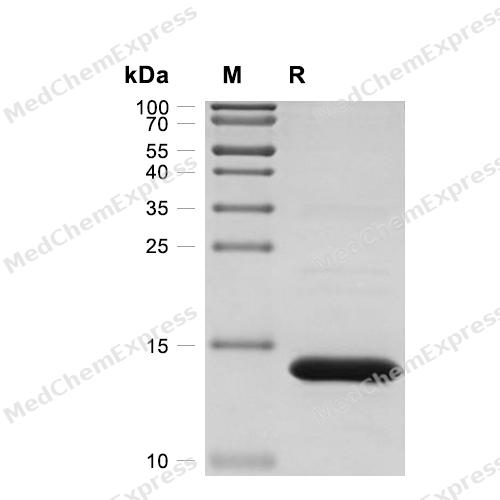
Purity - SDS-PAGE


Technical Parameters
-
Species Human
-
Source E. coli
-
Tag N-His
-
Accession
P83876 (M1-Y142)
-
Molecular Construction
-
N-term
-
His
-
TXNL4A (M1-Y142)
Accession # P83876 -
C-term
-
-
Protein Length
Full Length
-
Synonyms
TXNL4A; Thioredoxin-Like Protein 4A; Thioredoxin Like 4A; DIM1 Protein Homolog; TXNL4; Thioredoxin-Like 4; DIM1; HsT161; U5-15kD; Thioredoxin-Like 4A, Isoform CRA_a; SNRNP15; Similar To S. Pombe Dim1+; DIB1; Thioredoxin-Like 4A; Spliceosomal U5 SnRNP-Spec
-
AA Sequence
MSYMLPHLHNGWQVDQAILSEEDRVVVIRFGHDWDPTCMKMDEVLYSIAEKVKNFAVIYLVDITEVPDFNKMYELYDPCTVMFFFRNKHIMIDLGTGNNNKINWAMEDKQEMVDIIETVYRGARKGRGLVVSPKDYSTKYRY
-
Predicted Molecular Mass
16.8 kDa
-
Molecular Weight
Approximately 16 kDa, based on SDS-PAGE under reducing conditions.
-
Purity
≥ 95%, as determined by reducing SDS-PAGE.


Product Properties
Lyophilized powder.
1.Lyophilized from a 0.22 μm filtered solution of 50 mM Tris-HCl, 300 mM NaCl, pH 8.0.
Note: For SPR assay, please replace the buffer. Primary amine components (e.g., Tris, imidazole) can affect protein-coupled chips.
<1 EU/μg, determined by LAL method.
It is not recommended to reconstitute to a concentration less than 100 μg/mL in ddH2O.
Stored at -20°C for 2 years from date of receipt. After reconstitution, it is stable at 4°C for 1 week or -20°C for longer (with carrier protein). It is recommended to freeze aliquots at -20°C or -80°C for extended storage.
Room temperature in continental US; may vary elsewhere.


Documentation
-
Data Sheet (235 KB)
-
SDS (254 KB)
- English - EN (254 KB)
- Français - FR (254 KB)
- Deutsch - DE (254 KB)
- Norwegian - NO (254 KB)
- Español - ES (254 KB)
- Swedish - SV (254 KB)
- Italian - IT (254 KB)
- Korean - KR (254 KB)
- Portuguese - PT (254 KB)
-
Handling Instructions (2659 KB)

Calculators
Concentration (start) × Volume (start) = Concentration (final) × Volume (final)


 Powered by Bioz

