



Wnt5a Protein, Human (His)
Based on 1 publication(s) in Google Scholar
Wnt5a Protein, Human (His) is the recombinant human-derived Wnt5a, expressed by E. coli , with N-6*His labeled tag. ,
- Species: Human
- Source: E. coli
-
Storage:Stored at -20°C for 2 years from date of receipt. After reconstitution, it is stable at 4°C for 1 week or -20°C for longer (with carrier protein). It is recommended to freeze aliquots at -20°C or -80°C for extended storage.

To place orders, for customer services and technical support, please contact: MedChemExpress USA
Tel: 609-228-6898 E-mail: [email protected] [email protected]


-
 Biological Activity
-
Technical Parameters
-
Product Properties
- Documentation
- Help & FAQs


-
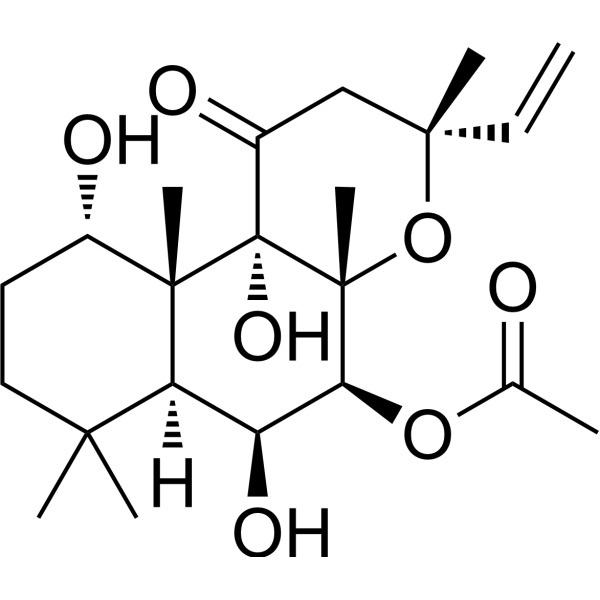
HY-15371
Forskolin -

HY-P700313
Wnt4 protein, Human (HEK293, C-hFc) -
HY-P70543
TGF beta 1/TGFB1 Protein, Human (HEK293) -
HY-P70725
THBS1 Protein, Human (HEK293, His) -
HY-P702628
Wnt6 Protein, Mouse (His, SUMO) -
HY-P7155A
DKK-1 Protein, Human (HEK293, His) -
HY-P70597
KGF/FGF-7 Protein, Human -
HY-P7008
BMP-7 Protein, Human -
HY-P7048
KGF-2/FGF-10 Protein, Human (169a.a) -
HY-P73412
Serpin A3 Protein, Human (HEK293, His) -
HY-P7409
SHH Protein, Mouse (C25II) -
HY-P700021AF
Animal-Free BMP-12/GDF-7 Protein, Human (His)


Biological Activity
Description
Wnt5a Protein, Human (His) is the recombinant human-derived Wnt5a, expressed by E. coli , with N-6*His labeled tag. ,
Background
The Wnt5a protein serves as a ligand for members of the frizzled family of seven transmembrane receptors and exhibits dual functionality in the canonical Wnt signaling pathway, depending on the receptor context. In the presence of FZD4, it activates beta-catenin signaling, while in the presence of ROR2, it inhibits the canonical Wnt pathway by promoting beta-catenin degradation through a GSK3-independent pathway. This inhibition allows for chondrogenesis and impedes tumor formation. Wnt5a stimulates cell migration and, as a potential tumor suppressor, reduces the proliferation, migration, invasiveness, and clonogenicity of carcinoma cells. Additionally, it plays a crucial role during embryogenesis, contributing to the extension of the primary anterior-posterior axis and the outgrowth of limbs and the genital tubercle. The protein forms a soluble 1:1 complex with AFM, preventing oligomerization and ensuring prolonged biological activity, potentially representing the physiological form in body fluids. As a homooligomer, Wnt5a is disulfide-linked, leading to inactivation. It interacts with PORCN, WLS, glypican GCP3, PKD1, and TMEM67, illustrating its intricate involvement in various signaling pathways and developmental processes.
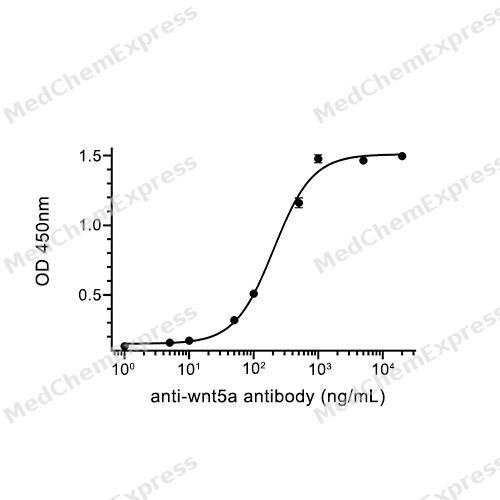
Verified Bioactivity
Immobilized Wnt5a at 2 μg/mL (100 μL/well) can bind Wnt5a antibody. The ED50 for this effect is 100-300 ng/mL.
MCE Validation Data
-
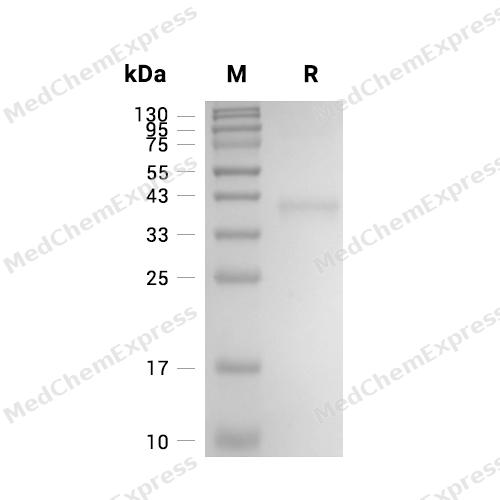
Purity - SDS-PAGE
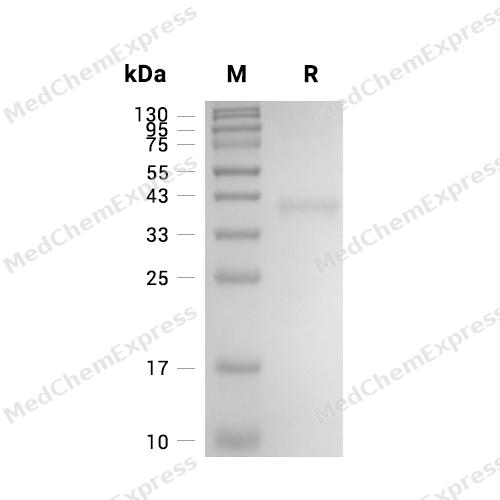
Purity - SDS-PAGE
-
Bioactivity - ELISA
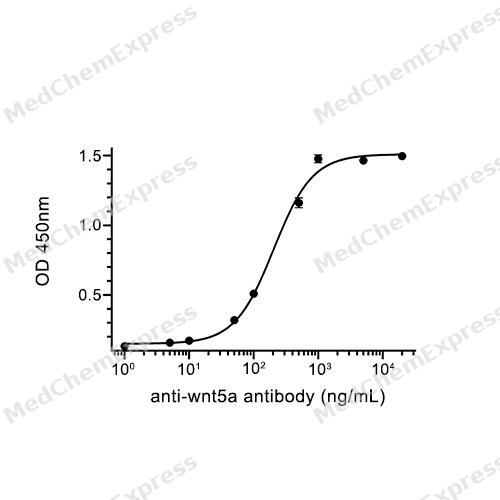
Bioactivity - ELISA


Publications (1)
-
Journal Impact Factor
-
Most Recent
-
J Adv Res
2026 May 16:S2090-1232(26)00432-7. PMID: 42144061


Technical Parameters
-
Species Human
-
Source E. coli
-
Tag N-6*His
-
Accession
P41221-1 (I62-K380)
-
Gene ID7474
-
Molecular Construction
-
N-term
-
6*His
-
Wnt5a (I62-K380)
Accession # P41221-1 -
C-term
-
-
Protein Length
Full Length of Isoform-1
-
Synonyms
WNT5A; Wnt Family Member 5A; HWNT5A; Wingless-Type MMTV Integration Site Family, Member 5A; WNT-5A Protein; Protein Wnt-5a; Wingless-Type MMTV Integration Site Family Member 5A Variant 2; Epididymis Secretory Sperm Binding Protein; Protein Wnt
-
AA Sequence
IIGAQPLCSQLAGLSQGQKKLCHLYQDHMQYIGEGAKTGIKECQYQFRHRRWNCSTVDNTSVFGRVMQIGSRETAFTYAVSAAGVVNAMSRACREGELSTCGCSRAARPKDLPRDWLWGGCGDNIDYGYRFAKEFVDARERERIHAKGSYESARILMNLHNNEAGRRTVYNLADVACKCHGVSGSCSLKTCWLQLADFRKVGDALKEKYDSAAAMRLNSRGKLVQVNSRFNSPTTQDLVYIDPSPDYCVRNESTGSLGTQGRLCNKTSEGMDGCELMCCGRGYDQFKTVQTERCHCKFHWCCYVKCKKCTEIVDQFVCK
-
Predicted Molecular Mass
39.8 kDa
-
Molecular Weight
Approximately 38 kDa, based on SDS-PAGE under reducing conditions.
-
Purity
≥ 90%, as determined by reducing SDS-PAGE.


Product Properties
Lyophilized powder
1.Lyophilized from a 0.22 μm filtered solution of PBS, 6% trehalose.
2.Lyophilized from a 0.22 μm filtered solution of PBS, pH 7.4, 6% trehalose.
Please refer to the lot-specific COA for specific buffer information.
<1 EU/μg, determined by LAL method.
It is not recommended to reconstitute to a concentration less than 100 μg/mL in ddH2O.
Stored at -20°C for 2 years from date of receipt. After reconstitution, it is stable at 4°C for 1 week or -20°C for longer (with carrier protein). It is recommended to freeze aliquots at -20°C or -80°C for extended storage.
Room temperature in continental US; may vary elsewhere.


Documentation
-
Data Sheet (237 KB)
-
SDS (251 KB)
- English - EN (251 KB)
- Français - FR (251 KB)
- Deutsch - DE (251 KB)
- Norwegian - NO (251 KB)
- Español - ES (251 KB)
- Swedish - SV (251 KB)
- Italian - IT (251 KB)
- Korean - KR (251 KB)
- Portuguese - PT (251 KB)
-
Handling Instructions (2659 KB)

Calculators
Concentration (start) × Volume (start) = Concentration (final) × Volume (final)


 Powered by Bioz

