


205 Results for "

Modifier

" in MedChemExpress (MCE) Product Catalog:
Products (205)

205 Results for "Modifier" in MCE Product Catalog:

Cat. No.: HY-P810817
Synonyms: SMT3B, SMT3H2, SUMO2, Small ubiquitin-related Modifier 2, SUMO-2, HSMT3, SMT3 homolog 2, SUMO-3, Sentrin-2, Ubiquitin-like protein SMT3B, Smt3B

Host:  

Mouse

Application:  

WB, ICC/IF

Reactivity:  

Human, Rat

loading...
    loading...
Cat. No.: HY-W591476
CAS No.: 134874-49-0
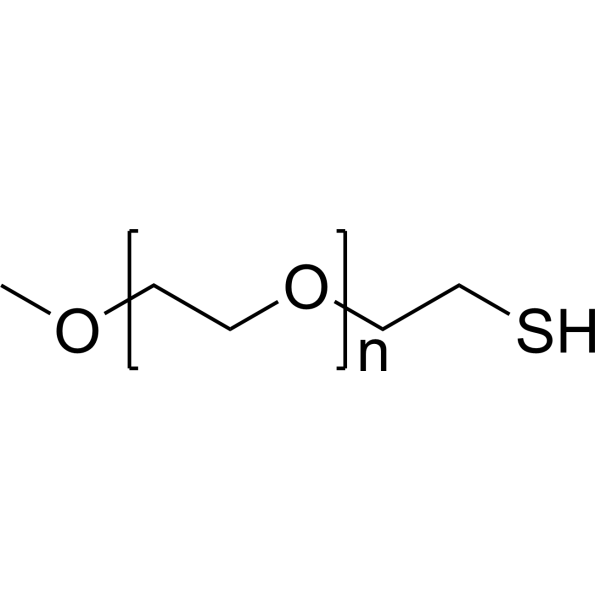
Synonyms: mPEG1000-SH
m-PEG1000-thiol (mPEG1000-SH) is a surface modifier that can modify DNA thiolation and is used in the synthesis of gold nanorods (AuNR). m-PEG1000-thiol can load thiolated DNA onto AuNR, form a covalent bond with the surface of gold nanoparticles through the thiol group, and stabilize the nanoparticles by the steric hindrance effect of the polyethylene glycol chain, preventing aggregation and enhancing its biocompatibility. m-PEG1000-thiol can also provide a platform for the subsequent coupling of biomolecules (such as DNA, antibodies) by replacing surfactants (such as CTAB) on the surface of nanoparticles, thereby exerting its activity in promoting the functionalization of nanomaterials [2].
loading...
    loading...
Cat. No.: HY-B2221B2
CAS No.: 9004-62-0
Research Areas:  

Others

Hydroxyethyl cellulose, Viscosity (2%):40000mPa.s is a class of nonionic cellulose ether gel-forming polymers with pH-independent drug release properties. When used as a tablet coating, Hydroxyethyl cellulose, Viscosity (2%):40000mPa.s regulates the water permeation rate, thereby altering the drug release lag time; the higher the viscosity, the longer the drug release lag time. When used as a hydrogel thickener, it increases the dynamic viscosity of the system. Hydroxyethyl cellulose, Viscosity (2%):40000mPa.s can be used in organic synthesis-related research, such as pharmaceutical excipients, hydrogel thickeners, etc.
loading...
    loading...
Cat. No.: HY-B2221B3
CAS No.: 9004-62-0
Research Areas:  

Others

Hydroxyethyl cellulose, Viscosity (2%):6000mPa.s is a class of nonionic cellulose ether gel-forming polymers with pH-independent drug release properties. When used as a tablet coating, Hydroxyethyl cellulose, Viscosity (2%):6000mPa.s regulates the water permeation rate, thereby altering the drug release lag time; the higher the viscosity, the longer the drug release lag time. When used as a hydrogel thickener, it increases the dynamic viscosity of the system. Hydroxyethyl cellulose, Viscosity (2%):6000mPa.s can be used in organic synthesis-related research, such as pharmaceutical excipients, hydrogel thickeners, etc.
loading...
    loading...
Cat. No.: HY-P70843
Purity:  ≥ 95%, as determined by reducing SDS-PAGE.
Synonyms: NEDD8; Neddylin; NEDD8 Ubiquitin Like Modifier; Neural Precursor Cell Expressed Developmentally Down-Regulated Protein 8; Nedd-8; Neural Cell Expressed Developmentally Down-Regulated Protein 8; Neural Precursor Cell Expressed, Developmentally Down-Regulat
Species:  
Human
Source:  
E. coli
loading...
    loading...
Cat. No.: HY-W127512R
CAS No.: 546-18-9
Research Areas:  

Others

5β-Cholanic acid is a hydrophobic modifier used to modify polymer carriers. 5β-Cholanic acid can improve the acid stability, cell penetration efficiency and drug sustained release ability of nanocarriers, and optimize the oral effectiveness of delivered molecules. 5β-Cholanic acid can covalently bind to Glycol chitosan (GC) to form a GC-CA conjugate, which optimizes the hydrophobic anchoring ability of nanoparticles and enables them to be stably adsorbed on the surface of PLGA nanoparticles. Such nanoparticles can resist dissociation in the gastric acid environment and maintain positive charge to enhance endocytic uptake by intestinal epithelial cells (such as Caco-2 cells). 5β-Cholanic acid can be used in the development of drug delivery systems .
loading...
    loading...
Cat. No.: HY-121277
CAS No.: 477-74-7
Research Areas:  

Others

Benzoflavine is an acridine dye and photodynamic sensitizer that regulates embryonic development. Benzoflavine can adsorb to the surface of Arbacia sea urchin egg cell membranes, enhance the sensitivity of highly physiologically active embryonic regions to visible light radiation, and induce anterior-posterior developmental differences; at high concentrations, it can independently inhibit embryonic development without illumination, and its photosensitive response range covers the blue-violet region of visible light. Benzoflavine can be used in research fields such as developmental biology, organic synthesis, and photobiochemistry .
loading...
    loading...
Cat. No.: HY-W250183
CAS No.: 9005-00-9
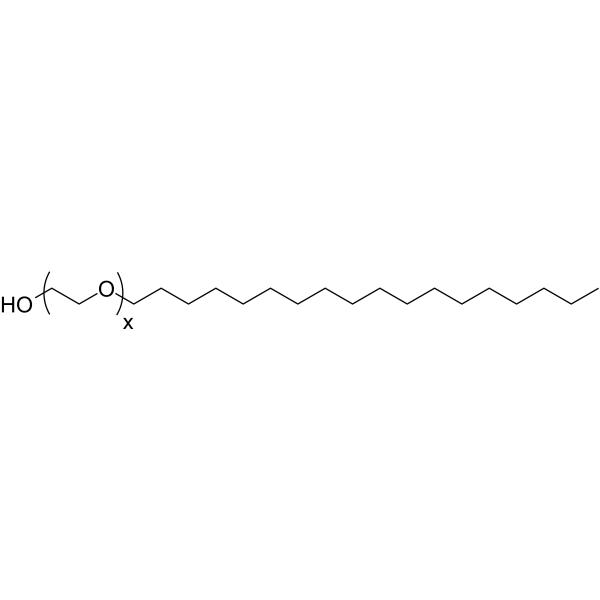
Synonyms: Polyethylene glycol octadecyl ether (n~10, average Mn~711)
Research Areas:  

Others

Polyoxyethylene (10) stearyl ether (Polyethylene glycol octadecyl ether (n~10, average Mn~711)) is a nonionic surfactant. Polyoxyethylene (10) stearyl ether reduces interfacial tension through its amphiphilic structure, stabilizes emulsions via steric hindrance, and forms micelles for solubilization. Polyoxyethylene (10) stearyl ether can serve as a biomaterial or organic compound for life science-related research.
loading...
    loading...
Cat. No.: HY-P703607
Purity:  ≥ 90%, as determined by reducing SDS-PAGE.
Synonyms: UBA2; SAE2; UBLE1B; HRIHFB2115; SUMO-activating enzyme subunit 2; EC 2.3.2.-; Anthracycline-associated resistance ARX; Ubiquitin-like 1-activating enzyme E1B; Ubiquitin-like Modifier-activating enzyme 2
Species:  
Human
Source:  
E. coli
loading...
    loading...
Cat. No.: HY-W250721F
CAS No.: 9007-20-9
Synonyms: Carboxy polymethylene (homopolymer)
Research Areas:  

Others

Carbomer homopolymer (Carboxy polymethylene (homopolymer)) is an acrylic acid polymer, which can be used as a thickening agent. Carbomer homopolymer provides a stable gel matrix, exhibits good heat, light and microbial contamination resistance. Carbomer homopolymer facilitates the drug release and local application, which can be used in the pharmaceutical industry .
loading...
    loading...
Cat. No.: HY-W250721G
CAS No.: 9007-20-9
Synonyms: Carboxy polymethylene (interpolymer)
Research Areas:  

Others

Carbomer interpolymer (Carboxy polymethylene (interpolymer)) is an acrylic acid polymer, which can be used as a thickening agent. Carbomer interpolymer provides a stable gel matrix, exhibits good heat, light and microbial contamination resistance. Carbomer interpolymer facilitates the drug release and local application, which can be used in the pharmaceutical industry .
loading...
    loading...
Cat. No.: HY-P702947
Purity:  ≥ 85%, as determined by reducing SDS-PAGE.
Synonyms: UBA2; SAE2; UBLE1B; HRIHFB2115; SUMO-activating enzyme subunit 2; EC 2.3.2.-; Anthracycline-associated resistance ARX; Ubiquitin-like 1-activating enzyme E1B; Ubiquitin-like Modifier-activating enzyme 2
Species:  
Human
Source:  
Sf9 insect cells
loading...
    loading...
Cat. No.: HY-P703608
Purity:  ≥ 95%, as determined by reducing SDS-PAGE.
Synonyms: UBA2; SAE2; UBLE1B; HRIHFB2115; SUMO-activating enzyme subunit 2; EC 2.3.2.-; Anthracycline-associated resistance ARX; Ubiquitin-like 1-activating enzyme E1B; Ubiquitin-like Modifier-activating enzyme 2
Species:  
Human
Source:  
E. coli
loading...
    loading...
Cat. No.: HY-112768
Purity:  ≥95.0%
Research Areas:  

Others

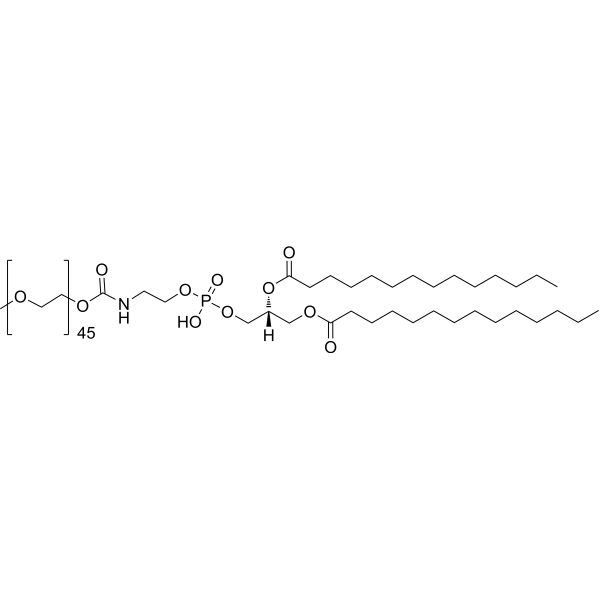
PEG2000-DMPE is a polyethylene glycol-lipid conjugate combined with phosphatidylethanolamine. PEG2000-DMPE undergoes a conformational transition from mushroom-like to brush-like at a concentration of 7 mol%, thereby exerting multiple functions such as inhibitor, stabilizer and surface defect modifier. PEG2000-DMPE can form a steric hindrance barrier on the vesicle surface to block calcium ion-induced liposome fusion, and dynamically regulate the fusion process through spontaneous transfer rate. PEG2000-DMPE can delay the thinning of foam thin liquid films and smoothly seal surface defects of solid support layers. PEG2000-DMPE can be used in the design and related research of stealth liposomes and micelles .
loading...
    loading...
Cat. No.: HY-L024
931 compounds

A histone modification, a covalent post-translational modification (PTM) to histone proteins, includes methylation, phosphorylation, acetylation, ubiquitylation, and sumoylation, etc. In general, histone modifications are catalyzed by specific enzymes that act predominantly at the histone N-terminal tails involving amino acids such as lysine or arginine, as well as serine, threonine, tyrosine, etc. The PTMs made to histones can impact gene expression by altering chromatin structure or recruiting histone modifiers. Histone modifications act in diverse biological processes such as transcriptional activation/inactivation, chromosome packaging, and DNA damage/repair. Deregulation of histone modification contributes to many diseases, including cancer and autoimmune diseases.

MCE owns a unique collection of 931 bioactive compounds targeting Epigenetic Reader Domain, HDAC, Histone Acetyltransferase, Histone Demethylase, Histone Methyltransferase, Sirtuin, etc. Histone Modification Research Compound Library is a useful tool for histone modification research and drug screening.

Cat. No.: HY-P80415
Synonyms: FIP3, NEMO, IKBKG, NF-kappa-B essential modulator, FIP-3, IkB kinase-associated protein 1, Inhibitor of nuclear factor kappa-B kinase subunit gamma, NF-kappa-B essential Modifier, IKKAP1, I-kappa-B kinase subunit gamma, IKK-gamma, IKKG, IkB kinase subunit gamma

Host:  

Rabbit

Application:  

WB, IHC-P, ICC/IF, IP, FC

Reactivity:  

Human, Mouse, Rat

loading...
    loading...
Cat. No.: HY-P87528
Synonyms: FIP3, NEMO, IKBKG, NF-kappa-B essential modulator, FIP-3, IkB kinase-associated protein 1, Inhibitor of nuclear factor kappa-B kinase subunit gamma, NF-kappa-B essential Modifier, IKKAP1, I-kappa-B kinase subunit gamma, IKK-gamma, IKKG, IkB kinase subunit gamma

Host:  

Rabbit

Application:  

WB, IHC-P, IHC-F, IF-Tissue, FC

Reactivity:  

Human, Mouse, Rat

loading...
    loading...
Cat. No.: HY-112624J
CAS No.: 9004-54-0
Synonyms: Dextran 4; Dextran D4; Dextran T4(MW 3200-4800)
Dextran 4,000 is a mucus rheology modifier. The dextran molecules in Dextran 4,000 can reduce the cross-link density of mucus through osmotic effects and hydrogen bond substitution, and reduce viscoelasticity and improve the mucociliary/cough clearance index by destroying the DNA-mucin network structure in mucus. Dextran 4,000 has the ability to improve the rheological properties and clearance ability of cystic fibrosis (CF) sputum, and can be used in the study of inhalation therapy or aerosol delivery of mucostatic respiratory diseases. The Dextran series of compounds are also natural polysaccharide drug carriers that can be connected to drugs through covalent bonding methods such as ester bonds, amide bonds or click chemistry, or self-assembled to form carriers such as nanoparticles and hydrogels. Dextran is biodegradable and biocompatible, and can achieve targeted delivery and controlled release of drugs. Dextran derivatives can prolong the half-life of drugs, increase local concentrations, and reduce the activity of immune clearance .
loading...
    loading...
Cat. No.: HY-W043748
CAS No.: 38862-24-7
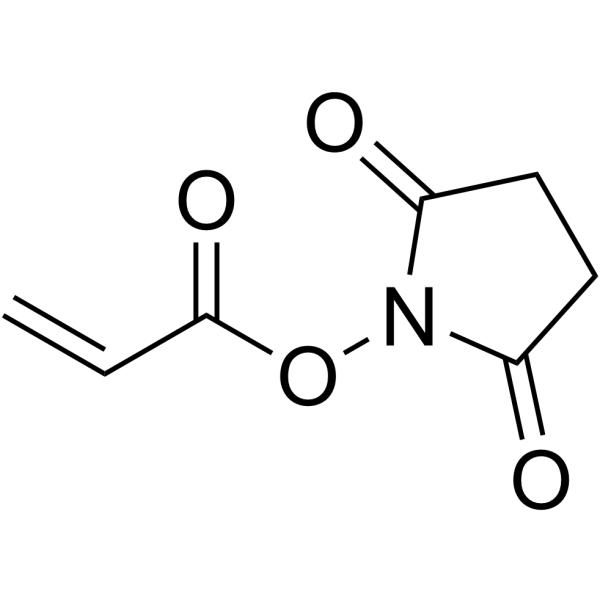
Synonyms: N-Succinimidyl acrylate
Research Areas:  

Others

2,5-Dioxopyrrolidin-1-yl acrylate (N-Succinimidyl acrylate) is a lysine residue modifier and coupling monomer. 2,5-Dioxopyrrolidin-1-yl acrylate covalently modifies the primary amines of lysine residues on monoclonal anti-horseradish peroxidase IgG antibodies, neutralizes positive charges and replaces them with low-affinity acrylate groups. 2,5-Dioxopyrrolidin-1-yl acrylate inhibits the formation of rapid hard coronas on citrate-coated gold nanoparticles, induces antibody unfolding and loss of antigen-binding function, but does not affect the antigen-binding function of antibodies in free solution. 2,5-Dioxopyrrolidin-1-yl acrylate reacts with the ε-amino groups on lysine residues of L-asparaginase, introduces vinyl groups and generates N-hydroxysuccinimide. 2,5-Dioxopyrrolidin-1-yl acrylate regulates the activity of L-asparaginase .
loading...
    loading...
Cat. No.: HY-P703601
Purity:  ≥ 95%, as determined by reducing SDS-PAGE.
Synonyms: UBA3; NEDD8-Activating Enzyme E1 Subunit 2; Prev. UBE1C; NEDD8-Activating Enzyme E1C; NEDD8-Activating Enzyme E1 Catalytic Subunit; UBA3, Ubiquitin-Activating Enzyme E1 Homolog; HUba3; Ubiquitin-Like Modifier Activating Enzyme 3; NAE2; Ubiquitin-Like Modifier-Activating Enzyme 3; Ubiquitin-Activating Enzyme E1C (Homologous To Yeast UBA3); Ubiquitin-Activating Enzyme E1C; Ubiquitin-Activating Enzyme E1C (UBA3 Homolog, Yeast); Nedd8-Activating Enzyme HUba3; Ubiquitin Like Modifier Activating Enzyme 3; Ubiquitin-Activating Enzyme 3; NAE1; Proto-Oncogene Protein 1; Prev. APPBP1; NEDD8-Activating Enzyme E1 Subunit; APP-BP1; Alternative Protein NAE1; Ula-1; Protooncogene Protein 1; Amyloid Beta Precursor Protein-Binding Protein 1, 59 KDa; A-116A10.1; Amyloid Beta Precursor Protein Binding Protein 1, 59kDa; NEDFIH; NEDD8-Activating Enzyme E1 Regulatory Subunit; HPP1; Amyloid Protein-Binding Protein 1; NEDD8 Activating Enzyme E1 Subunit 1; Amyloid Beta Precursor Protein-Binding Protein 1, 59kD
Species:  
Human
Source:  
Sf9 insect cells
loading...
    loading...

