306 Results for "

anticancer effect

" in MedChemExpress (MCE) Product Catalog:
Products (306)

306 Results for "anticancer effect" in MCE Product Catalog:

Cat. No.: HY-181840
CAS No.: 1846587-13-0
Target:  

Endonuclease

Research Areas:  

Cancer

MU262 is a MUS81 inhibitor with an IC50 value of 0.87 μM. MU262 directly inhibits the catalytic activity of MUS81 without interfering with DNA binding, induces genomic instability in tumor cells, and specifically inhibits the HR/BIR repair pathway. The combination of MU262 with Cisplatin (HY-17394) significantly enhances the chemotherapeutic killing effect. MU262 serves as a chemical biology tool for studying MUS81 function, and also acts as a lead compound for the development of anticancer therapies that exploit DNA repair defects in cancer cells .
loading...
    loading...
Cat. No.: HY-183143
CAS No.: 1392014-36-6
Lss-11 is a topoisomerase inhibitor. LSS-11 enhances cell death in cancer cells by inducing apoptosis through increasing the DR5 protein level and PARP1 cleavage. LSS-11 dose-dependently reduces STAT3 phosphorylation, downregulates its target genes MDR1 and MRP1, reduces P-gp protein expressionwithout affecting P-gp transport function. Lss-11 is a chemosensitizer and shows synergistic anticancer effect with Paclitaxel (HY-B0015). Lss-11 can be used for the research of paclitaxel-resistant lung cancer .
loading...
    loading...
Cat. No.: HY-W008566R
CAS No.: 244-63-3
Synonyms: Norharman (Standard); β-Carboline (Standard)
Norharmane (Standard) is the analytical standard of Norharmane. This product is intended for research and analytical applications. Norharmane (Norharman), a β-carboline alkaloid, is a potent and reversible monoamine oxidase inhibitor, with IC50 values of 6.5 and 4.7 μM for MAO-A and MAO-B, respectively. Norharmane causes antidepressant responses. Norharmane is also a prospective anti-cancer photosensitizer. Norharmane alters polar auxin transport (PAT) by inhibiting PIN2, PIN3 and PIN7 transport proteins, thus causing a significant inhibitory effect on the growth of Arabidopsis thaliana seedlings .
loading...
    loading...
Cat. No.: HY-W778207
CAS No.: 478510-79-1
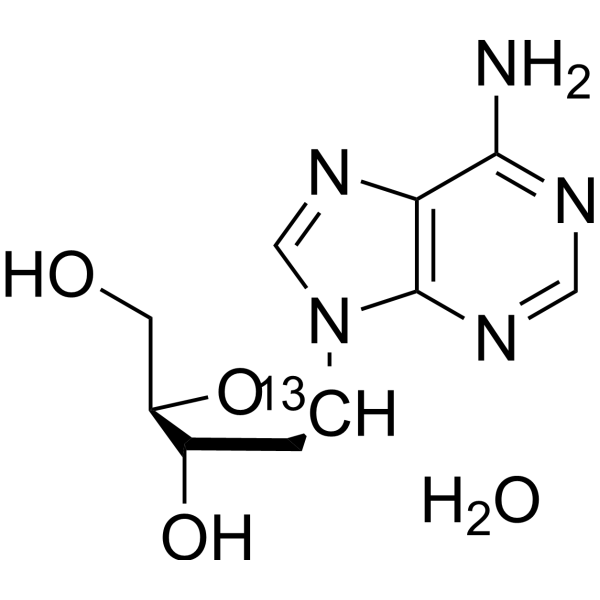
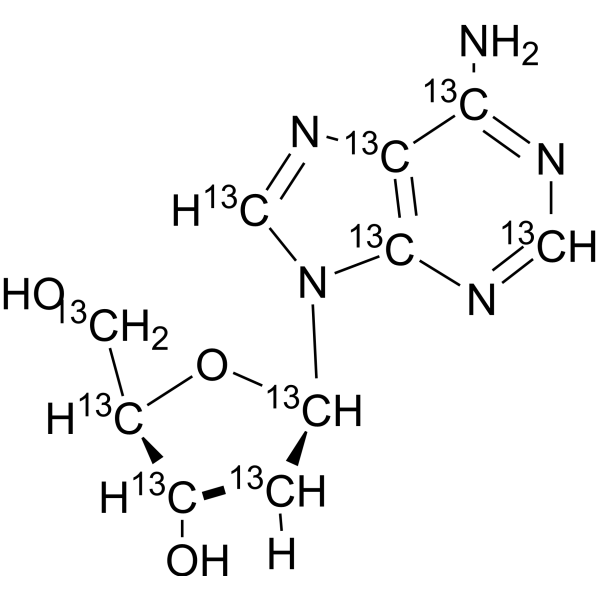
2'-Deoxyadenosine- 13C5 monohydrate is the 13C labeled isotope of '-Deoxyadenosine monohydrate (HY-W040329). 2′-Deoxyadenosine is an adenine nucleoside that inhibits glucose-stimulated insulin release. 2′-Deoxyadenosine inhibits glucose-stimulated increases seen in islet cyclic AMP (cAMP) accumulation. 2'-Deoxyadenosine activates caspase-3 and promotes apoptosis. 2'-Deoxyadenosine inhibits the activity of S-adenosyl-L-homocysteine hydrolase (SAHH). 2'-Deoxyadenosine inhibits the growth of various cells. 2'-Deoxyadenosine has an anticancer effect on colon cancer .
loading...
    loading...
Cat. No.: HY-L179
39 compounds

Radiotherapy is a common treatment for various cancers, and more than 50% of cancer patients require radiotherapy during the disease treatment. With advances in radiation technology and a better understanding of tumor biology, the efficacy of radiation therapy has gradually improved, and more and more patients have benefited from it. However, even with the use of advanced radiotherapy techniques, there are still many malignant tumor cells with low sensitivity to radiation, leading to the radiation effect is not ideal. To solve this problem, radiosensitizers have received more and more attention. Radiosensitizer is a kind of drug that can enhance the radiosensitivity of tumor cells and improve the effect of radiotherapy. Radiation sensitizers act in a variety of ways, such as killing hypoxic cells, enhancing DNA damage, inhibiting DNA damage repair, and blocking cell cycle progression, making tumor cells more susceptible to radiation damage and death than surrounding normal cells.

MCE designs a unique collection of 39 compounds with definite reported radiosensitization. It can be used for drug combination research in anti-cancer treatment.

Cat. No.: HY-130256
CAS No.: 2380000-55-3
Purity:  99.37%
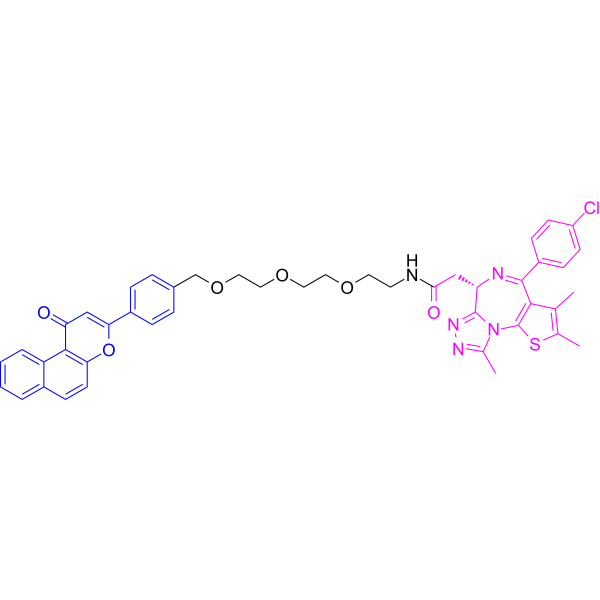
β-NF-JQ1 is a BRD2/3/4 PROTAC degrader. β-NF-JQ1 recruits the AhR E3 ligase complex to BRD2, BRD3 and BRD4, induces AhR-BRD interaction, and mediates AhR-dependent degradation through the proximity effect between the target protein and AhR. β-NF-JQ1 acts as an antiproliferative and cytotoxic agent that induces anticancer activity associated with BRD protein knockdown. β-NF-JQ1 can be used for research on breast cancer and neuroblastoma .
loading...
    loading...
Cat. No.: HY-178451
Target:  

Apoptosis

Research Areas:  

Cancer

NQO1-responsive prodrug is a prodrug of Gemcitabine (dFdC) (HY-17026) with anti-cancer effect. NQO1-responsive prodrug remains stable in plasma and liver/intestinal S9 fractions, releasing dFdC in an NQO1-dependent manner. NQO1-responsive prodrug induces S-phase arrest and apoptosis. NQO1-responsive prodrug inhibits tumor growth in an A549 xenograft mouse model. NQO1-responsive prodrug can be used for breast and non-small cell lung cancer (NSCLC) research .
loading...
    loading...
Cat. No.: HY-181017
Ola-NC-SS-PEG-Lap is a selective immunogenic cell death inducer. Ola-NC-SS-PEG-Lap exploits the synergistic interplay between an NQO1-bioactivated compound and a PARP inhibitor to selectively induce immunogenic cell death in tumor cells without harming normal cells. Ola-NC-SS-PEG-Lap induces ROS accumulation, increases DNA damage. Ola-NC-SS-PEG-Lap can be activated by GSH and release Ola, ultimately producing the synergistic antitumor effect with the Lap portion. Ola-NC-SS-PEG-Lap has anti-cancer activity against colon cancer .
loading...
    loading...
Cat. No.: HY-P992163
23ME-01473 is an anti-ULBP6/2/5 antibody with enhanced Fc effector function, with a Kd of 0.053 nmol/L against hULBP6, 0.23 nmol/L against hULBP2, and 1.92 nmol/L against hULBP5. 23ME-01473 restores anti-tumor immunity by activating NKG2D and FcγRIIIa. 23ME-01473 exerts anti-cancer activity in non-small cell lung cancer PDX models. 23ME-01473 can be used for the research of non-small cell lung cancer .
loading...
    loading...
Cat. No.: HY-W008566S
Synonyms: Norharman-13; β-Carboline-13C
Norharmane- 13C (Norharman- 13C) is the 13C-labeled Norharmane (HY-W008566). Norharmane (Norharman), a β-carboline alkaloid, is a potent and reversible monoamine oxidase inhibitor, with IC50 values of 6.5 and 4.7 μM for MAO-A and MAO-B, respectively. Norharmane causes antidepressant responses. Norharmane is also a prospective anti-cancer photosensitizer. Norharmane alters polar auxin transport (PAT) by inhibiting PIN2, PIN3 and PIN7 transport proteins, thus causing a significant inhibitory effect on the growth of Arabidopsis thaliana seedlings .
loading...
    loading...
Cat. No.: HY-W011683R
CAS No.: 16373-93-6
2'-Deoxyadenosine monohydrate (Standard) is the analytical standard of 2'-Deoxyadenosine monohydrate ((HY-W011683). This product is intended for research and analytical applications. 2′-Deoxyadenosine monohydrate is an adenine nucleoside that inhibits glucose-stimulated insulin release. 2′-Deoxyadenosine monohydrate inhibits glucose-stimulated increases seen in islet cyclic AMP (cAMP) accumulation. 2'-Deoxyadenosine monohydrate activates caspase-3 and promotes apoptosis. 2'-Deoxyadenosine monohydrate inhibits the activity of S-adenosyl-L-homocysteine hydrolase (SAHH). 2'-Deoxyadenosine monohydrate inhibits the growth of various cells. 2'-Deoxyadenosine monohydrate has an anticancer effect on colon cancer .
loading...
    loading...
Cat. No.: HY-W011683S
CAS No.: 446276-63-7
2'-Deoxyadenosine monohydrate-1′- 13C is the 13C labeled 2'-Deoxyadenosine monohydrate (HY-W011683) . 2′-Deoxyadenosine monohydrate is an adenine nucleoside that inhibits glucose-stimulated insulin release. 2′-Deoxyadenosine monohydrate inhibits glucose-stimulated increases seen in islet cyclic AMP (cAMP) accumulation. 2'-Deoxyadenosine monohydrate activates caspase-3 and promotes apoptosis. 2'-Deoxyadenosine monohydrate inhibits the activity of S-adenosyl-L-homocysteine hydrolase (SAHH). 2'-Deoxyadenosine monohydrate inhibits the growth of various cells. 2'-Deoxyadenosine monohydrate has an anticancer effect on colon cancer .
loading...
    loading...
Cat. No.: HY-W011683S1
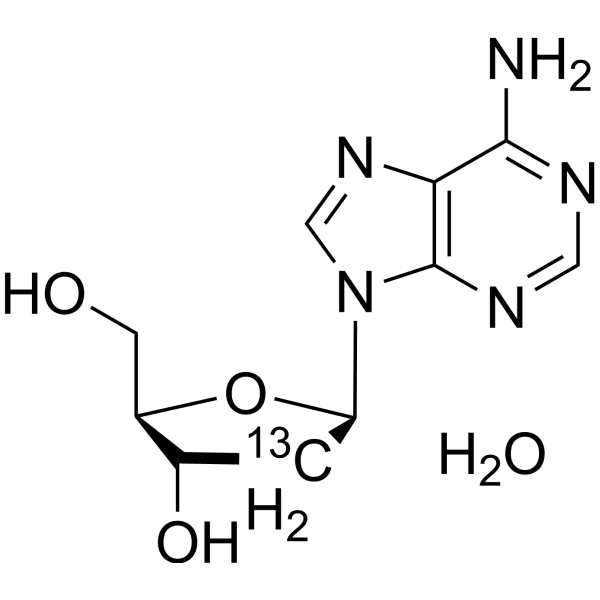
2'-Deoxyadenosine monohydrate-2′- 13C is the 13C labeled 2'-Deoxyadenosine monohydrate(HY-W011683) . 2′-Deoxyadenosine monohydrate is an adenine nucleoside that inhibits glucose-stimulated insulin release. 2′-Deoxyadenosine monohydrate inhibits glucose-stimulated increases seen in islet cyclic AMP (cAMP) accumulation. 2'-Deoxyadenosine monohydrate activates caspase-3 and promotes apoptosis. 2'-Deoxyadenosine monohydrate inhibits the activity of S-adenosyl-L-homocysteine hydrolase (SAHH). 2'-Deoxyadenosine monohydrate inhibits the growth of various cells. 2'-Deoxyadenosine monohydrate has an anticancer effect on colon cancer .
loading...
    loading...
Cat. No.: HY-W011683S3
CAS No.: 478510-77-9
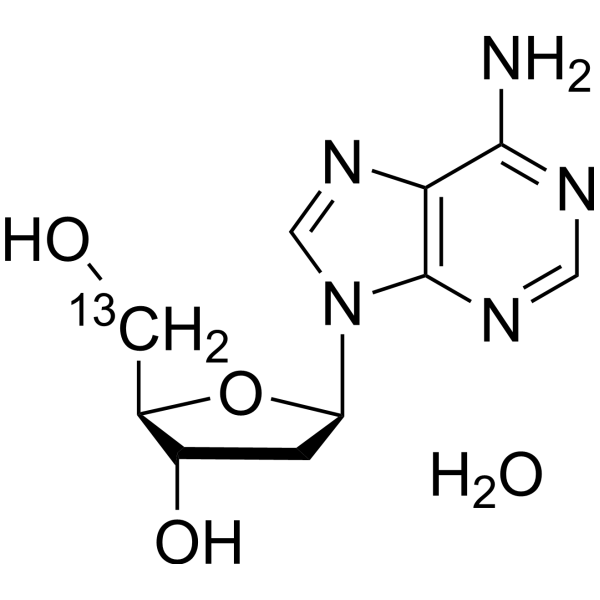
2'-Deoxyadenosine monohydrate-5′- 13C is the 13C labeled 2'-Deoxyadenosine monohydrate (HY-W011683) . 2′-Deoxyadenosine monohydrate is an adenine nucleoside that inhibits glucose-stimulated insulin release. 2′-Deoxyadenosine monohydrate inhibits glucose-stimulated increases seen in islet cyclic AMP (cAMP) accumulation. 2'-Deoxyadenosine monohydrate activates caspase-3 and promotes apoptosis. 2'-Deoxyadenosine monohydrate inhibits the activity of S-adenosyl-L-homocysteine hydrolase (SAHH). 2'-Deoxyadenosine monohydrate inhibits the growth of various cells. 2'-Deoxyadenosine monohydrate has an anticancer effect on colon cancer .
loading...
    loading...
Cat. No.: HY-W011683S7
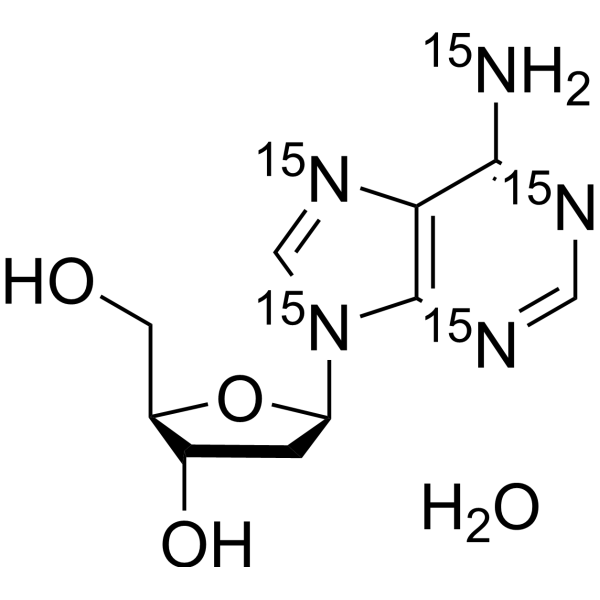
2'-Deoxyadenosine monohydrate- 15N5 is the 15N labeled 2'-Deoxyadenosine monohydrate (HY-W011683) . 2′-Deoxyadenosine monohydrate is an adenine nucleoside that inhibits glucose-stimulated insulin release. 2′-Deoxyadenosine monohydrate inhibits glucose-stimulated increases seen in islet cyclic AMP (cAMP) accumulation. 2'-Deoxyadenosine monohydrate activates caspase-3 and promotes apoptosis. 2'-Deoxyadenosine monohydrate inhibits the activity of S-adenosyl-L-homocysteine hydrolase (SAHH). 2'-Deoxyadenosine monohydrate inhibits the growth of various cells. 2'-Deoxyadenosine monohydrate has an anticancer effect on colon cancer .
loading...
    loading...
Cat. No.: HY-W040329R
CAS No.: 958-09-8
2'-Deoxyadenosine (Standard) is the analytical standard of 2'-Deoxyadenosine (HY-W040329). This product is intended for research and analytical applications. 2′-Deoxyadenosine is an adenine nucleoside that inhibits glucose-stimulated insulin release. 2′-Deoxyadenosine inhibits glucose-stimulated increases seen in islet cyclic AMP (cAMP) accumulation. 2'-Deoxyadenosine activates caspase-3 and promotes apoptosis. 2'-Deoxyadenosine inhibits the activity of S-adenosyl-L-homocysteine hydrolase (SAHH). 2'-Deoxyadenosine inhibits the growth of various cells. 2'-Deoxyadenosine has an anticancer effect on colon cancer .
loading...
    loading...
Cat. No.: HY-W040329S1
2'-Deoxyadenosine- 13C10 is 13C-labeled 2'-Deoxyadenosine (HY-W040329) . 2′-Deoxyadenosine is an adenine nucleoside that inhibits glucose-stimulated insulin release. 2′-Deoxyadenosine inhibits glucose-stimulated increases seen in islet cyclic AMP (cAMP) accumulation. 2'-Deoxyadenosine activates caspase-3 and promotes apoptosis. 2'-Deoxyadenosine inhibits the activity of S-adenosyl-L-homocysteine hydrolase (SAHH). 2'-Deoxyadenosine inhibits the growth of various cells. 2'-Deoxyadenosine has an anticancer effect on colon cancer .
loading...
    loading...
Cat. No.: HY-W745905
CAS No.: 106568-85-8
2'-Deoxyadenosine- 15N1 is the 15N-labeled 2'-Deoxyadenosine (HY-W040329). 2′-Deoxyadenosine is an adenine nucleoside that inhibits glucose-stimulated insulin release. 2′-Deoxyadenosine inhibits glucose-stimulated increases seen in islet cyclic AMP (cAMP) accumulation. 2'-Deoxyadenosine activates caspase-3 and promotes apoptosis. 2'-Deoxyadenosine inhibits the activity of S-adenosyl-L-homocysteine hydrolase (SAHH). 2'-Deoxyadenosine inhibits the growth of various cells. 2'-Deoxyadenosine has an anticancer effect on colon cancer .
loading...
    loading...
Cat. No.: HY-L058
1,379 compounds

Glycolysis is a series of metabolic processes by which one molecule of glucose is catabolized to two molecules of pyruvate with a net gain of two ATP. Glycolysis takes place in 10 steps and catalyzed by a series of enzyme, such as hexokinase, Glucose-6-phosphate isomerase, Phosphofructokinase, etc. Glycolysis is used by all cells in the body for energy generation.

Most cancer cells exhibit increased glycolysis and use this metabolic pathway for generation of ATP as a main source of their energy supply. This phenomenon is known as the Warburg effect and is considered as one of the most fundamental metabolic alterations during malignant transformation. Because increased aerobic glycolysis is commonly seen in a wide spectrum of human cancers, development of novel glycolytic inhibitors as a new class of anticancer agents is likely to have broad therapeutic applications.

MCE provides a unique collection of 1,379 glycolysis compounds that mainly target hexokinase, glucokinase, enolase, pyruvate kinase, PDHK, etc. MCE Glycolysis Compound Library is a useful tool for glucose metabolism research and anti-cancer drug discovery.

Cat. No.: HY-112654R
CAS No.: 2183470-12-2
GCN2iB (Standard) is the analytical standard of GCN2iB (HY-112654). This product is intended for research and analytical applications. GCN2iB is an ATP-competitive, selective GCN2 inhibitor with an IC50 of 2.4 nM. GCN2iB inhibits the activation of the GCN2 pathway and upregulates GPX4. GCN2iB enhances the anticancer effect of ASNase against acute lymphoblastic leukemia. GCN2iB increases left ventricular ejection fraction, while reducing fasting blood glucose and myocardial fibrosis. GCN2iB can be used in research related to acute lymphoblastic leukemia, acute myeloid leukemia and diabetic cardiomyopathy .
loading...
    loading...

