



β-NF-JQ1

Based on 1 Customer Validation
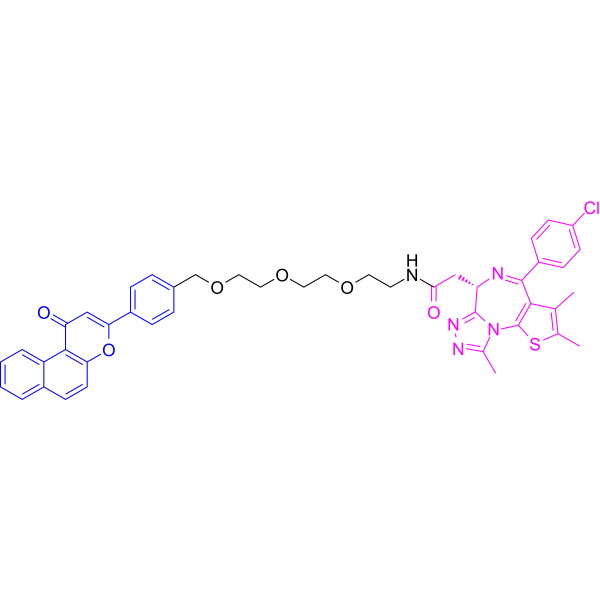
β-NF-JQ1 is a BRD2/3/4 PROTAC degrader. β-NF-JQ1 recruits the AhR E3 ligase complex to BRD2, BRD3 and BRD4, induces AhR-BRD interaction, and mediates AhR-dependent degradation through the proximity effect between the target protein and AhR. β-NF-JQ1 acts as an antiproliferative and cytotoxic agent that induces anticancer activity associated with BRD protein knockdown. β-NF-JQ1 can be used for research on breast cancer and neuroblastoma.
(Pink: BRD4 and BRD2 and BRD3 ligand (HY-78695); Blue: Aryl Hydrocarbon Receptor ligand (HY-114740); Black: linker (HY-176390)).
For research use only. We do not sell to patients.
- Purity : 98.05%
- CAS No.: 2380000-55-3
- Formula: C45H42ClN5O6S
- Molecular Weight:816.36
-
Storage:Powder -20°C, 3 years , 4°C, 2 years ; In solvent -80°C, 6 months , -20°C, 1 month

To place orders, for customer services and technical support, please contact: MedChemExpress USA
Tel: 609-228-6898 E-mail: [email protected] [email protected]


-
 Biological Activity
-
Chemical Information
-
Solvent & Solubility
- Protocols
- Purity & Documentation
- References
-
 Help & FAQs


All PROTACs Isoforms
More

Biological Activity
Description
IC50 & Target
[1]|
BRD4 |
BRD3 |
BRD2 |
In Vitro
β-NF-JQ1 (0.01-30 μM; 24 h) induces concentration-dependent degradation of BRD3, BRD4 and BRD2 proteins in MCF-7 cells, with the strongest effect on BRD3 at the highest concentration of 30 μM[1].
β-NF-JQ1 (30 μM; 6 h, co-treated with 10 μM MG132 (HY-13259)) induces the interaction between AhR and BRD2, BRD4 proteins in MCF-7 cells[1].
β-NF-JQ1 selectively degrades BRD3, but not BRD2 or BRD4, in AhR-negative human neuroblastoma SH-SY5Y cells via an AhR-independent mechanism[2].
β-NF-JQ1 (0.01-30 μM; 72 h) potently inhibits the growth of MCF-7 cells and induces concentration-dependent cytotoxicity[1].
β-NF-JQ1 (0-30 μM; 48 h, following 24 h siRNA transfection) induces growth inhibition in MCF-7 cells, and this effect is dependent on AhR[1].
β-NF-JQ1 (3-30 μM; 48 h) induces apoptosis in MCF-7 cells, which is confirmed by the cleavage of caspase-7, PARP and lamin B1, accompanied by the degradation of BRD4, BRD2, BRD3 and c-Myc proteins[1].
MedChemExpress (MCE) has not independently confirmed the accuracy of these methods. They are for reference only. Further protocols information, click here.
-
Cell Line:human breast carcinoma MCF-7 cells
-
Concentration:0.01, 0.03, 0.1, 0.3, 1, 3, 10, 30 μM
-
Incubation Time:24 h
-
Result:Reduced BRD3 protein levels in a concentration-dependent manner, with normalized BRD3/actin ratios decreasing from 100 (vehicle control) to 31 at 30 μM.
Reduced BRD4 protein levels at higher concentrations, with a normalized BRD4/actin ratio of 24 at 30 μM.
Reduced BRD2 protein levels at the highest concentration, with a normalized BRD2/actin ratio of 36 at 30 μM.
Caused initial slight decreases followed by increases in AhR protein levels at intermediate concentrations, then a decrease to a normalized AhR/actin ratio of 60 at 30 μM.
-
Cell Line:human breast carcinoma MCF-7 cells
-
Concentration:0, 1, 10, 30 μM
-
Incubation Time:8 h (following 42 h siRNA transfection)
-
Result:Reduced BRD3/actin ratios to 22 at 30 μM, BRD4/actin ratios to 38 at 30 μM, and BRD2/actin ratios to 33 at 30 μM in control siRNA-transfected cells.
Significantly abrogated β-NF-JQ1-induced degradation of BRD3, BRD4, and BRD2 in AhR-depleted cells (si-AhR#1, si-AhR#2), with normalized protein levels remaining close to control values at all tested concentrations.
-
Cell Line:human breast carcinoma MCF-7 cells
-
Concentration:0.01, 0.03, 0.1, 0.3, 1, 10, 30 μM
-
Incubation Time:72 h
-
Result:Inhibited MCF-7 cell growth in a concentration-dependent manner, with cell growth reduced to ~10% at 30 μM.
Showed significantly greater antiproliferative activity than a mixture of β-NF and (+)-JQ1 at concentrations above 1 μM.
-
Cell Line:human breast carcinoma MCF-7 cells
-
Concentration:0.01, 0.03, 0.1, 0.3, 1, 10, 30 μM
-
Incubation Time:72 h
-
Result:Induced MCF-7 cell death in a concentration-dependent manner, with cell death reaching ~17% at 30 μM.
Showed significantly greater cytotoxic activity than a mixture of β-NF and (+)-JQ1 at concentrations above 1 μM.
-
Cell Line:human breast carcinoma MCF-7 cells
-
Concentration:3, 10, 30 μM
-
Incubation Time:48 h
-
Result:Induced cleavage of caspase-7, PARP, and lamin B1 in a concentration-dependent manner, with increased cleavage observed at 10 and 30 μM.
Reduced protein levels of BRD4, BRD2, BRD3, and c-Myc at 3, 10, and 30 μM, whereas a mixture of β-NF and (+)-JQ1 showed minimal effects on these proteins or apoptosis markers.
-
Cell Line:human breast carcinoma MCF-7 cells
-
Concentration:0, 0.03, 1, 3, 10, 30 μM
-
Incubation Time:48 h (following 24 h siRNA transfection)
-
Result:Inhibited cell growth to ~30% at 30 μM in control siRNA-transfected cells.
Significantly suppressed β-NF-JQ1-induced growth inhibition in AhR-depleted cells (si-AhR#1, si-AhR#2), with cell growth remaining at ~45-50% at 30 μM.


Chemical Information
-
CAS No. 2380000-55-3
-
Appearance Solid
-
Molecular Weight 816.36
-
Formula C45H42ClN5O6S
-
Color Off-white to light yellow
-
SMILES
O=C(NCCOCCOCCOCC1=CC=C(C2=CC(C3=C(O2)C=CC4=CC=CC=C34)=O)C=C1)C[C@H]5C6=NN=C(C)N6C7=C(C(C)=C(C)S7)C(C8=CC=C(Cl)C=C8)=N5
-
Shipping
Room temperature in continental US; may vary elsewhere.
-
Storage
Powder -20°C 3 years 4°C 2 years In solvent -80°C 6 months -20°C 1 month


Solvent & Solubility
In Vitro:
DMSO : 100 mg/mL (122.49 mM; Need ultrasonic; Hygroscopic DMSO has a significant impact on the solubility of product, please use newly opened DMSO)
Please refer to the solubility information to select the appropriate solvent. Once prepared, please aliquot and store the solution to prevent product inactivation from repeated freeze-thaw cycles.
Storage method and period of stock solution: -80°C, 6 months; -20°C, 1 month. When stored at -80°C, please use it within 6 months. When stored at -20°C, please use it within 1 month.
Please refer to the solubility information to select the appropriate solvent. Once prepared, please aliquot and store the solution to prevent product inactivation from repeated freeze-thaw cycles.
Storage method and period of stock solution: -80°C, 6 months; -20°C, 1 month. When stored at -80°C, please use it within 6 months. When stored at -20°C, please use it within 1 month.
Concentration (start) × Volume (start) = Concentration (final) × Volume (final)
In Vivo:
Select the appropriate dissolution method based on your experimental animal and administration route.
- For the following dissolution methods, please ensure to first prepare a clear stock solution using an In Vitro approach and then sequentially add co-solvents:
- To ensure reliable experimental results, the clarified stock solution can be appropriately stored based on storage conditions. As for the working solution for In Vivo experiments, it is recommended to prepare freshly and use it on the same day.
- The percentages shown for the solvents indicate their volumetric ratio in the final prepared solution. If precipitation or phase separation occurs during preparation, heat and/or sonication can be used to aid dissolution.
In Vivo Dissolution Calculator
Please enter the basic information of animal experiments:
-
-
-
-
Recommended: Prepare an additional quantity of animals to account for potential losses during experiments.
Please enter your animal formula composition:
-
%DMSO +
Recommended: Keep the proportion of DMSO in working solution below 2% if your animal is weak.
-
%+
-
+%Tween-80 + +
-
%Saline +
The co-solvents required include: DMSO, . All of co-solvents are available by MedChemExpress (MCE). , Tween 80. All of co-solvents are available by MedChemExpress (MCE).
Working solution concentration: 0.22 mg/mL
Method for preparing stock solution: mg drug dissolved in μL DMSO. Stock solution concentration: mg/mL.
1. Take μL DMSO stock solution;
2. Add μL .
μL , mix evenly;
3. Then add μL Tween 80, mix evenly;
4. Then add μL
Please ensure that the stock solution in the first step is dissolved to a clear state, and add co-solvents in sequence. You can use ultrasonic heating (ultrasonic cleaner, recommended frequency 20-40 kHz), vortexing, etc. to assist dissolution.

Protocols
-
RNA interference technology
RNA interference (RNAi) is a cellular mechanism that inhibits gene expression by suppressing gene transcription or activating RNA degradation. This mechanism was discovered in plants in 1998 by Andrew Fire and Craig Mello. Today, this phenomenon can be observed in almost all eukaryotes, including protozoa, flies, nematodes, insects, parasites, and mammals.
-
Breast Cancer Modeling
Breast cancer is a heterogeneous cancer, and it has been distinguished into four subtypes: luminal A, luminal B, HER2-positive and basal-like. Molecular mutations, epigenetic alterations, hormone exposure and immune microenvironment are related to the progression of breast cancer.
-
Cell Viability Determination by MTT Colorimetric Assay
The following protocol uses the MTT colorimetric assay as a classic literature-established method for assessing cell viability/metabolic activity in cultured mammalian cells. MTT[3-(4,5-dimethylthiazol-2-yl)-2,5-diphenyltetrazolium bromide] is reduced by metabolically active cells to a colored formazan product; the amount of formazan is quantified spectrophotometrically and provides an indirect measure of metabolically active viable cells. Importantly, MTT reduction reflects cellular oxidoreductase/metabolic activity rather than an absolute direct count of living cells, so changes in cellular metabolism can alter the signal independently of cell number.


Purity & Documentation
-
Data Sheet (278 KB)
-
SDS (254 KB)
- English - EN (254 KB)
- Français - FR (254 KB)
- Deutsch - DE (254 KB)
- Norwegian - NO (254 KB)
- Español - ES (254 KB)
- Swedish - SV (254 KB)
- Italian - IT (254 KB)
- Korean - KR (254 KB)
- Portuguese - PT (254 KB)
-
Handling Instructions (2659 KB)
References
[1]. Ohoka N, et al. Development of Small Molecule Chimeras That Recruit AhR E3 Ligase to Target Proteins. ACS chemical biology. 2019 Dec 20;14(12):2822-2832. [Content Brief]
[2]. Shoda T, et al. Targeted Protein Degradation by Chimeric Compounds using Hydrophobic E3 Ligands and Adamantane Moiety. Pharmaceuticals (Basel, Switzerland). 2020 Feb 25;13(3):34. [Content Brief]


Complete Stock Solution Preparation Table
Please refer to the solubility information to select the appropriate solvent. Once prepared, please aliquot and store the solution to prevent product inactivation from repeated freeze-thaw cycles.
Storage method and period of stock solution: -80°C, 6 months; -20°C, 1 month. When stored at -80°C, please use it within 6 months. When stored at -20°C, please use it within 1 month.
| Optional Solvent | Concentration Solvent Mass | 1 mg | 5 mg | 10 mg | 25 mg |
|---|---|---|---|---|---|
| DMSO | 1 mM | 1.2249 mL | 6.1247 mL | 12.2495 mL | 30.6237 mL |
| 5 mM | 0.2450 mL | 1.2249 mL | 2.4499 mL | 6.1247 mL | |
| 10 mM | 0.1225 mL | 0.6125 mL | 1.2249 mL | 3.0624 mL | |
| 15 mM | 0.0817 mL | 0.4083 mL | 0.8166 mL | 2.0416 mL | |
| 20 mM | 0.0612 mL | 0.3062 mL | 0.6125 mL | 1.5312 mL | |
| 25 mM | 0.0490 mL | 0.2450 mL | 0.4900 mL | 1.2249 mL | |
| 30 mM | 0.0408 mL | 0.2042 mL | 0.4083 mL | 1.0208 mL | |
| 40 mM | 0.0306 mL | 0.1531 mL | 0.3062 mL | 0.7656 mL | |
| 50 mM | 0.0245 mL | 0.1225 mL | 0.2450 mL | 0.6125 mL | |
| 60 mM | 0.0204 mL | 0.1021 mL | 0.2042 mL | 0.5104 mL | |
| 80 mM | 0.0153 mL | 0.0766 mL | 0.1531 mL | 0.3828 mL | |
| 100 mM | 0.0122 mL | 0.0612 mL | 0.1225 mL | 0.3062 mL |


β-NF-JQ1 Related Classifications
HY-130256 Related Classifications
 Powered by Bioz