320 Results for "

Complete

" in MedChemExpress (MCE) Product Catalog:
Products (320)

320 Results for "Complete" in MCE Product Catalog:

Cat. No.: HY-DY1069
CAS No.: 1393363-07-9
Cy3 NHS ester (solution) is a CY dye. CY, short for Cyanine, is a compound consisting of two nitrogen atoms connected by an odd number of methyl units. Cyanine compounds have the characteristics of long wavelength, adjustable absorption and emission, high extinction coefficient, good water solubility and relatively simple synthesis . CY dyes are of en used for the labeling of proteins, antibodies and small molecular compounds. For the labeling of protein antibodies, the combination can be completed through a simple mixing reaction. Below, we introduce the labeling method of protein antibody labeling, which has certain reference significance .
Solvent and concentration: DMSO: 10 mM
loading...
    loading...
Cat. No.: HY-DY1119
CAS No.: 186205-37-8
Target:  

Fluorescent Dye

Research Areas:  

Others

Cy2 Iodide (solution) is a CY dye. CY, short for Cyanine, is a compound consisting of two nitrogen atoms connected by an odd number of methyl units. Cyanine compounds have the characteristics of long wavelength, adjustable absorption and emission, high extinction coefficient, good water solubility and relatively simple synthesis . CY dyes are of en used for the labeling of proteins, antibodies and small molecular compounds. For the labeling of protein antibodies, the combination can be completed through a simple mixing reaction. Below, we introduce the labeling method of protein antibody labeling, which has certain reference significance .
Solvent and concentration: DMSO: 10 mM
loading...
    loading...
Cat. No.: HY-P2996B
CAS No.: 9029-27-0
Target:  

Others

Research Areas:  

Others

Nitrate Reductase (NAD[P]H), Pichia pastoris (recombinant) is a simplified version of nitrate reductase S-NaR1 expressed and purified by Pichia pastoris. Nitrate Reductase (NAD[P]H), Pichia Pastoris (recombinant) contains sites binding molybdenum-molybdenopyridine (Mo-MPT) and nitrate reduction active sites and only contains two domains instead of the five domains of the complete NaR. This simplified form of nitrate reductase was expressed in high density in P. pastoris and purified to homogeneity in one step by fixed metal affinity chromatography (IMAC). Nitrate Reductase (NAD[P]H), Pichia Pastoris (recombinant) can be used in the development of biosensors and environmental monitoring .
loading...
    loading...
Cat. No.: HY-Y0912
CAS No.: 94790-37-1
Synonyms: N-HBTU
Research Areas:  

Inflammation/Immunology

HBTU (N-HBTU) is a guanidinium-based peptide coupling reagent and immunological sensitizer. HBTU can be used in combination with bases such as DIPEA (HY-130142) to complete coupling reactions, with HOBt and TMU as by-products. HBTU is a standard reagent in automated solid-phase peptide synthesis, particularly for the Fmoc/tBu strategy, which effectively promotes coupling steps, but it is not suitable for sterically hindered amino acids or dipeptide derivatives. HBTU can induce rhinitis, dermatitis, bronchial asthma and severe allergic reactions. HBTU can be used to study the pathogenesis of allergic reactions, occupational rhinitis, allergic contact dermatitis and bronchial asthma .
loading...
    loading...
Cat. No.: HY-116142
CAS No.: 138047-56-0
Target:  

iGluR

Research Areas:  

Neurological Disease

CP-283097 is an orally active and conformationally restricted and NR2B subtype-selective NMDA antagonist. CP-283097 efficiently competitively inhibits the binding of [³H]CP-101,606 to the rat meninges, with an IC50 value of 18 nM. CP-283097 exhibits nearly complete inhibition of the current mediated by the NR2B receptor (IC50 = 206 nM), while the inhibitory effect on the NR2A or NR2C receptors is very weak. CP-283097 demonstrates excellent central nervous system permeability and in vivo efficacy in animal models. CP-283097 can be used for neurological diseases related to excessive activation of NMDA receptors .
loading...
    loading...
Cat. No.: HY-145720
CAS No.: 1639264-46-2
Synonyms: ALN-CC5
Cemdisiran (ALN-CC5) is an N-acetylgalactosamine-conjugated RNAi agent and also a complement component C5 inhibitor. Cemdisiran targets C5 mRNA, cleaves C5 mRNA via the endogenous RNA interference pathway, and inhibits the production of C5 protein in the liver. Cemdisiran exerts a dose-dependent inhibitory effect on total C5 concentrations in cynomolgus monkeys. When used in combination with Pozelimab (HY-P99786) in cynomolgus monkeys, Cemdisiran achieves a more sustained and complete inhibitory effect on complement activity. Cemdisiran can be used in the research of paroxysmal nocturnal hemoglobinuria and other complement-mediated diseases .
loading...
    loading...
Cat. No.: HY-145720A
Purity:  96.02%
Synonyms: ALN-CC5 sodium
Cemdisiran sodium (ALN-CC5 sodium) is an N-acetylgalactosamine-conjugated RNAi agent and also a complement component C5 inhibitor. Cemdisiran sodium targets C5 mRNA, cleaves C5 mRNA via the endogenous RNA interference pathway, and inhibits the production of C5 protein in the liver. Cemdisiran sodium exerts a dose-dependent inhibitory effect on total C5 concentrations in cynomolgus monkeys. When used in combination with Pozelimab (HY-P99786) in cynomolgus monkeys, Cemdisiran sodium achieves a more sustained and complete inhibitory effect on complement activity. Cemdisiran sodium can be used in the research of paroxysmal nocturnal hemoglobinuria and other complement-mediated diseases .
loading...
    loading...
Cat. No.: HY-183596
CAS No.: 2941355-21-9
Target:  

Drug Intermediate

Research Areas:  

Cancer

L-His-BPA is a prodrug of L-p-Boronophenylalanine (L-BPA) (HY-W087830), formed by the peptide bond linkage of L-histidine (L-His) (HY-N0832) and L-BPA. L-His-BPA is rapidly cleaved by endogenous proteases to de novo release L-BPA in the systemic circulation. When used in combination with neutron irradiation, L-His-BPA induces complete and durable tumor regression, elicits cancer vaccine responses, and produces abscopal inhibitory effects on unirradiated distant tumors. L-His-BPA can be used in studies of boron neutron capture therapy (BNCT) for relapsed/advanced solid tumors .
loading...
    loading...
Cat. No.: HY-P10775A
Target:  

MMP

Research Areas:  

Cancer

BT1769 acetate is a conjugate and antitumor agent targeting MT1-MMP, with a Kd value of 3.35 nM against human targets. BT1769 acetate exhibits favorable pharmacokinetic properties. BT1769 acetate specifically binds to MT1-MMP via its bicyclic peptide component, delivering the cytotoxic agent MMAE (HY-15162) to antigen-expressing cells. It effectively inhibits tumor growth, induces complete responses, and significantly prolongs event-free survival in osteosarcoma patient-derived xenograft models. BT1769 acetate shows extremely low activity in Ewing sarcoma models and can be used in osteosarcoma-related research .
loading...
    loading...
Cat. No.: HY-P992032
Synonyms: BAY-943 antibody

Target:  

Interleukin Related

Research Areas:  

Cancer

TPP-9476 (BAY-943 antibody) is an anti-human IL3RA (CD123) monoclonal antibody with human IL3RA Kd of 11 nM and cynomolgus monkey IL3RA Kd of 16 nM. TPP-9476 binds specifically to human and cynomolgus monkey IL3RA, undergoes target-dependent internalization into lysosomes of IL3RA-positive cells.TPP-9476 exerts antiproliferative effects in IL3RA-expressing acute myeloid leukemia and classical Hodgkin lymphoma cells, reduces tumor burden, improves survival, and induces complete tumor remission in relevant xenograft mouse models .
loading...
    loading...
Cat. No.: HY-161183
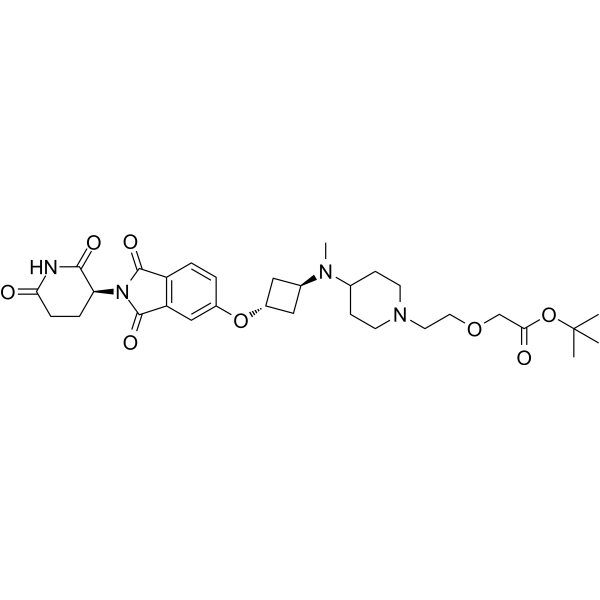
(S)-Thalidomide-O-(1S,3r)-C4H4-N(Me)-Pip-C2-O-C-boc is a conjugate of E3 ligase ligand and linker, consisting of Thalidomide (HY-14658) and the corresponding Linker. (S)-Thalidomide-O-(1S,3r)-C4H4-N(Me)-Pip-C2-O-C-boc can serve as a Cereblon ligand to recruit CRBN protein and serve as a key intermediate for the synthesis of complete PROTAC molecules.
loading...
    loading...
Cat. No.: HY-163226
(1R,5S)-Thalidomide-3,8-diazabicyclo[3.2.1]octane-(1R,4r)-cyclohexane-NH-Boc is a conjugate of E3 ligase ligand and linker, consisting of Thalidomide (HY-14658) and the corresponding Linker. (1R,5S)-Thalidomide-3,8-diazabicyclo[3.2.1]octane-(1R,4r)-cyclohexane-NH-Boc can serve as Cereblon ligand to recruit CRBN protein and serve as a key intermediate for the synthesis of complete PROTAC molecules.
loading...
    loading...
Cat. No.: HY-163227
(1R,4R)-Thalidomide-2,5-diazabicyclo[2.2.1]heptane-(1R,4r)-cyclohexane-NH-Boc is a conjugate of E3 ligase ligand and linker, consisting of Thalidomide (HY-14658) and the corresponding Linker. (1R,4R)-Thalidomide-2,5-diazabicyclo[2.2.1]heptane-(1R,4r)-cyclohexane-NH-Boc can serve as a Cereblon ligand to recruit CRBN protein and serve as a key intermediate for the synthesis of complete PROTAC molecules.
loading...
    loading...
Cat. No.: HY-163705
Target:  

PROTACs FGFR

Research Areas:  

Cancer

BR-cpd7 is an orally active, selective PROTAC degrader targeting FGFR1 and FGFR2, with a DC50 of 2.2 nM against FGFR1. BR-cpd7 reduces FGFR signaling. BR-cpd7 induces cell cycle arrest and selectively blocks the proliferation of FGFR1/FGFR2-dependent tumor cells. BR-cpd7 exhibits significant antitumor efficacy in FGFR1-dependent lung cancer animal models, while achieving complete depletion of FGFR1. BR-cpd7 can be used for cancer-related research .
loading...
    loading...
Cat. No.: HY-168282
CAS No.: 3047066-15-6
Research Areas:  

Cancer

DD205-291 is a selective, orally active HPK1 PROTAC degrader with a DC50 of 8.8 nM. By inducing complete degradation of HPK1 protein, DD205-291 simultaneously blocks both its kinase-dependent functions and non-kinase scaffold functions. DD205-291 inhibits the phosphorylation of SLP-76 with an EC50 of 22.98 nM. DD205-291 induces the production of IL-2 and IFN-γ with EC50 values of 34.68 nM and 32.6 nM, respectively. Combined with anti-PD1 in mouse models, DD205-291 exerts tumor-suppressive effects with favorable safety profiles. DD205-291 can be used in colon cancer-related research .
loading...
    loading...
Cat. No.: HY-178238
CAS No.: 3040077-52-6
Research Areas:  

Cancer

LD2-3 is a cytotoxic compound derived from Exatecan (HY-13631), designed to be conjugated with anti-FGFR2b or anti-CEA antibodies to form intact antibody-drug conjugate (ADC) molecules. LD2-3 exhibits a remarkable bystander killing effect: it not only effectively kills FGFR2b-positive tumor cells, but also eliminates surrounding FGFR2b-negative cells in co-culture and mixed tumor xenograft models, thereby inducing complete tumor regression. LD2-3 can be used for anti-tumor research in relevant fields such as gastric cancer and lung cancer .
loading...
    loading...
Cat. No.: HY-179404
CAS No.: 2966924-24-1
Target:  

Ras

Research Areas:  

Cancer

KRASG12C IN-18 is an orally active covalent KRAS G12C inhibitor that achieves complete covalent engagement of KRAS G12C in both GDP- and GMPPNP-bound states and displays strong antiproliferative activity against KRAS G12C and resistance-associated variants, including KRAS G12C/R68S, with low-nanomolar IC50 values. KRASG12C IN-18 exhibits marked in vivo efficacy in KRAS G12C-driven solid tumor and KRAS G12C/R68S xenograft models and can be used for colorectal cancer research .
loading...
    loading...
Cat. No.: HY-180561
CAS No.: 3076807-15-0
Research Areas:  

Cancer

WWQ-03-012 is a selective DESI2 inhibitor with an IC50 of 47.3 nM. WWQ-03-012 binds covalently to DESI2, blocks its enzymatic activity, and inhibits DESI2-mediated deSUMOylation, deubiquitination and stabilization of mutant JAK2, thereby promoting the complete degradation of mutant JAK2 via the intracellular ubiquitin-proteasome system and inducing apoptosis, while exerting no significant effect on wild-type JAK2. WWQ-03-012 can be used for research on myeloproliferative neoplasms (MPN) and secondary acute myeloid leukemia (sAML), especially for hematological malignancies carrying the JAK2-V617F mutation and those resistant to Ruxolitinib (HY-50856) .
loading...
    loading...
Cat. No.: HY-183253
DL149 is a component of an antibody-drug conjugate (ADC) formed by conjugating the eIF4A inhibitor FD236 (HY-186186) with an ADC linker, and exhibits potential antitumor activity. DL149 can bind to an anti-HER2 antibody to form a complete ADC molecule, which precisely binds to the HER2 receptor on the surface of tumor cells. After internalization into cells, it releases the eIF4A inhibitor payload. DL149 irreversibly blocks the mRNA translation process in tumor cells, thereby inhibiting tumor cell proliferation and inducing their death. DL149 exhibits in vivo antitumor activity in the SK-OV-3 xenograft tumor model, and can be used for the research of HER2-positive solid tumors .
loading...
    loading...
Cat. No.: HY-P0037
CAS No.: 136208-71-4
Synonyms: Org 30850ANT
Target:  

GnRH Receptor

Research Areas:  

Endocrinology

Org-30850 is a potent LHRH antagonist designed for treating hormone-dependent disorders. In animal studies, a single subcutaneous dose effectively inhibited ovulation in rats and significantly reduced testosterone levels in male rats for up to 48 hours post-administration. Daily doses of Org-30850 in female rats suppressed estrous cycles, decreased uterine and ovarian weights, and lowered estradiol and FSH serum levels. In male rats, prolonged treatment resulted in reversible reductions in gonadal function and testosterone levels, with almost complete recovery observed after cessation of treatment. Unlike comparable LHRH antagonists, Org-30850 exhibited minimal injection site irritation and no edematous reactions, suggesting a more favorable therapeutic profile .
loading...
    loading...