
63 Results for "

solution structure

" in MedChemExpress (MCE) Product Catalog:
Products (63)

63 Results for "solution structure" in MCE Product Catalog:

Cat. No.: HY-DY1059
CAS No.: 149838-22-2
FM1-43 (solution) is a very lipophilic, water-soluble styrene dyes, can specifically bind to cell membranes and inner membrane organelles to produce fluorescence. FM1-43 is widely used in endocytic and exospic membrane structure markers.
Solvent and concentration: DMSO: 10 mM
loading...
    loading...
Cat. No.: HY-D1056C5
Synonyms: LPS, from Salmonella enterica (Serotype minnesota Re 595 (Re mutant))
Lipopolysaccharides (LPS), from S. enterica (Salmonella enterica) serotype minnesota Re 595 (Re mutant) is prepared from Salmonella enterica strain Re 595 (Re mutant). The structure in the LPS of strain Re 595 was shown to induce secretion and aggregation in human platelets .
It is recommended to prepare a solution with concentration ≥2 mg/mL. Vortex thoroughly for more than 10 minutes. Due to the adsorption characteristics of LPS, silanized container or low adsorption centrifuge tubes should be used for aliquoting and storage, and mix thoroughly before use.
loading...
    loading...
Cat. No.: HY-D1056A4
Synonyms: LPS, from Escherichia coli (O128:B12)
Lipopolysaccharides, from E. coli O128:B12 (LPS, from Escherichia coli (O128:B12)) are endotoxins and TLR4 activators extracted from Escherichia coli (E. coli O128:B12) and are classified as S (smooth) type LPS. Lipopolysaccharides, from E. coli O128:B12 possess the typical three-part structure: O-antigen, R3-type core oligosaccharide, and lipid A. Lipopolysaccharides, from E. coli O128:B12 activate TLR-4 in immune cells, can be used to construct animal models of neonatal brain inflammation, and may influence preterm birth in neonates .
It is recommended to prepare a solution with concentration ≥2 mg/mL. Vortex thoroughly for more than 10 minutes. Due to the adsorption characteristics of LPS, silanized container or low adsorption centrifuge tubes should be used for aliquoting and storage, and mix thoroughly before use.
loading...
    loading...
Cat. No.: HY-145973A
Purity:  ≥99.0%
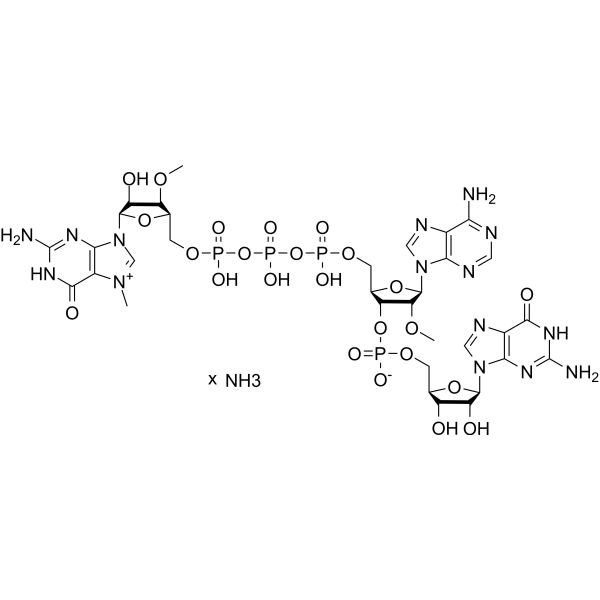
Synonyms: m7(3'OMeG)(5')ppp(5')(2'OMeA)pG ammonium solution (100 mM)
3’OMe-m7GpppAmpG (m7(3'OMeG)(5')ppp(5')(2'OMeA)pG) ammonium solution (100 mM) is a trinucleotide Cap1 analog with the structure m7 (3'OMeG)(5') ppp (5')(2'OMeA) pG, and also functions as a cis-acting ligase ribozyme inhibitor. 3’OMe-m7GpppAmpG ammonium solution (100 mM) effectively reduces free 5'-triphosphate groups on RNA transcripts, thereby enabling efficient co-transcriptional capping of in vitro transcribed mRNA. 3’OMe-m7GpppAmpG ammonium solution (100 mM) is not only widely used in the preparation of modified mRNA including trivalent influenza vaccine candidates, but also applicable to studies related to SARS-CoV-2 infection and other relevant research .
loading...
    loading...
Cat. No.: HY-D1056B4
Synonyms: LPS, from bacterial (Salmonella typhosa)
Lipopolysaccharides, from Salmonella typhosa are lipopolysaccharide endotoxins and TLR-4 activators derived from Salmonella typhosa, classified as S-type LPS, which can activate pathogen-associated molecular patterns (PAMP) of the immune system and induce cellular secretion of migrasomes. Lipopolysaccharides, from Salmonella typhosa exhibit a typical three-part structure: O-antigen, core oligosaccharide, and lipid A. Lipopolysaccharides, from Salmonella typhosa can serve as vaccine adjuvants and demonstrate adjuvant activity targeting B cells in immune responses in vivo .
It is recommended to prepare a solution with concentration ≥2 mg/mL. Vortex thoroughly for more than 10 minutes. Due to the adsorption characteristics of LPS, silanized container or low adsorption centrifuge tubes should be used for aliquoting and storage, and mix thoroughly before use.
loading...
    loading...
Cat. No.: HY-158772
Purity:  99.6%
Target:  

DNA/RNA Synthesis

Research Areas:  

Others

m7G(5')ppp(5')(2'OMeA)pU (ammonium) solution (100 mM) is a trinucleotide cap analog with a Cap1 structure. m7G(5')ppp(5')(2'OMeA)pU (ammonium) solution (100 mM) can be co-transcriptionally incorporated into the 5' end of mRNA during T7 RNA polymerase-mediated in vitro transcription to form a natural Cap1 cap structure. m7G(5')ppp(5')(2'OMeA)pU (ammonium) solution (100 mM) enhances mRNA translation efficiency and reduces innate immune recognition, and it has been used in the preparation of self-amplifying mRNA rabies vaccines. m7G(5')ppp(5')(2'OMeA)pU (ammonium) solution (100 mM) can be applied to research related to in vitro mRNA transcription and mRNA vaccines .
loading...
    loading...
Cat. No.: HY-W250145
CAS No.: 8005-03-6
Synonyms: Nigrosine
Research Areas:  

Others

Acid Black 2 (Nigrosine) is an alcohol-soluble absorber used to mimic skin pigmentation in tissue-mimicking phantoms. Acid Black 2 acts as an absorber in silicone-based thin tissue phantoms to simulate varying melanosome volume fractions in skin. Acid Black 2 can be used as a component of Eosin-Nigrosin Sperm Viability Staining Solution (HY-DY2022) to assess sperm viability and identify the integrity of the membrane structure and function of inactive sperm .
loading...
    loading...
Cat. No.: HY-D1056C3
Synonyms: LPS, from Salmonella enterica (Serotype typhimurium)
Lipopolysaccharides, from S. enterica (Salmonella enterica) serotype typhimurium are lipopolysaccharide endotoxins and TLR4 activators derived from serotype typhimurium of Salmonella enterica, and are classified as S-type LPS. Lipopolysaccharides, from S. enterica exhibit a typical three-part structure: O-antigen, core oligosaccharide, and lipid A. Lipopolysaccharides, from S. enterica serotype typhimurium can modulate the fate of bacteria in dendritic cells (DC), determining the uptake, degradation, and activation of immune functions by DC cells against the bacteria .
It is recommended to prepare a solution with concentration ≥2 mg/mL. Vortex thoroughly for more than 10 minutes. Due to the adsorption characteristics of LPS, silanized container or low adsorption centrifuge tubes should be used for aliquoting and storage, and mix thoroughly before use.
loading...
    loading...
Cat. No.: HY-D1056C1
Synonyms: LPS, from Salmonella enterica (Serotype enteritidis)
Lipopolysaccharides, from S. enterica (Salmonella enterica) serotype enteritidis are lipopolysaccharide endotoxins and TLR-4 activators derived from the enteritidis serotype of S. enterica, classified as S-type LPS, which can activate pathogen-associated molecular patterns (PAMP) of the immune system and induce cellular secretion of migrasomes. Lipopolysaccharides, from S. enterica serotype enteritidis exhibit a typical three-part structure: O-antigen, core oligosaccharide, and lipid A. Lipopolysaccharides, from S. enterica serotype enteritidis can induce systemic inflammatory responses, increasing levels of TNF-α, IFN-γ, IL-6, IL-10, and nitrate in plasma .
It is recommended to prepare a solution with concentration ≥2 mg/mL. Vortex thoroughly for more than 10 minutes. Due to the adsorption characteristics of LPS, silanized container or low adsorption centrifuge tubes should be used for aliquoting and storage, and mix thoroughly before use.
loading...
    loading...
Cat. No.: HY-21170E
CAS No.: 54010-75-2
Synonyms: Zinc(II) Triflate
Research Areas:  

Others

Zinc trifluoromethanesulfonate (Zinc (II) Triflate) is a Zn 2+ salt commonly used in potentiometric titration to determine the stability constants of Zn 2+-quinoline sulfonamide complexes. Aqueous solutions of Zinc trifluoromethanesulfonate form micellar structures, which result in poor desolvation kinetics of Zn 2+ and induce dendrite growth on zinc anodes, failing to support long-term cycling of zinc anodes .
loading...
    loading...
Cat. No.: HY-D1056B2
Synonyms: LPS, from bacterial (Proteus mirabilis)
Lipopolysaccharides, from Proteus mirabilis are lipopolysaccharide endotoxins and TLR-4 activators derived from Proteus mirabilis, classified as S-type LPS, which can activate pathogen-associated molecular patterns (PAMP) of the immune system and induce cellular secretion of migrasomes. Lipopolysaccharides, from Proteus mirabilis exhibit a typical three-part structure: O-antigen, core oligosaccharide, and lipid A. Proteus mirabilis is a major pathogen causing urinary tract infections and may also contribute to rheumatoid arthritis. Lipopolysaccharides, from Proteus mirabilis also exhibit potential anti-tumor effects, demonstrating in vivo inhibitory activity against solid tumors such as meningosarcoma and Walker carcinosarcoma .
It is recommended to prepare a solution with concentration ≥2 mg/mL. Vortex thoroughly for more than 10 minutes. Due to the adsorption characteristics of LPS, silanized container or low adsorption centrifuge tubes should be used for aliquoting and storage, and mix thoroughly before use.
loading...
    loading...
Cat. No.: HY-156198
CAS No.: 15005-62-6
Bottromycin A2 is a natural antibiotic. Bottromycin A2 is active against methicillin-resistant Staphylococcus aureus (MRSA) and vancomycin-resistant Enterococci (VRE) .
loading...
    loading...
Cat. No.: HY-142981
CAS No.: 112-99-2
Synonyms: DODA
Target:  

Liposome

Research Areas:  

Others

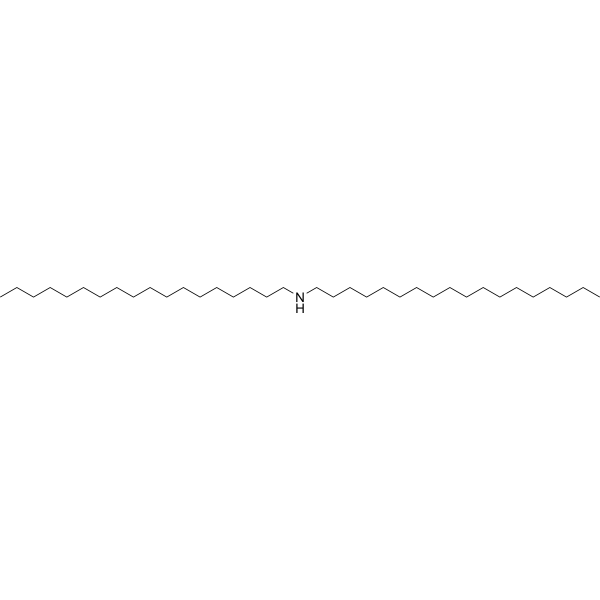
Dioctadecylamine (DODA) is a secondary amine that has been shown to self-organize in plate-like structures in aqueous solution. Dioctadecylamine exhibits sufficiently hydrophobic properties of nanoparticles and good dispersibility in nonpolar solvent. Dioctadecylamine does not form a monolayer above pH 3.9 .
loading...
    loading...
Cat. No.: HY-W011425B
NTP 25 mM Solution, PCR Grade is a mixed solution composed of 25 mM ATP (HY-B2176), 25 mM CTP (HY-125818), 25 mM GTP (HY-113225) and 25 mM UTP (HY-107372), free of DNase, RNase, phosphatase and protease. NTP 25 mM Solution, PCR Grade serves as an energy substrate and raw material for nucleic acid synthesis (DNA/RNA), and can also regulate the advanced structure of DNA to turn transcription on or off .
loading...
    loading...
Cat. No.: HY-118365
CAS No.: 106410-13-3
Target:  

RUNX

Research Areas:  

Infection Cancer

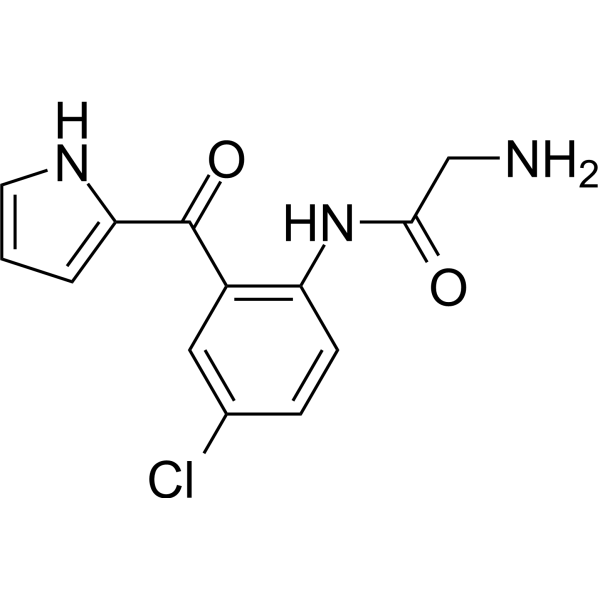
NSC 140873 is an inhibitor of the RUNX1-CBFβ interaction. NSC 140873 can be used for research of viral infection and leukemia. NSC 140873 has an unstable structure and can be converted spontaneously in solution to a benzodiazepine (Ro5-3335) .
loading...
    loading...
Cat. No.: HY-D1056A5
Synonyms: LPS, from Escherichia coli (K-235)
Lipopolysaccharides, from E. coli (Escherichia coli) K-235 are lipopolysaccharide endotoxins and TLR-4 activators derived from E. coli, classified as S-type LPS, which can activate pathogen-associated molecular patterns (PAMP) of the immune system and induce cellular secretion of migrasomes. Lipopolysaccharides, from E. coli K-235 exhibit a typical three-part structure: O-antigen (O-antigen), core oligosaccharide (core oligosaccharide), and lipid A (Lipid A). Lipopolysaccharides, from E. coli K-235 have a mitogenic effect on C57BL/10ScN spleen cells. Additionally, LPS purified using butanol and deoxycholic acid methods stimulates spleen cells in C57BL/10ScCR and C3H/HeJ mice .
It is recommended to prepare a solution with concentration ≥2 mg/mL. Vortex thoroughly for more than 10 minutes. Due to the adsorption characteristics of LPS, silanized container or low adsorption centrifuge tubes should be used for aliquoting and storage, and mix thoroughly before use.
loading...
    loading...
Cat. No.: HY-D1056B1
Synonyms: LPS, from bacterial (Proteus vulgaris)
Lipopolysaccharides, from Proteus vulgaris are lipopolysaccharide endotoxins and TLR-4 activators derived from Proteus vulgaris, classified as S-type LPS, which can activate pathogen-associated molecular patterns (PAMP) of the immune system and induce cellular secretion of migrasomes. Lipopolysaccharides, from Proteus vulgaris exhibit a typical three-part structure: O-antigen, core oligosaccharide, and lipid A. Lipopolysaccharides, from Proteus vulgaris possess a unique molecular structure and chitosan affinity (Kb=2.72 μM), surpassing that of Yersinia pseudotuberculosis (Kb=6.06 μM) and Escherichia coli (Kb=79.50 μM) .
It is recommended to prepare a solution with concentration ≥2 mg/mL. Vortex thoroughly for more than 10 minutes. Due to the adsorption characteristics of LPS, silanized container or low adsorption centrifuge tubes should be used for aliquoting and storage, and mix thoroughly before use.
loading...
    loading...
Cat. No.: HY-121120
CAS No.: 77900-75-5
Isosulfazecin (iSZ) is a novel β-lactam antibiotic produced by Pseudomonas acidophilus sp., synthesized in a nutrient solution supplemented with glycerol and sodium thiosulfate under aerobic conditions in parallel with bacterial growth. It is purified by chromatography and crystallization from aqueous methanol. Physicochemical analysis determined its molecular formula to be C12H20N4O9S, showing a structure with a β-lactam ring, methoxyl and sulfonate groups. Acid hydrolysis yields L-alanine and D-glutamic acid. iSZ is a diastereomer of sulfadiazine and exhibits moderate activity against both gram-positive and gram-negative bacteria, but potent activity against bacteria resistant to β-lactam antibiotics .
loading...
    loading...
Cat. No.: HY-DY2038
Target:  

Fluorescent Dye

Research Areas:  

Infection

Lignin Staining Solution (Pianeze Method) is a multichromatic staining solution for plant histology composed of malachite green, Martius yellow and acid fuchsin. Lignin Staining Solution (Pianeze Method) enables lignified secondary walls to appear bright green, non-lignified secondary walls to appear red, and tracheid pit membranes to appear pale red after long-time immersion. Lignin Staining Solution (Pianeze Method) can be used to distinguish lignified cell walls from non-lignified structures and observe the morphology of pit membranes in plant tissue sections such as fern rhizomes. Lignin Staining Solution (Pianeze Method) can be applied to relevant studies on flax wilt and root rot .
loading...
    loading...
Cat. No.: HY-DY2032
Research Areas:  

Others

Methyl Green Staining Solution (Chloroform-Extracted, 1%) is a basic dye stock solution with differential nucleic acid binding activity that distinguishes double-stranded DNA from RNA, and it can be used for assays related to nucleic acid distribution and DNA localization. Methyl Green Staining Solution (Chloroform-Extracted, 1%) functions by competitively binding to the phosphate groups of nucleic acids and stably binds to intact double-stranded DNA; RNA within the oocyte-specific ribonucleoprotein complex specifically binds to this dye, and RNase completely blocks this binding reaction. The nucleic acid recognition of Methyl Green Staining Solution (Chloroform-Extracted, 1%) depends on the size of the dye cation and the intact double-helical structure of DNA .
loading...
    loading...

