4900 Results for "

Conjugates

" in MedChemExpress (MCE) Product Catalog:
Products (4900)

4900 Results for "Conjugates" in MCE Product Catalog:

Cat. No.: HY-148140C
CAS No.: 9041-35-4
Research Areas:  

Others

Cross-linked dextran G 25, fine is a cross-linked dextran gel chromatography fine (average particle size D50 = 70-90 μm) that possesses multiple separation activities, including molecular sieve effects, weak anion exchange, and aromatic adsorption. Cross-linked dextran G 25, fine weakly exchanges cations through immobilized terminal carboxyl groups and repels anions at low ionic strength. Cross-linked dextran G 25, fine is used for the fractionation of low molecular weight solutes, including peptides, amino acids, nucleotide sugar derivatives, and aromatic compounds .
loading...
    loading...
Cat. No.: HY-187336
CAS No.: 3087291-80-0
Target:  

NAMPT

Research Areas:  

Cancer

Nampt-IN-22 is a nicotinamide phosphoribosyltransferase (NAMPT) inhibitor. Nampt-IN-22 blocks the NAD + salvage synthesis pathway by inhibiting nicotinamide phosphoribosyltransferase (NAMPT). Its tertiary alcohol forms hydrogen bonds with His191 of NAMPT and enhances lysosomal stability via intramolecular hydrogen bonds. As an ADC payload, Nampt-IN-22 exhibits low nanomolar cytotoxicity against tumor cells after conjugation to an anti-CD30 antibody, prolongs survival in a disseminated L540 Hodgkin lymphoma mouse model, and suppresses subcutaneous tumor growth. Nampt-IN-22 can be used in studies related to Hodgkin lymphoma .
loading...
    loading...
Cat. No.: HY-123715
CAS No.: 1983924-20-4
Target:  

Apoptosis

Research Areas:  

Cancer

Anticancer agent 255 is a monocarbonylated curcumin-1,2,3-oxazole conjugate with significant anticancer activity. The IC50 values of Anticancer agent 255 in prostate cancer cells PC-3 and DU-145 are 8.8μM and 9.5μM respectively. The IC50 values of Anticancer agent 255 against breast cancer cells MCF-7, MDA-MB-231 and 4T1 are 6μM, 10μM and 6.4μM, showing good anti-cancer activity Effect. Anticancer agent 255 can induce mitochondria-mediated apoptosis in cancer cells and prevent cell cycle progression. Anticancer agent 255 down-regulated the cell proliferation marker PCNA and inhibited the activation of cell survival proteins. Anticancer agent 255 up-regulated the pro-apoptotic protein Bax and down-regulated the anti-apoptotic protein Bcl-2 .
loading...
    loading...
Cat. No.: HY-131027
Purity:  99.87%
Synonyms: JF646, Azide
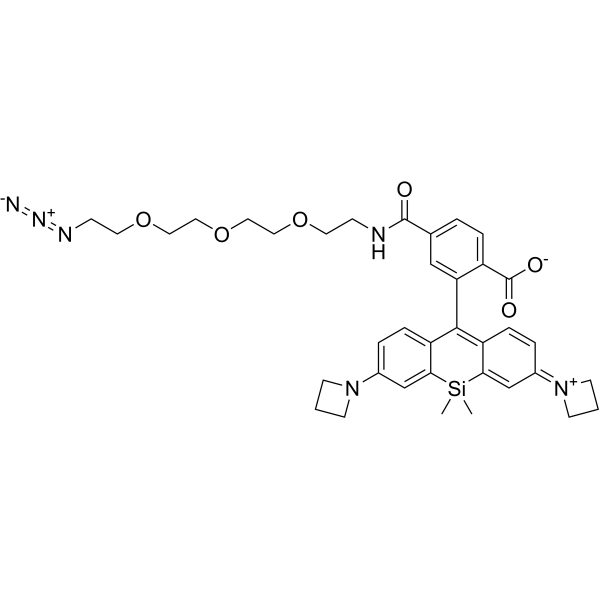
Janelia Fluor 646, Azide (JF646, Azide) is a red fluorogenic fluorescent dye containing a click chemistry group Azide. Janelia Fluor 646, Azide can be used for live-cell imaging experiments . Janelia Fluor fluorescent dyes can be chemically conjugated to the specific HaloTag substrate (a chloroalkane ligand) to form a fluorescent ligand, rather than binding directly to the HaloTag protein itself. Janelia Fluor products are licensed under U.S. Pat. Nos. 9,933,417, 10,018,624 and 10,161,932 and other patents from Howard Hughes Medical Institute. Janelia Fluor 646, Azide is a click chemistry reagent, it contains an Azide group and can undergo copper-catalyzed azide-alkyne cycloaddition reaction (CuAAc) with molecules containing Alkyne groups. It can also undergo strain-promoted alkyne-azide cycloaddition (SPAAC) reactions with molecules containing DBCO or BCN groups (Ex/Em = 646/664 nm).
loading...
    loading...
Cat. No.: HY-174870
PROTAC ERα Degrader-11 is a selective and intrinsically fluorescent (Ex: 366 nm, Em: 440 nm) ERα PROTAC degrader. PROTAC ERα Degrader-11 shows good antiproliferative activity, selective ERα degradation and imaging capabilities in MCF-7 breast cancer cell lines. PROTAC ERα Degrader-11 induces G2/M phase arrest and induces apoptosis in MCF-7 cells. PROTAC ERα Degrader-11 is well-tolerated up to a dose of 500 mg/ kg with no acute toxicity in athymic nude mice. PROTAC ERα Degrader-11 can be used for the study of breast cancer.(Pink: ERα ligand (HY-167701), Blue: CRBN Ligand (HY-150831), Black: Linker, E3 ligase ligand-linker conjugate (HY-174880)) .
loading...
    loading...
Cat. No.: HY-187243
Synonyms: DMG-PEG1000-Cys-SRNLIDC
Research Areas:  

Cancer

DMG-PEG1000-LyP-1 (DMG-PEG1000-Cys-SRNLIDC) is a functionalized PEGylated lipid conjugate composed of three modular components: dimyristoylglycerol (DMG) as the lipid anchoring group, PEG, and LyP-1 peptide (CGNKRTRGC) (HY-P2526) as the terminal targeting/functional ligand. LyP-1 is a cyclic 9-amino acid peptide that specifically binds to p32/gC1qR protein, which is highly expressed on tumor-associated macrophages, lymphatic endothelial cells, and certain tumor cells. DMG-PEG1000-LyP-1 can be incorporated into liposomes, lipid nanoparticles (LNPs), or other nanocarriers to confer ligand-directed targeting capability against p32/gC1qR protein on the surface of lymphatic vessels, tumor-associated macrophages, and tumor cells.
loading...
    loading...
Cat. No.: HY-187243A
Synonyms: DMG-PEG2000-Cys-SRNLIDC
Research Areas:  

Cancer

DMG-PEG2000-LyP-1 (DMG-PEG2000-Cys-SRNLIDC) is a functionalized PEGylated lipid conjugate composed of three modular components: dimyristoylglycerol (DMG) as the lipid anchoring group, PEG, and LyP-1 peptide (CGNKRTRGC) (HY-P2526) as the terminal targeting/functional ligand. LyP-1 is a cyclic 9-amino acid peptide that specifically binds to p32/gC1qR protein, which is highly expressed on tumor-associated macrophages, lymphatic endothelial cells, and certain tumor cells. DMG-PEG2000-LyP-1 can be incorporated into liposomes, lipid nanoparticles (LNPs), or other nanocarriers to confer ligand-directed targeting capability against p32/gC1qR protein on the surface of lymphatic vessels, tumor-associated macrophages, and tumor cells.
loading...
    loading...
Cat. No.: HY-187243B
Synonyms: DMG-PEG3400-Cys-SRNLIDC
Research Areas:  

Cancer

DMG-PEG3400-LyP-1 (DMG-PEG3400-Cys-SRNLIDC) is a functionalized PEGylated lipid conjugate composed of three modular components: dimyristoylglycerol (DMG) as the lipid anchoring group, PEG, and LyP-1 peptide (CGNKRTRGC) (HY-P2526) as the terminal targeting/functional ligand. LyP-1 is a cyclic 9-amino acid peptide that specifically binds to p32/gC1qR protein, which is highly expressed on tumor-associated macrophages, lymphatic endothelial cells, and certain tumor cells. DMG-PEG3400-LyP-1 can be incorporated into liposomes, lipid nanoparticles (LNPs), or other nanocarriers to confer ligand-directed targeting capability against p32/gC1qR protein on the surface of lymphatic vessels, tumor-associated macrophages, and tumor cells.
loading...
    loading...
Cat. No.: HY-187243C
Synonyms: DMG-PEG5000-Cys-SRNLIDC
Research Areas:  

Cancer

DMG-PEG5000-LyP-1 (DMG-PEG5000-Cys-SRNLIDC) is a functionalized PEGylated lipid conjugate composed of three modular components: dimyristoylglycerol (DMG) as the lipid anchoring group, PEG, and LyP-1 peptide (CGNKRTRGC) (HY-P2526) as the terminal targeting/functional ligand. LyP-1 is a cyclic 9-amino acid peptide that specifically binds to p32/gC1qR protein, which is highly expressed on tumor-associated macrophages, lymphatic endothelial cells, and certain tumor cells. DMG-PEG5000-LyP-1 can be incorporated into liposomes, lipid nanoparticles (LNPs), or other nanocarriers to confer ligand-directed targeting capability against p32/gC1qR protein on the surface of lymphatic vessels, tumor-associated macrophages, and tumor cells.
loading...
    loading...
Cat. No.: HY-187318
Synonyms: DOPE-PEG1000-Cys-SRNLIDC
Research Areas:  

Cancer

DOPE-PEG1000-LyP-1 (DOPE-PEG1000-Cys-SRNLIDC) is a functionalized PEGylated lipid conjugate composed of three modular components: dioleoylphosphatidylethanolamine (DOPE) as the lipid anchoring group, PEG, and LyP-1 peptide (CGNKRTRGC) (HY-P2526) as the terminal targeting/functional ligand. LyP-1 is a cyclic 9-amino acid peptide that specifically binds to p32/gC1qR protein, which is highly expressed on tumor-associated macrophages, lymphatic endothelial cells, and certain tumor cells. DOPE-PEG1000-LyP-1 can be incorporated into liposomes, lipid nanoparticles (LNPs), or other nanocarriers to confer ligand-directed targeting capability against p32/gC1qR protein on the surface of lymphatic vessels, tumor-associated macrophages, and tumor cells.
loading...
    loading...
Cat. No.: HY-187318A
Synonyms: DOPE-PEG2000-Cys-SRNLIDC
Research Areas:  

Cancer

DOPE-PEG2000-LyP-1 (DOPE-PEG2000-Cys-SRNLIDC) is a functionalized PEGylated lipid conjugate composed of three modular components: dioleoylphosphatidylethanolamine (DOPE) as the lipid anchoring group, PEG, and LyP-1 peptide (CGNKRTRGC) (HY-P2526) as the terminal targeting/functional ligand. LyP-1 is a cyclic 9-amino acid peptide that specifically binds to p32/gC1qR protein, which is highly expressed on tumor-associated macrophages, lymphatic endothelial cells, and certain tumor cells. DOPE-PEG2000-LyP-1 can be incorporated into liposomes, lipid nanoparticles (LNPs), or other nanocarriers to confer ligand-directed targeting capability against p32/gC1qR protein on the surface of lymphatic vessels, tumor-associated macrophages, and tumor cells.
loading...
    loading...
Cat. No.: HY-187318B
Synonyms: DOPE-PEG3400-Cys-SRNLIDC
Research Areas:  

Cancer

DOPE-PEG3400-LyP-1 (DOPE-PEG3400-Cys-SRNLIDC) is a functionalized PEGylated lipid conjugate composed of three modular components: dioleoylphosphatidylethanolamine (DOPE) as the lipid anchoring group, PEG, and LyP-1 peptide (CGNKRTRGC) (HY-P2526) as the terminal targeting/functional ligand. LyP-1 is a cyclic 9-amino acid peptide that specifically binds to p32/gC1qR protein, which is highly expressed on tumor-associated macrophages, lymphatic endothelial cells, and certain tumor cells. DOPE-PEG3400-LyP-1 can be incorporated into liposomes, lipid nanoparticles (LNPs), or other nanocarriers to confer ligand-directed targeting capability against p32/gC1qR protein on the surface of lymphatic vessels, tumor-associated macrophages, and tumor cells.
loading...
    loading...
Cat. No.: HY-187318C
Synonyms: DOPE-PEG5000-Cys-SRNLIDC
Research Areas:  

Cancer

DOPE-PEG5000-LyP-1 (DOPE-PEG5000-Cys-SRNLIDC) is a functionalized PEGylated lipid conjugate composed of three modular components: dioleoylphosphatidylethanolamine (DOPE) as the lipid anchoring group, PEG, and LyP-1 peptide (CGNKRTRGC) (HY-P2526) as the terminal targeting/functional ligand. LyP-1 is a cyclic 9-amino acid peptide that specifically binds to p32/gC1qR protein, which is highly expressed on tumor-associated macrophages, lymphatic endothelial cells, and certain tumor cells. DOPE-PEG5000-LyP-1 can be incorporated into liposomes, lipid nanoparticles (LNPs), or other nanocarriers to confer ligand-directed targeting capability against p32/gC1qR protein on the surface of lymphatic vessels, tumor-associated macrophages, and tumor cells.
loading...
    loading...
Cat. No.: HY-187361
CAS No.: 3107740-33-7
Target:  

PROTACs HIV

Research Areas:  

Infection

PROTAC HIV-1 degrader-1 is a HIV-1 capsid (CA) PROTAC degrader, with a DC50 of 3 nM against HIV-1IIIB (MT‑4 cells) and a DC50 of 1.17 nM against HIV-1NL4-3 (MT‑4 cells). PROTAC HIV-1 degrader-1 conjugates HIV-1 capsid (CA) with the VHL E3 ubiquitin ligase, triggering polyubiquitination and proteasome-mediated degradation of CA, as well as competitively inhibiting the binding of host factors CPSF6 and Sec24C to CA. PROTAC HIV-1 degrader-1 degrades CA drug-resistant mutants (N74D, K70R). PROTAC HIV-1 degrader-1 is applicable to research related to HIV-1 infection .
loading...
    loading...
Cat. No.: HY-D2747
CAS No.: 1638784-10-7
BP Fluor 405 acid is a water-soluble, blue-fluorescent dye that is often used in multi-color applications, including flow cytometry and super-resolution microscopy using STORM. Its excitation is ideally suited for the 407 nm spectral line of the krypton laser or the 408 nm violet laser diode. BP Fluor 405 conjugates are pH-insensitive from pH 4 to pH 10. The carboxylic acid of BP Fluor 405 is a reagent of choice for the preparation of custom activated esters that often are not commercially available. Examples of such activated esters include sulfo-NHS, TFP (2,3,5,6-Tetrafluorophenol), and STP (4-Sulfo-2,3,5,6-Tetrafluorophenol, Sodium Salt). Another common application for the non-activated carboxylic acid is peptide modification during solid phase synthesis, which usually requires in-situ activation with peptide coupling regents, e.g. HATU. BP Fluor 405 acid is also often used for control experiments, and for calibration.
loading...
    loading...
Cat. No.: HY-P11698
CAS No.: 476667-31-9
Research Areas:  

Cancer

Guanidino-G-Clamp-PNA is a highly efficient sequence-specific RNA binder and gene silencer. Guanidino-G-Clamp-PNA precisely targets such targets as miR-155 or transthyretin (TTR) mRNA through base pairing: the former regulates tumor-related signaling pathways by reducing microRNA activity, while the latter inhibits the translation of harmful proteins via steric hindrance. Guanidino-G-Clamp-PNA effectively stabilizes DNA/RNA duplexes, induces cancer cell apoptosis, and suppresses tumor growth. In addition, Guanidino-G-Clamp-PNA can be conjugated with targeting ligands to improve tissue-specific delivery and reduce in vivo adverse reactions, and it can also enhance the splicing regulation efficacy of other oligonucleotide platforms (such as PMO) when integrated into them. Guanidino-G-Clamp-PNA is applicable to the research of various diseases including diffuse large B-cell lymphoma and hereditary transthyretin-related amyloidosis .
loading...
    loading...
Cat. No.: HY-P4087
CAS No.: 1417221-06-7
Target:  

HIV

Research Areas:  

Infection Cancer

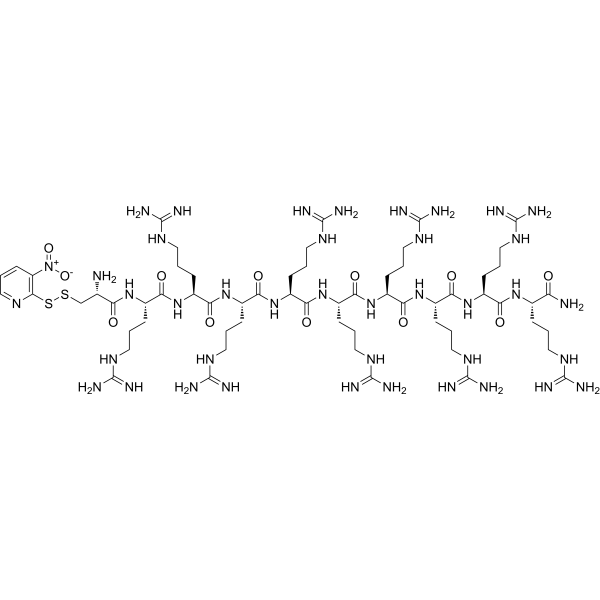
Cys(Npys)-(Arg)9 is a synthetic cationic cell-penetrating peptide with a reversible thiol-reactive nitropyridyl (Npys) group. Cys(Npys)-(Arg)9 efficiently mediates the internalization and delivery of various "cargo" such as proteins and antibodies by forming reversible disulfide bonds with surface-exposed cysteine residues. Cys(Npys)-(Arg)9 endows TALEN proteins with cell-penetrating activity, enabling gene knockout in mammalian cells and protein transduction in wheat microspores. Cys(Npys)-(Arg)9 can be conjugated with antibodies to form cationized IgG for enhancing endosomal escape of oligonucleotides, or form siRNA delivery complexes. When the molar ratio of Cys(Npys)-(Arg)9 to loaded molecules is higher than 1:1, it exerts certain cytotoxic effects on cells. Cys(Npys)-(Arg)9 can be used in studies related to oral squamous cell carcinoma and HIV infection .
loading...
    loading...
Cat. No.: HY-P4087B
Target:  

HIV

Research Areas:  

Others

Cys(Npys)-(Arg)9 acetate is a synthetic cationic cell-penetrating peptide with a reversible thiol-reactive nitropyridyl (Npys) group. Cys(Npys)-(Arg)9 acetate efficiently mediates the internalization and delivery of various "cargo" such as proteins and antibodies by forming reversible disulfide bonds with surface-exposed cysteine residues. Cys(Npys)-(Arg)9 acetate endows TALEN proteins with cell-penetrating activity, enabling gene knockout in mammalian cells and protein transduction in wheat microspores. Cys(Npys)-(Arg)9 acetate can be conjugated with antibodies to form cationized IgG for enhancing endosomal escape of oligonucleotides, or form siRNA delivery complexes. When the molar ratio of Cys(Npys)-(Arg)9 acetate to loaded molecules is higher than 1:1, it exerts certain cytotoxic effects on cells. Cys(Npys)-(Arg)9 acetate can be used in studies related to oral squamous cell carcinoma and HIV infection .
loading...
    loading...
Cat. No.: HY-L050
507 compounds

Protein ubiquitination is an enzymatic post-translational modification in which an ubiquitin protein is attached to a substrate protein. Ubiquitination involves three main steps: activation, conjugation, and ligation, performed by ubiquitin-activating enzymes (E1s), ubiquitin-conjugating enzymes (E2s), and ubiquitin ligases (E3s), respectively. Ubiquitination affects cellular processes such as apoptosis, cell cycle, DNA damage repair, and membrane transportation, etc. by regulating the degradation of proteins (via the proteasome and lysosome), altering the cellular localization of proteins, affecting proteins activity, and promoting or preventing protein-protein interactions. Deregulation of ubiquitin pathway leads to many diseases such as neurodegeneration, cancer, infection and immunity, etc.

MCE offers a unique collection of 507 small molecule modulators with biological activity used for ubiquitination research. Compounds in this library target the key enzymes in ubiquitin pathway. MCE Ubiquitination Compound Library is a useful tool for the research of ubiquitination regulation and the corresponding diseases.

Cat. No.: HY-W998680
CAS No.: 2228857-33-6
Synonyms: 5-FITC-Maleimide
Fluorescein-maleimide (5-FITC-Maleimide) is a thiol-reactive fluorescent derivatization reagent and non-specific protein labeling reagent. Fluorescein-maleimide covalently binds to protein thiol groups for protein labeling. Fluorescein-maleimide covalently binds to protein amino and imidazole groups under neutral pH conditions. Fluorescein-maleimide is used for fluorescent labeling of proteins, nucleic acids or other molecules containing one or more thiol groups (Ex/Em = 494/519 nm) .
loading...
    loading...

