71 Results for "

brain cortex

" in MedChemExpress (MCE) Product Catalog:
Products (71)

71 Results for "brain cortex" in MCE Product Catalog:

Art. -Nr.: HY-13225H
Synonyms: RJR-2403 hydrochloride; Metanicotine hydrochloride
Target:  

nAChR

Forschungsgebiete:  

Neurological Disease

Rivanicline (RJR-2403) hydrochloride is a neuronal nicotinic receptor agonist. Rivanicline hydrochloride is highly selective for the rat brain cortex nAChRs (Ki = 26 nM, EC50 of 732 nM) and α4β2 subtype (Ki = 26 nM, EC50 = 16 μM). Rivanicline hydrochloride can significantly restore the learning impairment and cognitive dysfunction. Rivanicline hydrochloride can be used for the study of neurodegenerative diseases (such as schizophrenia or Alzheimer's disease) .
loading...
    loading...
Art. -Nr.: HY-106874B
CAS. Nr.: 119813-87-5
Synonyms: rel-RS-15385-197
Target:  

Adrenergic Receptor

Forschungsgebiete:  

Neurological Disease

rel-Delequamine (rel-RS-15385-197) is an orally active, brain-penetrant, potent and selective M2-adrenoceptor antagonist and α2-adrenoceptor antagonist. rel-Delequamine has a pKi of 9.45 for α2-adrenoceptors in the rat cortex. rel-Delequamine augments K +-evoked release of noradrenaline with an EC50 of 1 nM .
loading...
    loading...
Art. -Nr.: HY-U00033
CAS. Nr.: 127985-21-1
Target:  

Endogenous Metabolite

Forschungsgebiete:  

Neurological Disease

Iomazenil is a benzodiazepine receptor antagonist with partial inverse agonist activity. Iomazenil can assess the binding potential of central benzodiazepine receptors in the cerebral cortex and may reflect neuronal function in viable tissue. Iomazenil use is associated with improved cognitive function in adult patients with ischemic cerebral pathology after indirect revascularization surgery. Iomazenil demonstrated restoration of benzodiazepine receptor binding potential in the affected hemisphere after surgery on brain SPECT imaging .
loading...
    loading...
Art. -Nr.: HY-B0416R
CAS. Nr.: 65-29-2
Forschungsgebiete:  

Cardiovascular Disease

Gallamine Triethiodide (Standard) is the analytical standard of Gallamine Triethiodide. This product is intended for research and analytical applications. Gallamine Gallamine Triethiodide is a blood-brain barrier-permeable skeletal muscle relaxant. Gallamine Triethiodide induces skeletal muscle paralysis by blocking acetylcholine. Gallamine Triethiodide directly stimulates intracardiac β receptors. Gallamine Triethiodide prolongs the duration of afterdischarge in the cat cerebral cortex. Gallamine Triethiodide can be used in studies related to convulsive disorders .
loading...
    loading...
Art. -Nr.: HY-178153
CAS. Nr.: 1204572-46-2
Target:  

iGluR

Forschungsgebiete:  

Neurological Disease

BPAM363 is an orally active, selective positive allosteric modulator (PAM) of AMPARs with blood-brain barrier penetration. BPAM363 selectively potentiates AMPAR activity in human and rat models, with an EC2x value of 0.96 μM in rat embryonic cortex primary neurons. BPAM363 upregulates BDNF protein expression in rat primary cortical neuronal cultures. BPAM363 enhances AMPA-mediated excitatory postsynaptic responses in rat and mice. BPAM363 can be used for the study of cognitive disorders .
loading...
    loading...
Art. -Nr.: HY-116062A
CAS. Nr.: 129540-12-1
Forschungsgebiete:  

Neurological Disease

JNJ-7925476 is a triple reuptake inhibitor that selectively and potently inhibits the activity of the serotonin transporter (SERT), norepinephrine transporter (NET), and dopamine transporter (DAT). JNJ-7925476 is rapidly absorbed into the blood and its concentration in the brain is 7-fold higher than that in plasma. The occupancy ED(50) values of JNJ-7925476 for SERT, NET, and DAT in the rat brain are 0.18, 0.09, and 2.4 mg/kg, respectively. JNJ-7925476 rapidly induces a significant increase in the levels of extracellular serotonin, dopamine, and norepinephrine in the rat cerebral cortex in a dose-dependent manner. JNJ-7925476 exhibits potent antidepressant-like activity in the mouse tail suspension test. These results suggest that JNJ-7925476 has in vivo efficacy in biochemical and behavioral models of depression .
loading...
    loading...
Art. -Nr.: HY-16728A
CAS. Nr.: 491872-39-0
Synonyms: GLYX-13 acetate
Target:  

iGluR mTOR ERK

Forschungsgebiete:  

Neurological Disease

Rapastinel (GLYX-13) acetate is a potent NMDAR modulator capable of crossing the blood-brain barrier, and it exhibits extremely high affinity for human NMDAR (EC50=0.0017-9.9 nM). Rapastinel acetate enhances ERK signaling and activates the mTOR pathway, thereby upregulating the expression of BDNF and VGF, and inducing significant neuroplastic changes such as enhanced LTP and increased mature dendritic spine density in the hippocampus. Rapastinel acetate moderately elevates the efflux of dopamine, norepinephrine and 5-HT in the prefrontal cortex, and uniquely avoids side effects of traditional antidepressants such as dissociation, addiction or sedation. Rapastinel acetate is applicable to the research of major depressive disorder and hepatocellular carcinoma .
loading...
    loading...
Art. -Nr.: HY-12193
CAS. Nr.: 556835-30-4
Target:  

Histamine Receptor

Forschungsgebiete:  

Others

A-349821 is a histamine H3 receptor antagonist characterized as a radioligand ([3H]-A-349821) for in vivo receptor occupancy assessment. In rats, [3H]-A-349821 penetrated the brain, showing higher levels in the cortex compared to the cerebellum, indicating selective H3 receptor binding. Its cortical occupancy was saturable, correlating with in vitro binding data. Inhibition studies with ABT-239 and other H3 antagonists showed dose-dependent reductions in receptor occupancy, matching blood levels associated with cognitive efficacy in preclinical models. [3H]-A-349821 thus serves as a valid tracer for H3 receptor occupancy, aiding in the development and clinical interpretation of H3 receptor antagonists .
loading...
    loading...
Art. -Nr.: HY-100834A
CAS. Nr.: 1184986-70-6
Synonyms: 5,7-DCKA sodium
Target:  

iGluR

Forschungsgebiete:  

Neurological Disease

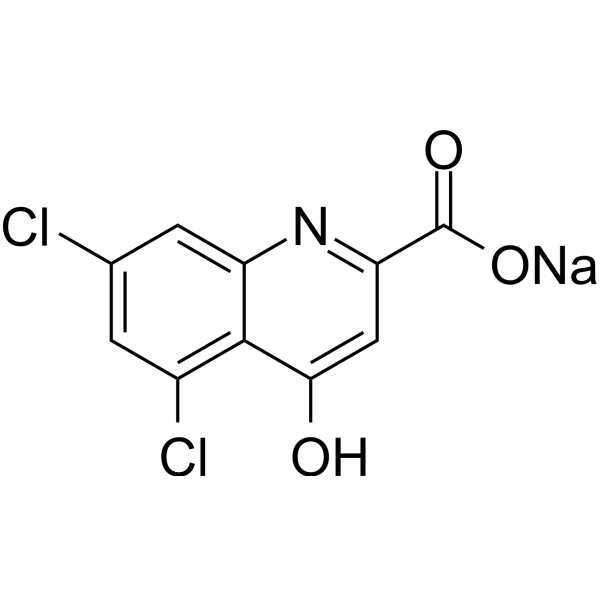
5,7-Dichlorokynurenic acid (5,7-DCKA) sodium is a selective and competitive antagonist of the glycine site on NMDA receptor with a KB of 65 nM. 5,7-Dichlorokynurenic acid sodium reduces NMDA-induced neuron injury. 5,7-Dichlorokynurenic acid sodium increases social interaction time, increases open arm exploration time, disinhibits suppressed conflict responding in rodent models. 5,7-Dichlorokynurenic acid sodium exhibits anxiolytic-like activity in rodent models and supports exploration of glycine’s role in NMDA receptor-mediated synaptic transmission .
loading...
    loading...
Art. -Nr.: HY-183166
CAS. Nr.: 2810056-57-4
Target:  

Cathepsin

Forschungsgebiete:  

Neurological Disease

Z-Arg-Lys-AOMK is a cathepsin B inhibitor that can cross the blood-brain barrier. Z-Arg-Lys-AOMK reduces cytosolic cathepsin B activity in homogenates of mouse cerebral cortex and hippocampal tissues, and alleviates motor dysfunction associated with CCI-TBI. Z-Arg-Lys-AOMK can be used in the research of traumatic brain injury .
loading...
    loading...
Art. -Nr.: HY-183166A
Target:  

Cathepsin

Forschungsgebiete:  

Neurological Disease

Z-Arg-Lys-AOMK diTFA is a cathepsin B inhibitor that can cross the blood-brain barrier. Z-Arg-Lys-AOMK diTFA reduces cytosolic cathepsin B activity in homogenates of mouse cerebral cortex and hippocampal tissues, and alleviates motor dysfunction associated with CCI-TBI. Z-Arg-Lys-AOMK diTFA can be used in the research of traumatic brain injury .
loading...
    loading...
Art. -Nr.: HY-105461
CAS. Nr.: 154619-51-9
Target:  

Cholinesterase (ChE)

Forschungsgebiete:  

Neurological Disease

MF 268 is an orally active, blood-brain barrier-permeable acetylcholinesterase (AChE) inhibitor with an IC50 of 9 nM in rats. MF 268 binds to both the catalytic site and the regulatory anionic site of acetylcholinesterase, and increases the extracellular levels of acetylcholine, norepinephrine, dopamine and serotonin in the rat cortex via a dose-dependent pathway. MF 268 exhibits anti-amnesic effects in rats. MF 268 can be used in research related to Alzheimer's disease .
loading...
    loading...
Art. -Nr.: HY-187088
CAS. Nr.: 1198309-73-7
Target:  

mGluR

Forschungsgebiete:  

Neurological Disease

AZD-8418 is an orally active positive allosteric modulator of metabotropic glutamate receptor 2 (mGluR2), with an EC50 of 0.86 μM for rat mGlu2 receptors. AZD-8418 reduces the in vitro binding level of [ 3H]AZ12559322 in prefrontal cortex brain tissues of non-human primates. AZD8418 enhances the inhibitory effect of the mGlu2/3 agonist DCG-IV (HY-101335) on field excitatory postsynaptic potentials (fEPSP) in rat hippocampal brain slices. AZD-8418 reduces nicotine self-administration behavior in rats, and blocks cue-induced reinstatement of nicotine-seeking and food-seeking behaviors. The attenuating effect on nicotine self-administration behavior develops rapid tolerance, while inhibition of food self-administration behavior requires chronic administration. AZD-8418 can be used in research related to nicotine dependence and neuropsychiatric disorders .
loading...
    loading...
Art. -Nr.: HY-102050R
CAS. Nr.: 1415637-72-7
PF-05085727 (Standard) is the analytical standard of PF-05085727 (HY-102050). This product is intended for research and analytical applications. PF-05085727 is a potent, selective and brain penetrant inhibitor of cGMP-dependent PDE2A (IC50=2 nM). PF-05085727 inhibits PDE2A >4,000-fold selectivity over PDE1 and PDE3-11 .
loading...
    loading...
Art. -Nr.: HY-113203A
CAS. Nr.: 27561-79-1
Target:  

Endogenous Metabolite

Forschungsgebiete:  

Neurological Disease

Putreanine dihydrochloride is an alkaline diamino monocarboxylic acid amino acid that exists exclusively in the central nervous system of mammals and birds. Putreanine dihydrochloride reaches its highest concentration in the caudal region of the brain. Putreanine dihydrochloride appears in the brain tissue of rats 2 weeks after birth, and its concentration gradually increases to adult levels over several months .
loading...
    loading...
Art. -Nr.: HY-13225D
CAS. Nr.: 183288-99-5
Synonyms: RJR-2403 fumarate; (E)-Metanicotine fumarate
Target:  

nAChR

Forschungsgebiete:  

Neurological Disease

Rivanicline (RJR-2403) fumarate is a neuronal nicotinic receptor agonist. Rivanicline fumarate is highly selective for the rat brain cortex nAChRs (Ki = 26 nM, EC50 of 732 nM) and α4β2 subtype (Ki = 26 nM, EC50 = 16 μM). Rivanicline fumarate can significantly restore the learning impairment and cognitive dysfunction. Rivanicline fumarate can be used for the study of neurodegenerative diseases (such as schizophrenia or Alzheimer's disease) .
loading...
    loading...
Art. -Nr.: HY-59201
CAS. Nr.: 848591-89-9
A-582941 is a selective, orally active, blood-brain barrier-permeable α7 nAChR agonist, with Ki values of 10.8 nM and 17 nM in rat brain and human frontal cortex, respectively. A-582941 exhibits agonistic activity at 5-HT3 receptors, with a Ki of 150 nM. A-582941 triggers phosphorylation of ERK1/2 and CREB, inhibits GSK-3β via Ser-9 phosphorylation, increases acetylcholine release, induces the expression of Arc and c-Fos, activates brain regions associated with working memory and attention, and reduces cell death caused by nerve growth factor (NGF) deprivation. A-582941 is applicable for the research of Alzheimer's disease and schizophrenia .
loading...
    loading...
Art. -Nr.: HY-129245
CAS. Nr.: 78466-98-5
Synonyms: Hoe 175
Target:  

Endogenous Metabolite

Forschungsgebiete:  

Neurological Disease

Razobazam (Hoe 175) is a benzodiazepine derivative with cognitive activity. Razobazam has been shown to improve learning performance in socially deprived rats. Razobazam increased avoidance scores by 18% after training. Razobazam caused significant changes in the optical density of certain areas of the rat brain, including a 22% decrease in the lateral habenula and a 25% increase in the ventral tegmental area. Razobazam also caused a 13% increase in optical density in the prefrontal cortex of rats .
loading...
    loading...
Art. -Nr.: HY-182304
CAS. Nr.: 1338489-62-5
CLR01 sodium is a blood-brain barrier-permeable anti-aggregation agent. CLR01 sodium inhibits the de novo aggregation of Amyloid-β 40/42, α-synuclein, IAPP, tau protein and SOD1. CLR01 sodium reduces amyloid plaque burden in the cortex of triple-transgenic mice and improves the memory and motor abilities of these mice. CLR01 sodium can be used in research related to Alzheimer's disease, Parkinson's disease, and amyotrophic lateral sclerosis (ALS) .
loading...
    loading...
Art. -Nr.: HY-184666
CAS. Nr.: 85118-43-0
Synonyms: Sgd 144/8
Target:  

Adrenergic Receptor

Forschungsgebiete:  

Cardiovascular Disease

Fluprofylline (Sgd 144/8) is a selective α1-adrenergic receptor antagonist with a pIC50 of 7.55. Fluprofylline attenuates the pressor response induced by 5-HT (HY-B1473A). Fluprofylline can be used in hypertension research .
loading...
    loading...

