65 Results for "

coefficient

" in MedChemExpress (MCE) Product Catalog:
Products (65)

65 Results for "coefficient" in MCE Product Catalog:

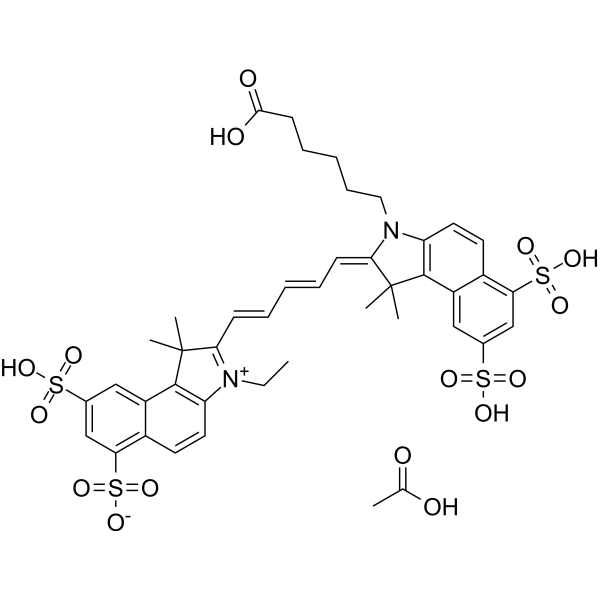
Cat. No.: HY-D0924A
Synonyms: Sulfo-Cyanine5.5 acetate
Cy5.5 acetate is a CY dye. CY, short for Cyanine, is a compound consisting of two nitrogen atoms connected by an odd number of methyl units. Cyanine compounds have the characteristics of long wavelength, adjustable absorption and emission, high extinction coefficient, good water solubility and relatively simple synthesis . CY dyes are of en used for the labeling of proteins, antibodies and small molecular compounds. For the labeling of protein antibodies, the combination can be completed through a simple mixing reaction. Below, we introduce the labeling method of protein antibody labeling, which has certain reference significance .
loading...
    loading...
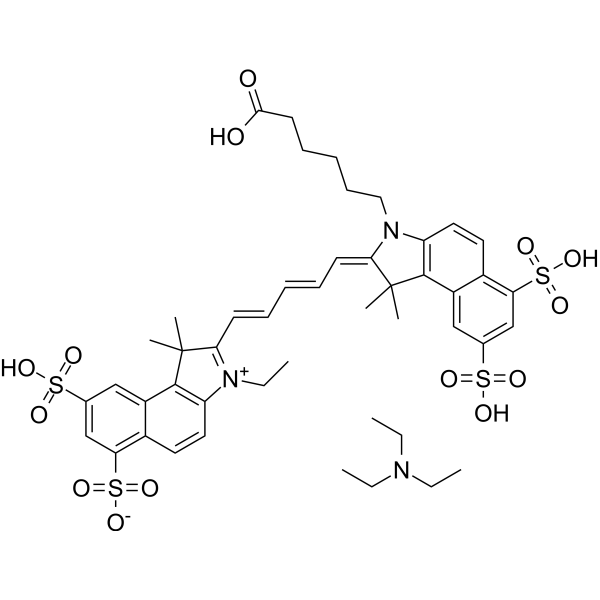
Cat. No.: HY-D0924B
Synonyms: Sulfo-Cyanine5.5 TEA
Cy5.5 TEA is a CY dye. CY, short for Cyanine, is a compound consisting of two nitrogen atoms connected by an odd number of methyl units. Cyanine compounds have the characteristics of long wavelength, adjustable absorption and emission, high extinction coefficient, good water solubility and relatively simple synthesis . CY dyes are of en used for the labeling of proteins, antibodies and small molecular compounds. For the labeling of protein antibodies, the combination can be completed through a simple mixing reaction. Below, we introduce the labeling method of protein antibody labeling, which has certain reference significance .
loading...
    loading...
Cat. No.: HY-112498A
CAS No.: 2892098-34-7
Synonyms: Cyanine3 NHS ester bromide
Target:  

Fluorescent Dye

Research Areas:  

Others

Cy3 NHS ester bromide is a CY dye. CY, short for Cyanine, is a compound consisting of two nitrogen atoms connected by an odd number of methyl units. Cyanine compounds have the characteristics of long wavelength, adjustable absorption and emission, high extinction coefficient, good water solubility and relatively simple synthesis . CY dyes are of en used for the labeling of proteins, antibodies and small molecular compounds. For the labeling of protein antibodies, the combination can be completed through a simple mixing reaction. Below, we introduce the labeling method of protein antibody labeling, which has certain reference significance .
loading...
    loading...
Cat. No.: HY-N15791
CAS No.: 3077081-59-2
Target:  

Fluorescent Dye

Research Areas:  

Others

Cyanine3.5 maleimide chloride is a CY dye. CY, short for Cyanine, is a compound consisting of two nitrogen atoms connected by an odd number of methyl units. Cyanine compounds have the characteristics of long wavelength, adjustable absorption and emission, high extinction coefficient, good water solubility and relatively simple synthesis . CY dyes are of en used for the labeling of proteins, antibodies and small molecular compounds. For the labeling of protein antibodies, the combination can be completed through a simple mixing reaction. Below, we introduce the labeling method of protein antibody labeling, which has certain reference significance .
loading...
    loading...
Cat. No.: HY-N16328
CAS No.: 3091880-03-1
Category:  

Lipids

Target:  

Fluorescent Dye

Cy7.5 maleimide chloride is a CY dye. CY, short for Cyanine, is a compound consisting of two nitrogen atoms connected by an odd number of methyl units. Cyanine compounds have the characteristics of long wavelength, adjustable absorption and emission, high extinction coefficient, good water solubility and relatively simple synthesis . CY dyes are of en used for the labeling of proteins, antibodies and small molecular compounds. For the labeling of protein antibodies, the combination can be completed through a simple mixing reaction. Below, we introduce the labeling method of protein antibody labeling, which has certain reference significance .
loading...
    loading...
Cat. No.: HY-121235R
CAS No.: 17737-65-4
Synonyms: SCH-10304 (Standard)
Clonixin (SCH-10304) (Standard) is the analytical standard of Clonixin. This product is intended for research and analytical applications. Clonixin is an orally active non-steroidal anti-inflammatory agent (NSAID) that inhibits COX synthesis. Clonixin acts as a voltage-gated L-type calcium channel blocker, exerts vasodilatory effects by antagonizing Ca 2+ in vascular smooth muscle. Clonixin inhibits TGF-β, reduces lung coefficient, immune cell infiltration level, oxidative stress response, airway resistance, hydroxyproline content and collagen deposition. Clonixin can be used in research related to inflammation such as idiopathic pulmonary fibrosis and moderate to severe pain .
loading...
    loading...
Cat. No.: HY-34544R
CAS No.: 18794-77-9
Daucosterol (Standard) is the analytical standard of Daucosterol. This product is intended for research and analytical applications. Daucosterol is an orally active natural sterol compound, which has anti-inflammatory, anticancer and immunomodulatory activities. Daucosterol inhibits cancer cell proliferation by inducing autophagy through ROS-dependent manner. Daucosterol also inhibits colon cancer growth by inducing apoptosis, inhibiting cell migration and invasion and targeting caspase signalling pathway .
loading...
    loading...
Cat. No.: HY-N18054
CAS No.: 640281-80-7
Cinnamyl-(6'-O-β-xylopyranosyl)-O-β-glucopyranoside is a phenylpropanoid glycoside found in the roots of Rhodiola rosea .
loading...
    loading...
Cat. No.: HY-L901
50,000 compounds

MCE 50K Diversity Library consists of 50,000 lead-like compounds with multiple characteristics such as calculated good solubility (-3.2 < logP < 5), oral bioavailability (RotB <= 10), drug transportability (PSA < 120). These compounds were selected by dissimilarity search with an average Tanimoto Coefficient of 0.52. There are 36,857 unique scaffolds and each scaffold 1 to 7 compounds. What’s more, compounds with the same scaffold have as many functional groups as possible, which make abundant chemical spaces. This exceptionally diverse library is highly recommended for random screening against new as well as popular targets based its novel, diverse scaffolds, abundant chemical spaces and the convenience for subsequent modification.

Cat. No.: HY-L0121V
10,000 compounds

Natural products are an attractive source with varied structures that exhibit potent biological activities, and desirable pharmacological profiles. The core scaffold of a natural product can also provide a biologically validated framework upon which to display diverse functional groups. Inspired by bioactive natural products, natural product-like compounds, occupying the same chemical space, are ideally suited to explore and to facilitate understanding of biological pathways.

MCE 10K Natural Product-like Compound Library consists of 10,000 natural product-like compounds. Each compound has scaffold of natural products or Tanimoto coefficient >0.6 with natural products. The natural-likeness scoring of these compounds is >-2. What’s more, compounds in the library are drug-like and readily available for re-supply, making it a powerful tool for new drug research and development. It can be widely applied in high-throughput screening (HTS) and high-content screening (HCS).

Cat. No.: HY-L905
4,813 compounds

Natural products are an attractive source with varied structures that exhibit potent biological activities, and desirable pharmacological profiles. The core scaffold of a natural product can also provide a biologically validated framework upon which to display diverse functional groups. Inspired by bioactive natural products, natural product-like compounds, occupying the same chemical space, are ideally suited to explore and to facilitate understanding of biological pathways.

MCE 5K Natural Product-like Compound Library consists of 4,813 natural product-like compounds. Each compound has scaffold of natural products or Tanimoto coefficient >0.6 with natural products. The natural-likeness scoring of these compounds is >-2. What’s more, compounds in the library are drug-like and readily available for re-supply, making it a powerful tool for new drug research and development. It can be widely applied in high-throughput screening (HTS) and high-content screening (HCS).

Cat. No.: HY-Y1422T
Target:  

Lipase

Research Areas:  

Metabolic Disease

Lipase, Porcine is an orally active triglyceride hydrolase and fat absorption enhancer. Lipase, Porcine catalyzes the breakdown of triglycerides into fatty acids, as well as the hydrolysis of triglycerides and other carboxylic acid esters. Lipase, Porcine increases the absorption coefficients of fats, proteins and carbohydrates. Lipase, Porcine can be used in studies related to exocrine pancreatic insufficiency and congenital pancreatic triglyceride lipase deficiency .
loading...
    loading...
Cat. No.: HY-171744
CAS No.: 1333382-32-3
Target:  

Casein Kinase

Research Areas:  

Cancer

CX-5279 is an efficient and selective CK2 inhibitor with IC50 values for nCK2 and CK2α of 2.73 and 0.91 nM, respectively. CX-5279 is sensitive to mutations at Val66, Ile174, and V66I174AA, with IC50 values of 13.8, 12.5, and 23.35 nM, respectively. CX-5279's inhibitory activity against PIM1 is very weak, with a IC50 value of 8.52 μM. CX-5279 exhibits anti-proliferative activity in various cancer cell lines. CX-5279 can be used for research on cancers such as pancreatic cancer and leukemia .
loading...
    loading...
Cat. No.: HY-184458
CAS No.: 1009821-64-0
Target:  

Casein Kinase

Research Areas:  

Cancer

CX-5279 free acid is an efficient and selective CK2 inhibitor with IC50 values for nCK2 and CK2α of 2.73 and 0.91 nM, respectively. CX-5279 free acid is sensitive to mutations at Val66, Ile174, and V66I174AA, with IC50 values of 13.8, 12.5, and 23.35 nM, respectively. CX-5279 free acid's inhibitory activity against PIM1 is very weak, with a IC50 value of 8.52 μM. CX-5279 free acid exhibits anti-proliferative activity in various cancer cell lines. CX-5279 free acid can be used for research on cancers such as pancreatic cancer and leukemia .
loading...
    loading...
Cat. No.: HY-D0925C
CAS No.: 910482-46-1
Synonyms: Cyanine5.5 NHS ester potassium
Target:  

Fluorescent Dye

Research Areas:  

Others

Cy5.5-SE (Cyanine5.5 NHS ester) potassium is a CY dye. CY, short for Cyanine, is a compound consisting of two nitrogen atoms connected by an odd number of methyl units. Cyanine compounds have the characteristics of long wavelength, adjustable absorption and emission, high extinction coefficient, good water solubility and relatively simple synthesis. CY dyes are of en used for the labeling of proteins, antibodies and small molecular compounds. For the labeling of protein antibodies, the combination can be completed through a simple mixing reaction. Below, we introduce the labeling method of protein antibody labeling, which has certain reference significance .
loading...
    loading...
Cat. No.: HY-DY1119
CAS No.: 186205-37-8
Target:  

Fluorescent Dye

Research Areas:  

Others

Cy2 Iodide (solution) is a CY dye. CY, short for Cyanine, is a compound consisting of two nitrogen atoms connected by an odd number of methyl units. Cyanine compounds have the characteristics of long wavelength, adjustable absorption and emission, high extinction coefficient, good water solubility and relatively simple synthesis . CY dyes are of en used for the labeling of proteins, antibodies and small molecular compounds. For the labeling of protein antibodies, the combination can be completed through a simple mixing reaction. Below, we introduce the labeling method of protein antibody labeling, which has certain reference significance .
Solvent and concentration: DMSO: 10 mM
loading...
    loading...
Cat. No.: HY-D0005
CAS No.: 4733-39-5
Target:  

Amyloid-β

Research Areas:  

Neurological Disease

Bathocuproine is a phenanthroline chelator that binds specifically to Cu +. Bathocuproine preferentially binds Cu + over Cu 2+ to form a chromogenic complex, which is used to detect the oxidation state of copper in biomolecules. Bathocuproine undergoes concentration-dependent self-association to form dimers, and it can engage in aromatic stacking interactions with aromatic residues of (Kd ≈ 1 mM). Bathocuproine is applicable to research related to Alzheimer's disease .
loading...
    loading...
Cat. No.: HY-121235S1
Synonyms: SCH-10304-13C,d3
Clonixin- 13C,d3 (SCH-10304- 13C,d3) is the deuterium and 13C-labeled Clonixin (HY-121235). Clonixin is an orally active non-steroidal anti-inflammatory agent (NSAID) that inhibits COX synthesis. Clonixin acts as a voltage-gated L-type calcium channel blocker, exerts vasodilatory effects by antagonizing Ca 2+ in vascular smooth muscle. Clonixin inhibits TGF-β, reduces lung coefficient, immune cell infiltration level, oxidative stress response, airway resistance, hydroxyproline content and collagen deposition. Clonixin can be used in research related to inflammation such as idiopathic pulmonary fibrosis and moderate to severe pain.
loading...
    loading...
Cat. No.: HY-L910V
50,000 compounds
MegaUni 50K Virtual Diversity Library consists of 50,000 novel, synthetically accessible, lead-like compounds. With MCE's 40,662 Building Blocks, covering around 273 reaction types, more than 40 million molecules were generated. Based on Morgan Fingerprint and Tanimoto Coefficient, molecular clustering analysis was carried out, and molecules closest to each clustering center were extracted to form a drug-like and synthesizable diversity library. The selected 50,000 drug-like molecules have 46,744 unique Bemis-Murcko Scaffolds (BMS), each containing only 1-3 compounds. This diverse library is highly recommended for virtual screening and novel lead discovery.
Cat. No.: HY-L187
2,196 compounds

Fragment-based drug development (FBDD) is a strategy for drug discovery that can be applied both academically and commercially to enhance the identification of some non-drug targets. Fragment-based drug development has identified low molecular weight molecules (<300 Da) capable of binding to related macromolecules. These fragments can cover a wide chemical space and are easy to optimize later. Currently, several fragment-based drugs have entered clinical trials, of which two drugs, Vemurafenib and Venetoclax, have been approved for marketing.

Based on Tanimoto coefficient, MCE uses similarity algorithm to carefully select 2,196 high-structurally diverse 'RO3' compliant fragment molecules from large-scale fragment molecules, which can be applied to fragment based drug development.

