76 Results for "

duodenum

" in MedChemExpress (MCE) Product Catalog:
Products (76)

76 Results for "duodenum" in MCE Product Catalog:

Cat. No.: HY-169914A
CAS No.: 140850-73-3
Synonyms: JO 1784
Igmesine (JO 1784) is a selective σ-1 receptor agonist (IC50 = 39 nM) with oral activity and blood-brain barrier penetration. Igmesine stimulates duodenal bicarbonate secretion in rats via a σ1/vagal/CCK-A-dependent pathway, without antisecretory activity. Igmesine centrally blocks CRF-mediated gastrin-inhibitory effects, and in TMT toxicity and MCAO focal ischemia models, it downregulates PTBBS, reduces NOS, and modulates M1/M2 density. Igmesine is used in research on duodenal ulcers, Alzheimer's disease, and related diseases .
loading...
    loading...
Cat. No.: HY-182393
CAS No.: 126869-04-3
Target:  

Histamine Receptor

Research Areas:  

Inflammation/Immunology

IGN-2098 is an orally active, competitive histamine H2 receptor antagonist with a pA2 value of 7.32. IGN-2098 inhibits basal and stimulated gastric acid secretion. IGN-2098 accelerates ulcer healing, suppresses ulcer edge elevation, and protects gastric and duodenal mucosa from damage. IGN-2098 can be used in research related to gastric ulcers .
loading...
    loading...
Cat. No.: HY-124203
CAS No.: 64099-44-1
Synonyms: LM 24056
Target:  

Calmodulin mAChR

Research Areas:  

Inflammation/Immunology

Quisultidine (LM 24056) is an orally active phenothiazine derivative with both calmodulin (Calmodulin) inhibitory activity (with a IC50 of 55 μM against porcine calmodulin) and muscarinic acetylcholine receptor (mAChR) ligand activity (with a IC50 of 400 nM). It inhibits gastric acid and pepsin secretion, reduces circulating gastrin levels, and blocks histamine-stimulated gastric acid secretion. Quisultidine can be used in the research of duodenal ulcer .
loading...
    loading...
Cat. No.: HY-105015
CAS No.: 137927-14-1
Target:  

Na+/K+ ATPase

Research Areas:  

Inflammation/Immunology

TY-11345 is an orally active gastric mucosal H +/K +-ATPase inhibitor, with IC50 values of 5.8 μM (Reference 1) and 3.3 μM (Reference 2) at pH 6.0, respectively. TY-11345 inhibits basal gastric acid secretion stimulated by Tetragastrin (HY-125556) and Pentagastrin (HY-A0261), and prevents gastric and duodenal injuries in rats. TY-11345 can be used in the research of peptic ulcer disease and acid-related gastrointestinal diseases .
loading...
    loading...
Cat. No.: HY-P80274
Synonyms: IPF1, STF1, PDX1, Pancreas/duodenum homeobox protein 1, PDX-1, Glucose-sensitive factor, Insulin promoter factor 1, Insulin upstream factor 1, Islet/duodenum homeobox-1, Somatostatin-transactivating factor 1, GSF, IPF-1, IUF-1, IDX-1, STF-1

Host:  

Rabbit

Application:  

WB, IHC-P, ICC/IF

Reactivity:  

Human

loading...
    loading...
Cat. No.: HY-P89405
Synonyms: IPF1, STF1, PDX1, Pancreas/duodenum homeobox protein 1, PDX-1, Glucose-sensitive factor, Insulin promoter factor 1, Insulin upstream factor 1, Islet/duodenum homeobox-1, Somatostatin-transactivating factor 1, GSF, IPF-1, IUF-1, IDX-1, STF-1

Host:  

Rabbit

Application:  

WB, IHC-P, ICC/IF

Reactivity:  

Human, Mouse

loading...
    loading...
Cat. No.: HY-P89405A
Synonyms: IPF1, STF1, PDX1, Pancreas/duodenum homeobox protein 1, PDX-1, Glucose-sensitive factor, Insulin promoter factor 1, Insulin upstream factor 1, Islet/duodenum homeobox-1, Somatostatin-transactivating factor 1, GSF, IPF-1, IUF-1, IDX-1, STF-1

Host:  

Rabbit

Application:  

WB, IHC-P, ICC/IF

Reactivity:  

Human, Mouse

loading...
    loading...
Cat. No.: HY-169223
CAS No.: 97900-88-4
Target:  

Endogenous Metabolite

Research Areas:  

Endocrinology

Roxatidine hydrochloride is an anti-ulcer compound with the activity of inhibiting gastric acid secretion. Roxatidine hydrochloride effectively inhibits duodenal and gastric ulcers and reduces ulcer pain. Roxatidine hydrochloride has a better safety profile than other similar compounds due to the lower dose required for effective inhibition .
loading...
    loading...
Cat. No.: HY-E70968
Target:  

Endogenous Metabolite

Research Areas:  

Metabolic Disease

Enterokinase, Porcine (EC 3.4.21.9), is an enzyme produced by duodenal cells and participates in the digestive process in humans and animals. Enterokinase converts trypsinogen (an enzyme precursor) into its active form, trypsin, thereby activating pancreatic digestive enzymes. Deficiency of enterokinase can lead to intestinal digestive dysfunction.
loading...
    loading...
Cat. No.: HY-P5495
CAS No.: 219486-69-8
Target:  

Inhibitory Antibodies

Research Areas:  

Others

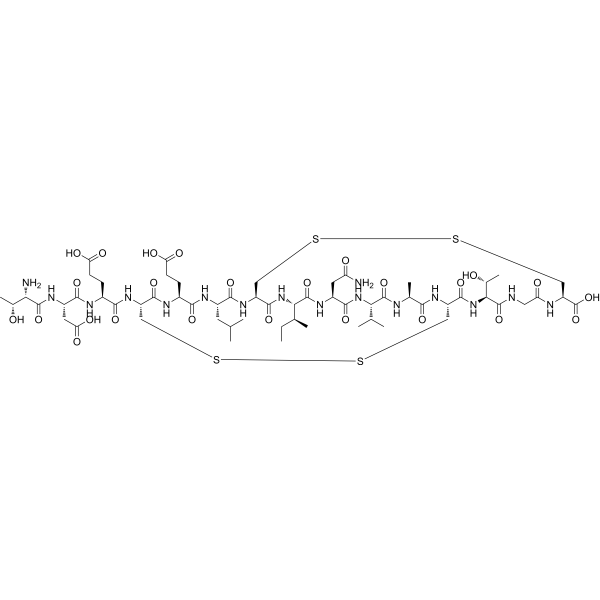
Uroguanylin-15 (Rat) is a biological active peptide. (Uroguanylin is a natriuretic peptide, a hormone that regulates sodium excretion by the kidney when excess NaCl is consumed. Uroguanylin and guanylin are related peptides that activate common guanylate cyclase signaling molecules in the intestine and kidney. Uroguanylin was isolated from urine and duodenum but was not detected in extracts from the colon of rats.)
loading...
    loading...
Cat. No.: HY-108278R
CAS No.: 1222-57-7
Research Areas:  

Endocrinology

Zolimidine (Standard) is the analytical standard of Zolimidine (HY-108278). This product is intended for research and analytical applications. Zolimidine, a derivate of imidazopyridine, is an orally active antiulcer agent. Zolimidine stimulates mucus secretion in intestinal mucosal cells and enhacnes intestinal wall more resistant to ulceration. Zolimidine exhibits gastroprotective effect in duodenal ulcer research .
loading...
    loading...
Cat. No.: HY-P2974A
Target:  

Elastase

Research Areas:  

Metabolic Disease

Elastase, Rat (EC 3.4.21.35) is a form of elastase that is produced in the acinar cells of the pancreas, initially produced as an inactive zymogen and later activated in the duodenum by trypsin. Elastases form a subfamily of serine proteases, characterized by a distinctive structure consisting of two beta-barrel domains converging at the active site that hydrolyze amides and esters amongst many proteins in addition to elastin, a type of connective tissue that holds organs together.
loading...
    loading...
Cat. No.: HY-19153A
CAS No.: 157564-11-9
Synonyms: rel-TY-11345
Target:  

Proton Pump

Research Areas:  

Inflammation/Immunology

Nepaprazole sodium (rel-TY-11345) is a proton pump H+/K+-ATPase inhibitor. Nepaprazole sodium inhibits H+/K+-ATPase activity in rabbit gastric mucosal microsomes, with IC50 values of 5.8 μM and 9.9 μM at pH 6.0 and pH 7.4, respectively, and its inhibitory activity is enhanced under weakly acidic conditions. Nepaprazole sodium inhibits basal and Tetragastrin (HY-125556)-stimulated gastric acid secretion. Nepaprazole sodium can be used in studies on gastric proton pump function, gastric acid secretion, and mechanisms related to peptic ulcers .
loading...
    loading...
Cat. No.: HY-N9554
CAS No.: 150881-27-9
WIN-64821 is a secondary metabolite produced by Aspergillus species, and acts as a Neurokinin Receptor antagonist. The Ki values of WIN-64821 for NK1, NK2 and NK3 receptors are 0.24 (human astrocytoma cells), 0.26 (rat duodenum) and 15.2 (guinea pig forebrain) μM, respectively. WIN-64821 inhibits apamin-induced contraction of rat vas deferens, blocks substance P-induced contraction of guinea pig ileum and Ca 2+ efflux in human astrocytoma cells. WIN-64821 is applicable to analgesic and anti-inflammatory research .
loading...
    loading...
Cat. No.: HY-187045
CAS No.: 71876-60-3
Target:  

Drug Intermediate

Research Areas:  

Inflammation/Immunology Cancer

Heliantriol C is a taraxerane-type trihydroxy triterpenoid present in the ray florets of Asteraceae plants. Heliantriol C inhibits TPA (HY-18739)-induced inflammation. Heliantriol C exhibits anticancer activity, and its acetylated derivatives show enhanced cytotoxicity against cancer cells. Heliantriol C can be used in studies related to inflammation and cancers such as leukemia and lung cancer .
loading...
    loading...
Cat. No.: HY-N6655R
CAS No.: 3493-12-7
Synonyms: DL-MMSC (Standard)
DL-Methionine methylsulfonium chloride (Standard) (DL-MMSC (Standard)) is the analytical standard of DL-Methionine methylsulfonium chloride (HY-N6655). This product is intended for research and analytical applications. DL-Methionine methylsulfonium chloride (MMSC) is an orally effective methionine-derived sulfonium salt that promotes gastric emptying and gastrointestinal transit. DL-Methionine methylsulfonium chloride attenuates oxidative stress and inflammatory responses, and enhances anti-apoptotic (apoptosis) signaling, thereby ameliorating Sodium metabisulfite (HY-Y1326)-induced testicular dysfunction and semen quality impairment. DL-Methionine methylsulfonium chloride is applicable for research on functional dyspepsia, gastrointestinal motility, and male reproductive function injury .
loading...
    loading...

