8320 Results for "

Protac

" in MedChemExpress (MCE) Product Catalog:
Products (8320)

8320 Results for "Protac" in MCE Product Catalog:

Cat. No.: HY-172590
LZ-07 is a selective IRAK4 PROTAC degrader with DC50 values of 1.14 nM (DOHH2) and 2.70 nM (TMD8). LZ-07 acts as a PI3Kδ kinase inhibitor with an IC50 of 92 nM. By bridging IRAK4 and the CRBN E3 ubiquitin ligase, LZ-07 induces IRAK4 degradation via the ubiquitin-proteasome system, ablates both its kinase and scaffold functions, and thereby blocks downstream inflammatory signal transduction. LZ-07 can be used in research related to autoimmune diseases .
loading...
    loading...
Cat. No.: HY-172798
Target:  

PROTACs Bcl-2 Family

Research Areas:  

Cancer

XZ338 is a highly potent and selective BCL-XL PROTAC degrader derived from A-1331852 (HY-19741), with a DC50 of 0.43 nM in MOLT‑4 cells. XZ338 induces the formation of a ternary complex with BCL-XL and VHL E3 ligase, mediates target protein degradation via the ubiquitin-proteasome system, and exhibits significantly weaker degradation activity in platelets than in tumor cells. XZ338 possesses anti-cancer activity. XZ338 can be used in the research of T-cell acute lymphoblastic leukemia (T-ALL) .
loading...
    loading...
Cat. No.: HY-173158
CAS No.: 3031593-79-7
Research Areas:  

Cancer

AUR1545 is a selective KAT2A/KAT2B ((GCN5/PCAF)) PROTAC degrader that induces monocyte differentiation and inhibits the growth of acute myeloid leukemia cells. AUR1545 inhibits cell growth, induces epithelial differentiation and suppresses tumor growth in small cell lung cancer models. AUR1545 inhibits cell growth and induces differentiation in neuroendocrine prostate cancer cells and primary patient-derived organoids. AUR1545 is applicable to research related to acute myeloid leukemia, small cell lung cancer and neuroendocrine prostate cancer .
loading...
    loading...
Cat. No.: HY-174458
Target:  

PROTACs MDM-2/p53

Research Areas:  

Cancer

MD-4251 is an orally active MDM2 PROTAC degrader with a DC50 of 0.2 nM in RS4;11 cells. MD-4251 induces cereblon-dependent depletion and degradation of MDM2 protein, elevates p53 protein levels and activates p53. MD-4251 inhibits the proliferation of wild-type p53 acute leukemia cells, induces complete and durable tumor regression in xenograft models, and upregulates the protein levels of DSC1, NBEA and CASP14. MD-4251 can be used in studies related to acute leukemia .
loading...
    loading...
Cat. No.: HY-175417
Target:  

PROTACs

Research Areas:  

Others

VHL-SNAP2-5C is a PROTAC degrader targeting SNAP-tag fusion proteins, with an IC50 of 0.33 μM for binding to VHL. VHL-SNAP2-5C covalently binds to the SNAP-tag target at one end and recruits the VHL ubiquitin E3 ligase at the other end to form a ternary complex, thereby inducing proteasome-dependent ubiquitination and degradation of SNAP fusion proteins through its heterobifunctional structure. VHL-SNAP2-5C can be used in studies of protein homeostasis and degradation mechanisms .
loading...
    loading...
Cat. No.: HY-178777
CAS No.: 3084696-50-1
Target:  

PROTACs BCL6

Research Areas:  

Cancer

BCL6-760 is an orally active BCL-6 PROTAC degrader with an EC50 of 0.8 nM. BCL6-760 only degrades BCL6 and has no effect on other CRBN substrates. BCL6-760 demonstrates significant efficacy in the orthotopic xenograft mouse model of OCI-LY-1 tumors. BCL6-760 can be used in the research of diffuse Large B-cell Lymphoma (DLBCL) (Pink: BCL-6 ligand (HY-179317); Blue: CRBN ligand (HY-179305); Black: Linker) .
loading...
    loading...
Cat. No.: HY-178825
Research Areas:  

Cancer

LD-110 is a PROTAC degrader targeting LSD1 with a DC50 of 0.44-1.24 μM. LD-110 acts through the CRBN E3 ubiquitin ligase and the ubiquitin-proteasome system, leading to H3K4me2 accumulation. LD-110 induces apoptosis and inhibits the growth and survival of multiple esophageal squamous cell carcinoma (ESCC) cell lines. LD-110 inhibits tumor growth in the KYSE-150 xenograft model. LD-110 can be used in research related to esophageal squamous cell carcinoma .
loading...
    loading...
Cat. No.: HY-178825B
Research Areas:  

Cancer

LD-110 trihydrochloride is a PROTAC degrader targeting LSD1 with a DC50 of 0.44-1.24 μM. LD-110 trihydrochloride acts through the CRBN E3 ubiquitin ligase and the ubiquitin-proteasome system, leading to H3K4me2 accumulation. LD-110 trihydrochloride induces apoptosis and inhibits the growth and survival of multiple esophageal squamous cell carcinoma (ESCC) cell lines. LD-110 trihydrochloride inhibits tumor growth in the KYSE-150 xenograft model. LD-110 trihydrochloride can be used in research related to esophageal squamous cell carcinoma .
loading...
    loading...
Cat. No.: HY-179243
CAS No.: 3033746-21-0
Target:  

PROTACs STAT MDM-2/p53

Research Areas:  

Cancer

S3D5 is a highly efficient and selective PROTAC degrader targeting STAT3 (KD = 4.35 μM). S3D5 induces degradation of STAT3 in HepG2 cells without significant effects on other STAT proteins. S3D5 exhibits good anti-hepatocellular carcinoma cell proliferation activity, which can be explained by activating the p53 pathway. S3D5 degradation of the STAT3 protein is mediated by the ubiquitin–proteasome system (UPS). S3D5 can be used for the study of hepatocellular carcinoma .
loading...
    loading...
Cat. No.: HY-180964
CAS No.: 3057939-67-7
Research Areas:  

Cancer

Lys-PEG3-BA is an EML4-ALK/EGFR PROTAC degrader with DC50 values of 1.32 and 19.66 μM for H3122 (EML4-ALK) and H1975 (EGFR-L858R/T790M) cells, respectively. Lys-PEG3-BA hinders proliferation via rewiring the ubiquitin- proteasome system in vitro. Lys-PEG3-BA can be used for non-small cell lung cancer research .
loading...
    loading...
Cat. No.: HY-181490
Target:  

PROTACs CDK Apoptosis

Research Areas:  

Cancer

WWZ-11-098 is a selective CDK6 PROTAC degrader with DC50 of 2.6 nM. WWZ-11-098 induces degradation of CDK6 in a CRBN-dependent manner, while sparing CDK1, CDK2, CDK4, and CDK9. WWZ-11-098 induces apoptosis, G1-S cell cycle arrest and shows anti-proliferative activity in cancer cells. WWZ-11-098 exhibits antitumor efficacy in a xenograft model without signs of toxicity. WWZ-11-098 can be used for the research of leukemia .
loading...
    loading...
Cat. No.: HY-181759
CAS No.: 3086024-48-5
CBP/p300/BRD4 ligand-1 is a small-molecule inhibitor targeting CBP, p300, and BRD4. CBP/p300/BRD4 ligand-1 competitively binds to the functional domains of target proteins without disrupting key interactions. CBP/p300/BRD4 ligand-1 can be used for the construction of dual-target PROTAC degraders (HY-181758) in studies related to prostate cancer and other cancers .
loading...
    loading...
Cat. No.: HY-183995
SH-26 is a PHD1 PROTAC degrader with DC50s of 1.06 μM, 4.16 μM and 4.91 μM in MDA-MB-231, HepG2 and HEK-293T cells, respectively. SH-26 recruits CRBN to induce PHD1 degradation via the ubiquitin-proteasome system. SH-26 attenuates APAP (HY-66005)-triggered ROS accumulation, mitochondrial dysfunction, and NLRP3 inflammasome activation. SH-26 can be used for the research of acute liver injury .
loading...
    loading...
Cat. No.: HY-184506
Target:  

PROTACs Ferroptosis

Research Areas:  

Cancer

R4VPL3-1 is a PROTAC-like degrader that simultaneously targets RNF4 and VHL, and also acts as a ferroptosis inducer. R4VPL3-1 induces iron-dependent lipid peroxidation and ferroptosis-mediated rapid cell death in cancer cells. R4VPL3-1 is applicable to research on human melanoma, human cutaneous squamous cell carcinoma, metastatic human sarcoma, malignant peripheral nerve sheath tumor, pigmented villonodular synovitis, undifferentiated pleomorphic sarcoma, myxofibrosarcoma, and lung adenocarcinoma .
loading...
    loading...
Cat. No.: HY-185697
CAS No.: 3136609-62-3
Target:  

PROTACs IFNAR c-Myc

Research Areas:  

Cancer

dIRF4-2 is a selective IRF4 PROTAC degrader with a DC50 value of 2.2 μM. dIRF4-2 forms a ternary complex between IRF4 and CRBN, inducing ubiquitination and proteasomal degradation of IRF4. dIRF4-2 downregulates MYC. dIRF4-2 exhibits anticancer activity against myeloma. dIRF4-2 acts as a chemical probe for investigating IRF4 function, mimicking the IRF4 gene knockout phenotype. dIRF4-2 can be used in the research of multiple myeloma .
loading...
    loading...
Cat. No.: HY-P11228
Research Areas:  

Cancer

FPP29 is a potent peptide-based FOXM1 PROTAC degrader. FPP29 induces ubiquitination and degradation of FOXM1. FPP29 inhibits FOXM1 via the ubiquitin-proteasome degradation pathway. FPP29 induces Apoptosis. FPP29 suppresses tumor growth in hepatocellular carcinoma xenograft models. FPP29 can be used in the research of hepatocellular carcinoma (cell-penetrating peptide: (HY-P0133); VHL ligase ligand: (HY-P11493); linker: (HY-W013664); FOXM1 ligand: (HY-P11494)) .
loading...
    loading...
Cat. No.: HY-W021401
CAS No.: 134179-38-7
Target:  

PROTAC Linkers

Research Areas:  

Cancer

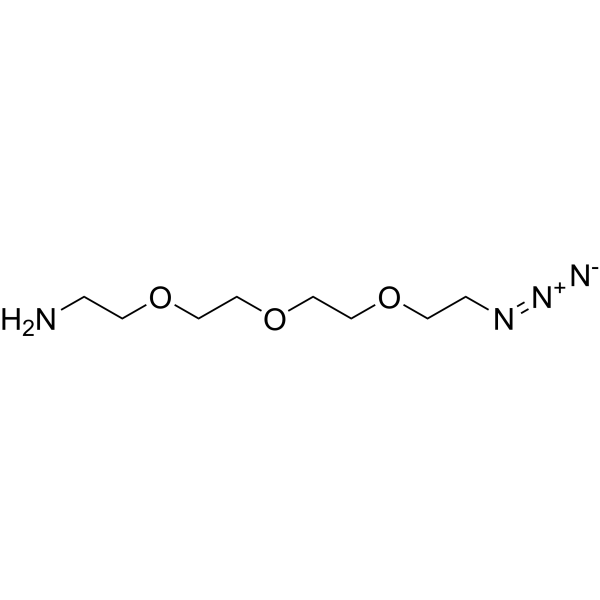
Amino-PEG3-C2-Azido is a PEG-based PROTAC linker can be used in the synthesis of the PARP1 degrader iRucaparib-TP3 (HY-130645) . Amino-PEG3-C2-Azido is a click chemistry reagent, it contains an Azide group and can undergo copper-catalyzed azide-alkyne cycloaddition reaction (CuAAc) with molecules containing Alkyne groups. It can also undergo strain-promoted alkyne-azide cycloaddition (SPAAC) reactions with molecules containing DBCO or BCN groups.
loading...
    loading...
Cat. No.: HY-103598
CAS No.: 1797406-80-4
Purity:  99.67%
Synonyms: VH032-PEG3-N3; VHL Ligand-Linker Conjugates 8; E3 ligase Ligand-Linker Conjugates 12
Research Areas:  

Cancer

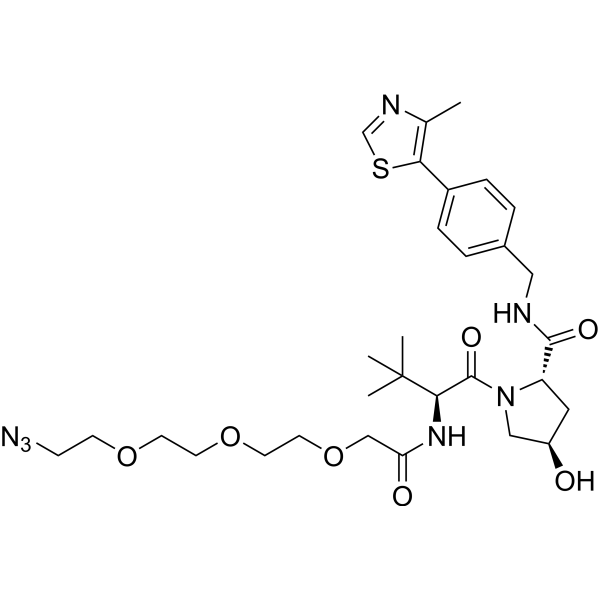
(S,R,S)-AHPC-PEG3-N3 is a synthesized E3 ligase ligand-linker conjugate that incorporates the (S,R,S)-AHPC based VHL ligand and 3-unit PEG linker used in PROTAC technology. (S,R,S)-AHPC-PEG3-N3 is a click chemistry reagent, it contains an Azide group and can undergo copper-catalyzed azide-alkyne cycloaddition reaction (CuAAc) with molecules containing Alkyne groups. It can also undergo strain-promoted alkyne-azide cycloaddition (SPAAC) reactions with molecules containing DBCO or BCN groups.
loading...
    loading...
Cat. No.: HY-103602R
CAS No.: 2097971-11-2
Synonyms: VH032-PEG3-NH2 hydrochloride (Standard); VHL Ligand-Linker Conjugates 1 hydrochloride (Standard); E3 ligase Ligand-Linker Conjugates 5 (Standard)
(S,R,S)-AHPC-PEG3-NH2 hydrochloride (Standard) is the analytical standard of (S,R,S)-AHPC-PEG3-NH2 hydrochloride (HY-103602). This product is intended for research and analytical applications. (S,R,S)-AHPC-PEG3-NH2 (VH032-PEG3-NH2) hydrochloride is a synthesized E3 ligase ligand-linker conjugate that incorporates the (S,R,S)-AHPC based VHL ligand and 3-unit PEG linker used in PROTAC technology.
loading...
    loading...
Cat. No.: HY-103603AR
CAS No.: 2010159-60-9
Synonyms: VH032-PEG2-NH2 (Standard); VHL Ligand-Linker Conjugates 3 (Standard); E3 ligase Ligand-Linker Conjugates 6 Free Base (Standard)
(S,R,S)-AHPC-PEG2-NH2 (Standard) is the analytical standard of (S,R,S)-AHPC-PEG2-NH2 (HY-103603A). This product is intended for research and analytical applications. (S,R,S)-AHPC-PEG2-NH2 (VH032-PEG2-NH2) is a synthesized E3 ligase ligand-linker conjugate that incorporates the (S,R,S)-AHPC based VHL ligand and 2-unit PEG linker used in the synthesis of PROTACs .
loading...
    loading...

