5 Results for "

CAMA1

" in MedChemExpress (MCE) Product Catalog:
Products (5)

5 Results for "CAMA1" in MCE Product Catalog:

Cat. No.: HY-148789
CAS No.: 2092925-89-6
Purity:  99.90%
Synonyms: OP-1250
Target:  

Estrogen Receptor/ERR

Research Areas:  

Inflammation/Immunology Cancer

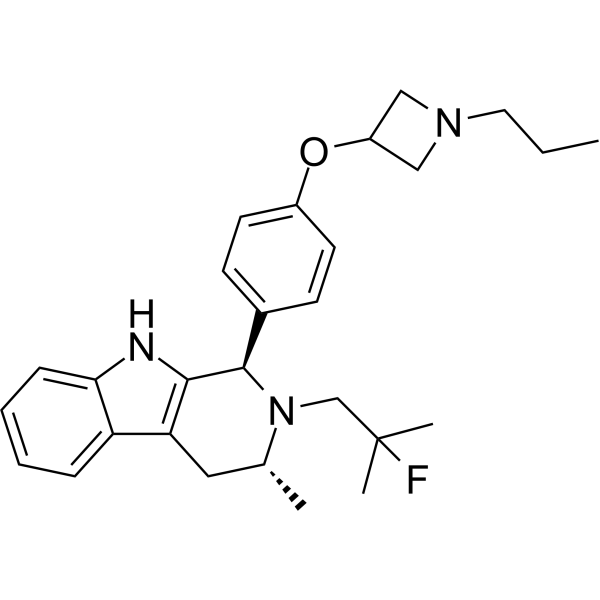
Palazestrant is an antiestrogen and antineoplastic agent. Palazestrant can completely inhibit the activity of 17b-estradiol (E2) with IC50 value of 6.4 nM, and inhibit the proliferation of MCF7 and CAMA-1 cells with IC50 value of 1.4-1.6 nM. Palazestrant can inhibit ER +/HER2 + cancer [1] .
loading...
    loading...
Cat. No.: HY-153444
CAS No.: 2569008-99-5
Purity:  99.62%
Synonyms: PF-07248144
Research Areas:  

Cancer

Prifetrastat (PF-07248144), a first-in-class, selective, and orally active KAT6A and KAT6AB inhibitor. Prifetrastat can be used for the study of ER+/HER2− breast cancer [1].
loading...
    loading...
Cat. No.: HY-177046
CAS No.: 3092067-21-2
Research Areas:  

Cancer

KAT6A/KAT7-IN-4 is a KAT6A and KAT7 inhibitor. KAT6A/KAT7-IN-4 has IC50 values of both ≤ 1 nM for KAT6A and KAT7. KAT6A/KAT7-IN-4 can inhibit the acetylation of H3K14 and H3K23. KAT6A/KAT7-IN-4 also inhibits tumor cell proliferation, with an IC50 of ≤ 100 nM for CAMA-1. KAT6A/KAT7-IN-4 can be used in the study of breast cancer [1].
loading...
    loading...
Cat. No.: HY-135312
CAS No.: 2361115-35-5
Purity:  98.13%
Research Areas:  

Cancer

AZ'6421 is an orally active ERα PROTAC degrader with a DC50 of 0.4 nM. AZ'6421 recruits the VHL E3 ligase to form a ternary complex, inducing proteasome-mediated polyubiquitination and degradation of ERα. AZ'6421 inhibits the growth of ER + cancer cells. AZ'6421 can be used in studies related to ER + breast cancer [1] .
loading...
    loading...
Cat. No.: HY-170336
CAS No.: 2421260-43-5
Research Areas:  

Cancer

PROTAC ERα Degrader-10 is an orally active estrogen receptor α (ERα) PROTAC degrader, with DC50 values of 0.37, 1.1, and 0.47 nM in MCF7, T47D, and CAMA-1 cells, respectively. PROTAC ERα Degrader-10 exhibits significant anti-tumor activity both in vitro and in vivo, and can be used for breast cancer research [1].
loading...
    loading...

