8 Results for "

Doxorubicin Analog

" in MedChemExpress (MCE) Product Catalog:
Products (8)

8 Results for "Doxorubicin Analog" in MCE Product Catalog:

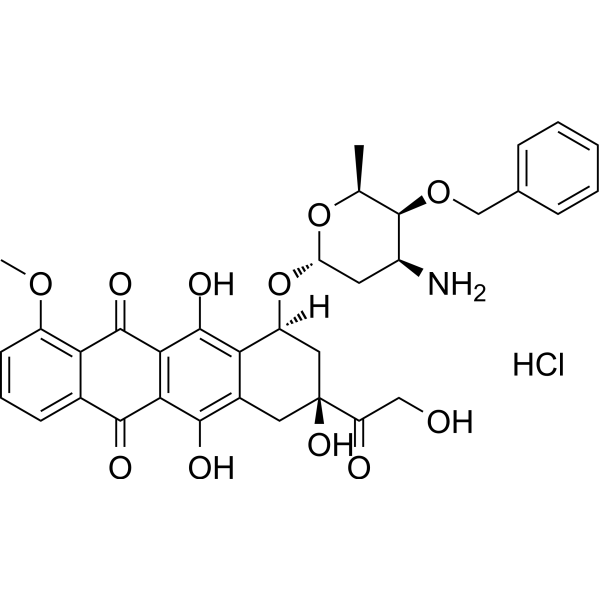
Cat. No.: HY-14942A
CAS No.: 293736-67-1
Purity:  95.08%
Synonyms: RTA 744; WP 744; WP 769 hydrochloride
Berubicin (RTA 744) hydrochloride is a Doxorubicin (HY-15142A) analog that can cross the blood-brain barrier. Berubicin hydrochloride inhibits P-gp and MRP1-mediated efflux and suppresses glioblastoma multiforme (GBM). Berubicin hydrochloride exerts toxic effects on leukemia cells by activating nuclear factor κB (NF-κB) and induces apoptosis in neuroblastoma cells. Berubicin hydrochloride can be used in the study of tumors related to the nervous system .
loading...
    loading...
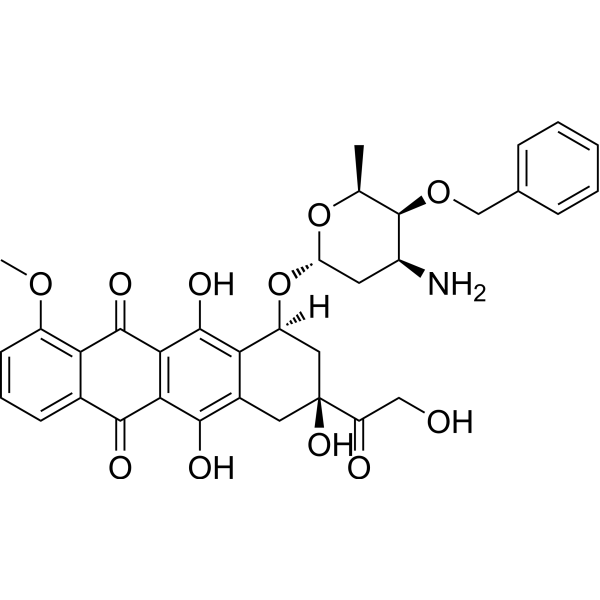
Cat. No.: HY-14942
CAS No.: 677017-23-1
Purity:  87.76%
Synonyms: RTA 744 free base; WP 744 free base; WP 769
Berubicin (RTA 744 free base) is a Doxorubicin (HY-15142A) analog that can cross the blood-brain barrier. Berubicin inhibits P-gp and MRP1-mediated efflux and suppresses glioblastoma multiforme (GBM). Berubicin exerts toxic effects on leukemia cells by activating nuclear factor κB (NF-κB) and induces apoptosis in neuroblastoma cells. Berubicin can be used in the study of tumors related to the nervous system .
loading...
    loading...
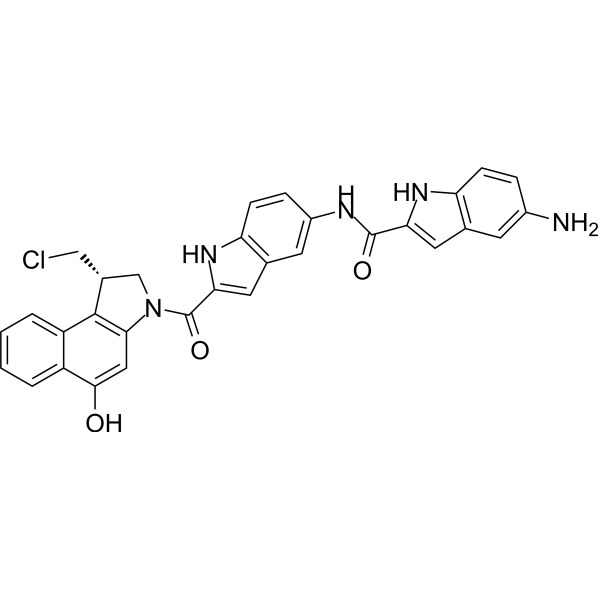
Cat. No.: HY-129379
CAS No.: 615538-51-7
Purity:  95.00%
Target:  

ADC Payloads

Research Areas:  

Cancer

DC0-NH2 is an effector moiety for ADC and a simplified analog of DC1 with better stability. DC0-NH2 is about 1000-fold more cytotoxic than commonly used anticancer agents (ex. Doxorubicin). DC0-NH2 can bind to the minor groove of DNA, followed by alkylation of adenine residues by its propabenzindole (CBI) component .
loading...
    loading...
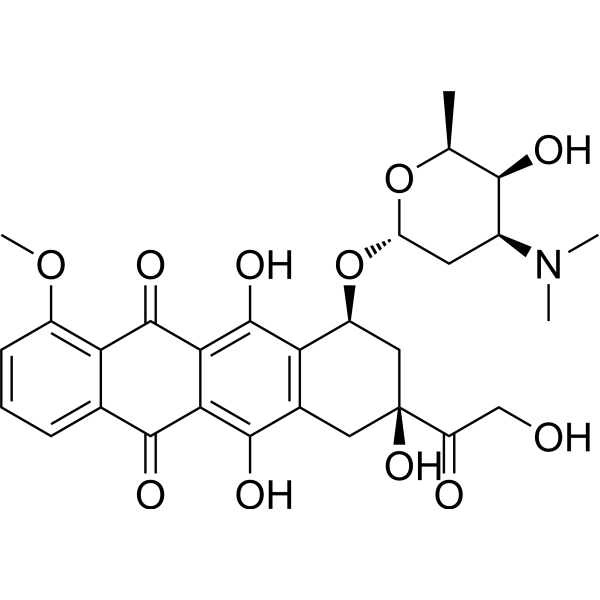
Cat. No.: HY-154797
CAS No.: 70222-95-6
Target:  

Topoisomerase

Research Areas:  

Cancer

N,N-Dimethyldoxorubicin is an analog of Doxorubicin (HY-15142A). N,N-Dimethyldoxorubicin induces chromatin damage via histone eviction, while barely inducing DNA double-strand breaks. N,N-Dimethyldoxorubicin exhibits cytotoxicity against a variety of tumor cells. N,N-Dimethyldoxorubicin can be used in research related to multiple types of cancer .
loading...
    loading...
Cat. No.: HY-P10453
Target:  

Inhibitory Antibodies

Research Areas:  

Others

Myr5A peptide is an acylated peptide composed of apolipoprotein A1 (ApoA1) analog peptide 5A peptide coupled to the saturated fatty acid myristate. Myr5A peptide self-assembled into lipid nanostructures can be used to encapsulate anthracycline Doxorubicin (HY-15142A) and Valrubicin (HY-13772) for compound release studies in vitro .
loading...
    loading...
Cat. No.: HY-109113
CAS No.: 236095-26-4
Synonyms: GPX-150
Target:  

Topoisomerase

Research Areas:  

Cancer

Camsirubicin (GPX-150) is a non-cardiotoxic Doxorubicin (HY-15142) analog that selectively targets topoisomerase IIβ. Camsirubicin reduces cell viability and clone formation of MDA-MB-468 breast cancer cells. Camsirubicin increases the exposure of CALR and HSP90 on the cell surface. Camsirubicin can be used for the study of breast cancer .
loading...
    loading...
Cat. No.: HY-106414A
CAS No.: 64291-45-8
Synonyms: NSC 292652 hydrochloride; RP 33921 hydrochloride
Detorubicin hydrochloride (NSC 292652 hydrochloride) is a semi-synthetic analog of Daunorubicin (HY-13062A) and a prodrug of Doxorubicin (HY-15142A). Detorubicin hydrochloride hydrolyzes to release Doxorubicin under neutral pH conditions. Detorubicin hydrochloride forms complexes with DNA. Detorubicin hydrochloride exhibits anti-hematologic tumor and metastatic melanoma activities. Detorubicin hydrochloride causes myocardial injury, skin damage, alopecia, and high mortality in golden hamsters. Detorubicin hydrochloride can be used in research related to leukemia, and metastatic melanoma .
loading...
    loading...
Cat. No.: HY-183402
CAS No.: 917813-60-6
Synonyms: GO-Y026
Research Areas:  

Cancer

FLLL12 (GO-Y026) is a curcumin analog anticancer agent. FLLL12 inhibits the phosphorylation of AKT, Bcl-2, Bid, EGFR, mTOR, FOXO1a, FOXO3a, STAT3, HER2/neu, as well as pancreatic AKT/STAT3; upregulates the expression of Bim and DR5; and activates PTPs. FLLL12 regulates downstream pathways, induces mitochondria-mediated and DR5-dependent extrinsic apoptosis, inhibits cancer cell viability, proliferation, anchorage-independent growth and migration, and exerts a synergistic effect with Doxorubicin (HY-15142A). FLLL12 can be used in research related to head and neck squamous cell carcinoma, breast cancer, prostate cancer, pancreatic cancer, lung cancer, colon cancer and colorectal cancer .
loading...
    loading...

