9 Results for "

GSK3β inhibitor II

" in MedChemExpress (MCE) Product Catalog:
Products (9)

9 Results for "GSK3β inhibitor II" in MCE Product Catalog:

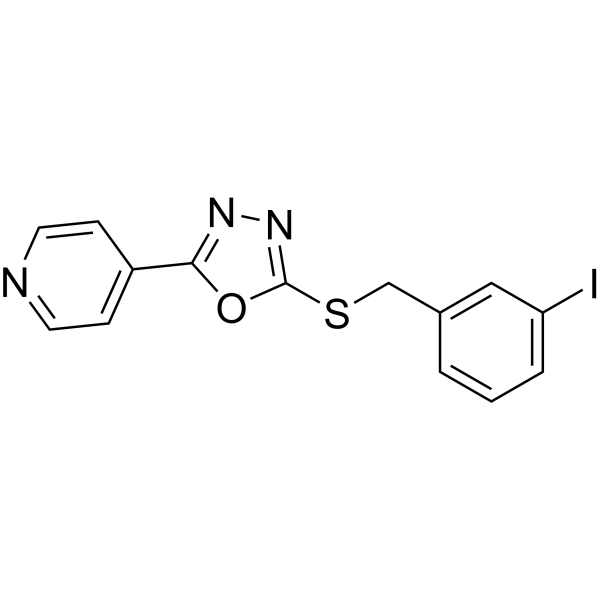
Cat. No.: HY-14679
CAS No.: 478482-75-6
Purity:  99.76%
Target:  

GSK-3

Research Areas:  

Neurological Disease

GSK3β inhibitor II is an inhibitor of GSK3β. GSK3β inhibitor II can be used for research of Alzheimer’s disease (AD) .
loading...
    loading...
15
15 Publications Verification
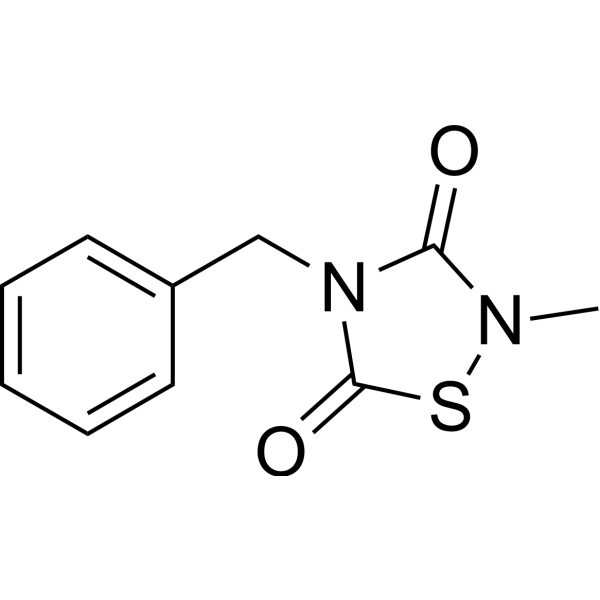
Cat. No.: HY-11012
CAS No.: 327036-89-5
Purity:  99.76%
Synonyms: GSK- inhibitor I; NP 01139
Target:  

GSK-3

Research Areas:  

Cancer

TDZD-8 is an inhibitor of GSK-3β, with an IC50 of 2 μM; TDZD-8 shows less potent activities against Cdk-1/cyclin B, CK-II, PKA, and PKC, with all IC50s of >100 μM.
loading...
    loading...
1
1 Cited Publications
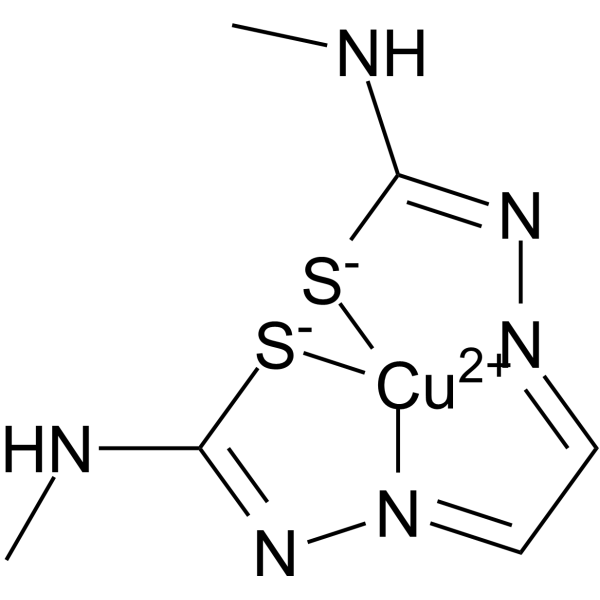
Cat. No.: HY-139324
CAS No.: 68341-14-0
Purity:  ≥95.0%
Target:  

GSK-3 Amyloid-β

Research Areas:  

Neurological Disease Cancer

Cu(II)GTSM, a cell-permeable Cu-complex, significantly inhibits GSK3β. Cu(II)GTSM inhibits Amyloid-β oligomers (AβOs) and decreases tau phosphorylation. Cu(II)GTSM also decreases the abundance of Amyloid-β trimers. Cu(II)GTSM is a potential anticancer and antimicrobial agent .
loading...
    loading...
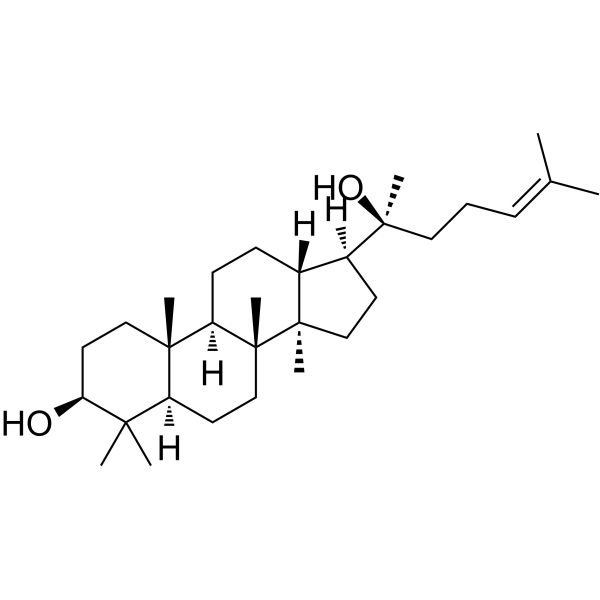
Cat. No.: HY-N3677
CAS No.: 14351-29-2
Dammarenediol II is a ginsenoside precursor . Dammarenediol II reduces the activity of O-GlcNAc transferase (OGT) and downregulates the global O-GlcNAcylation level. Dammarenediol II inhibits the phosphorylation of Akt, mTOR and GSK3β. Dammarenediol II inhibits human carboxylesterase activity, VEGF-induced ROS production, stress fiber formation and vascular endothelial cadherin disruption. Dammarenediol II promotes cell apoptosis (apoptosis), increases the levels of cleaved PARP1 and p53, and inhibits retinal microvascular leakage. Dammarenediol II can be used in studies related to liver cancer and diabetic retinopathy .
loading...
    loading...
Cat. No.: HY-161595
CAS No.: 1212711-91-5
Target:  

CDK GSK-3

Research Areas:  

Cancer

CDK5-IN-4 (compound 4) is a potent multikinase type-II inhibitor targeting CDK5, with an IC50 of 9.8 μM. CDK5-IN-4 also inhibits GSK-3α, GSK-3β, CDK9, and CDK2, with IC50 values of 0.98, 4.00, 1.76, and 6.24 μM, respectively. CDK5-IN-4 can be used for glioblastoma research .
loading...
    loading...
Cat. No.: HY-11012R
CAS No.: 327036-89-5
Synonyms: GSK- inhibitor I (Standard); NP 01139 (Standard)
Research Areas:  

Cancer

TDZD-8 (Standard) is the analytical standard of TDZD-8. This product is intended for research and analytical applications. TDZD-8 is an inhibitor of GSK-3β, with an IC50 of 2 μM; TDZD-8 shows less potent activities against Cdk-1/cyclin B, CK-II, PKA, and PKC, with all IC50s of >100 μM.
loading...
    loading...
Cat. No.: HY-13551C
CAS No.: 80277-14-1
Synonyms: m-AMSA isethionate; Acridinyl anisidide isethionate
Amsacrine isethionate (m-AMSA isethionate) is a Topoisomerase II inhibitor. Amsacrine isethionate intercalates into DNA. Amsacrine isethionate induces Ca 2+-mediated inactivation of ERK, and also downregulates AKT, promoting MCL1 downregulation mediated by GSK3β via reducing the phosphorylation level of GSK3β. Amsacrine isethionate induces Apoptosis by activating Caspase-9 and Caspase-3. Amsacrine isethionate blocks HERG potassium channels in the open/inactivated state. Amsacrine isethionate induces chromosomal aberrations and sister chromatid exchanges, and inhibits the synthesis of RNA and DNA. Amsacrine isethionate exhibits anti-leukemic activity. Amsacrine isethionate causes cardiac repolarization disorders, QT interval prolongation, ventricular arrhythmias, and increases the risk of sudden cardiac death. Amsacrine isethionate can be used in research related to acute myeloid leukemia, lymphoma and progressive malignancies .
loading...
    loading...
Cat. No.: HY-13551D
CAS No.: 80277-11-8
Synonyms: m-AMSA lactate; Acridinyl anisidide lactate
Amsacrine lactate (m-AMSA lactate) is a Topoisomerase II inhibitor. Amsacrine lactate intercalates into DNA. Amsacrine lactate induces Ca 2+-mediated inactivation of ERK, and also downregulates AKT, promoting MCL1 downregulation mediated by GSK3β via reducing the phosphorylation level of GSK3β. Amsacrine lactate induces Apoptosis by activating Caspase-9 and Caspase-3. Amsacrine lactate blocks HERG potassium channels in the open/inactivated state. Amsacrine lactate induces chromosomal aberrations and sister chromatid exchanges, and inhibits the synthesis of RNA and DNA. Amsacrine lactate exhibits anti-leukemic activity. Amsacrine lactate causes cardiac repolarization disorders, QT interval prolongation, ventricular arrhythmias, and increases the risk of sudden cardiac death. Amsacrine lactate can be used in research related to acute myeloid leukemia, lymphoma and progressive malignancies .
loading...
    loading...
Cat. No.: HY-N11231
CAS No.: 7176-02-5
Fucoxanthinol, a carotenoid, is a deacetylated Fucoxanthin (HY-N2302) metabolite with oral activity, and inhibits rat pancreatic lipase with an IC50 of 764 nM. Fucoxanthinol reduces expression of Bcl-2, Bcl-xL, survivin, XIAP, cIAP2, cyclin D1, cyclin D2, cyclin E, CDK4, CDK6, β-catenin, JunD, PPARγ, and induces GADD45α expression. Fucoxanthinol activates caspase-3, caspase-8, caspase-9, Nrf2/Keap1/ARE pathway, and inhibits activation of Akt, NF-κB, AP-1, PDPK1, GSK3β phosphorylation. Fucoxanthinol induces apoptosis, G0/G1 cell cycle arrest, inhibits cancer cell viability, proliferation, migration, invasiveness, tumour growth, adipocyte differentiation, oxidative stress, neurotoxicity, triglyceride absorption, angiogenesis, and obesity-induced inflammation. Fucoxanthinol can be used for the research of osteosarcoma, leukemia, lymphoma, adult T-cell leukemia, prostate cancer, colon cancer, breast cancer, hypertriglyceridaemia, Alzheimer’s disease, Parkinson’s disease, obesity, insulin resistance, malignant melanoma, and type II diabetes .
loading...
    loading...

