1. Search Result
Search Result
Results for "

HepG-2 xenograft model

" in MedChemExpress (MCE) Product Catalog:

11

Inhibitors & Agonists

1

Peptides

1

Inhibitory Antibodies

Cat. No. Product Name Target Research Areas Chemical Structure
  • HY-170027

    HIF/HIF Prolyl-Hydroxylase AMPK Cancer
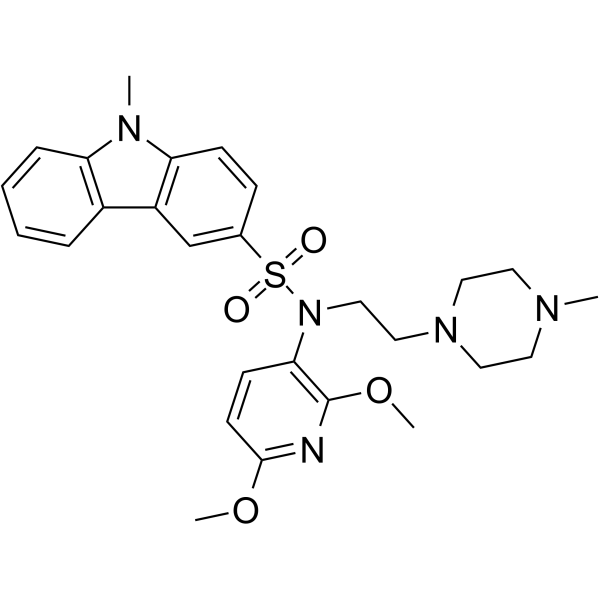
    LW1564 is an inhibitor for HIF-1α with an IC50 of 1.2 µM in HepG2. LW1564 inhibits mitochondrial respiration, reduces ATP production, stimulates HIF-1α degradation, and inhibits proliferation of various cancer cells with GI50 of 0.4-4.6 μM. LW1564 activates AMPK signaling pathway and inhibits lipid synthesis. LW1564 exhibits antitumor in HepG2 xenograft mouse model .
    LW1564
  • HY-P991448

    Glycoprotein VI Cancer
    MDX-1414 is a human IgG1 monoclonal antibody (mAb) targeting GPC3. MDX-1414 has antitumor activity in the HepG2 xenograft model. MDX-1414 can be used in liver cancer research. Recommended isotype control: Human IgG1 kappa, Isotype Control (HY-P99001) .
    MDX-1414
  • HY-178960

    Microtubule/Tubulin Apoptosis Cancer
    Tubulin-IN-59 (Compound 8g) is an orally active Tubulin inhibitor. Tubulin-IN-59 exhibits potent anti-proliferative activity against HCT116 colorectal cancer, HeLa cervical cancer, and HepG2 liver cancer cell lines, with its IC₅₀ value ranging from 16 to 35 nM. Tubulin-IN-59 arrests HeLa cells in the G2/M phase and induces cell apoptosis. Tubulin-IN-59 demonstrates significant anti-tumor activity in the HT29 human colon cancer mouse xenograft model. Tubulin-IN-59 can be used for the study of colorectal cancer and cervical cancer .
    Tubulin-IN-59
  • HY-176740

    PROTACs Bcl-2 Family p38 MAPK Reactive Oxygen Species (ROS) Mitochondrial Metabolism Apoptosis ERK JNK Cancer
    PROTAC Bcl-xL degrader-4 (Compound 2-38-III) is a Bcl-xL PROTAC degrader. PROTAC Bcl-xL degrader-4 has strong anti-tumor activity against HepG2 cells and HUVEC cells. PROTAC Bcl-xL degrader-4 induces cells apoptosis by decreasing mitochondrial membrane potential and activating the MAPK signaling pathway. PROTAC Bcl-xL degrader-4 significantly inhibits tumor growth in xenograft tumor mouse models . Pink: MAPK ligand (HY-176741); Blue: CRBN ligase ligand (HY-10984); Black: linker (HY-W017440)
    PROTAC Bcl-xL degrader-4
  • HY-146465

    Microtubule/Tubulin Cancer
    Anticancer agent 60 (compound 3h) has antiproliferative activity against human HepG2 cells (IC50 = 4.13 μM) and presents antitumor efficacy in a human HepG2 xenograft mouse model .
    Anticancer agent 60
  • HY-W276819

    Polo-like Kinase (PLK) Cancer
    PLK1-IN-9 (Compound M2) is an inhibitor for polo-like kinase 1 (PLK1), that inhibits PLK proteins modified with peptides 1010pT, cdc25c and PBIP, with IC50s of 1.6, 0.8 and 1.4 μM, respectively. PLK1-IN-9 inhibits proliferations of cancer cells HeLa, HL60, SNU387/499, HepG2, exhibits cytotoxicity and induces apoptosis. PLK1-IN-9 inhibits tumor growth in HepG2 xenograft mouse model .
    PLK1-IN-9
  • HY-146114

    Microtubule/Tubulin Quinone Reductase Cancer
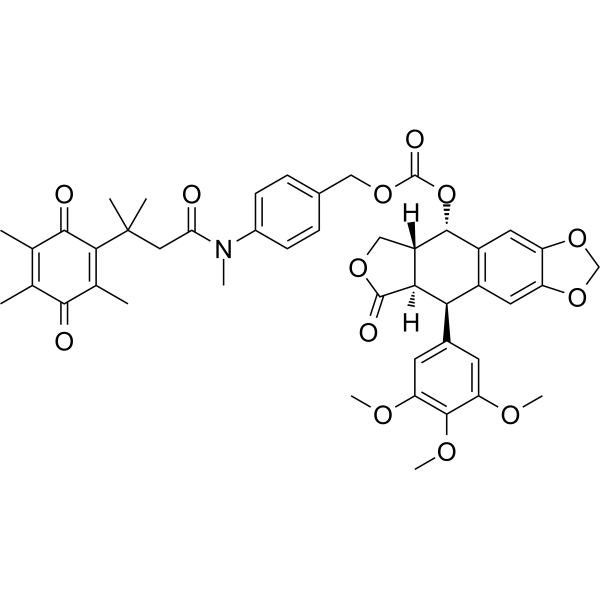
    Antitumor agent-67 (compound 3) is a potent antitumor agent. Antitumor agent-67 has highly selective toxicity to cancer cells and lower damage to normal cells. Antitumor agent-67 can be activated by NQO1 and effectively liberate podophyllotoxin and kill tumor cells. Antitumor agent-67 significantly suppresses cancer growth in HepG2 xenograft models without obvious toxicity .
    Antitumor agent-67
  • HY-177268

    Apoptosis Reactive Oxygen Species (ROS) PARP Caspase Akt Cancer
    CHNQD-01426 (Compound 4a) is an anticancer agent. CHNQD-01426 has cytotoxic activities against cancer cells. CHNQD-01426 significantly inhibits hepatocellular carcinoma cells proliferation via arresting S and G2/M phase cell cycle and induces apoptosis by inducing ROS production and elevating apoptosis-related proteins expression. CHNQD-01426 potently inhibits tumor growth in HepG2 xenograft mice model .
    CHNQD-01426
  • HY-174411

    Microtubule/Tubulin MMP Bcl-2 Family Reactive Oxygen Species (ROS) Caspase Cancer
    Tubulin polymerization-IN-82 is a tubulin inhibitor. Tubulin polymerization-IN-82 inhibits cell migration and invasion, and triggers cell apoptosis through the mitochondria and ER stress mediated pathway. Tubulin polymerization-IN-82 exhibits antitumor activity against drug resistance cancer cells, and inhibits tumor growth, can be used for liver cancer research .
    Tubulin polymerization-IN-82
  • HY-P11618

    Glycoprotein VI Cancer
    10P3Me is a Glypican-3 (GPC3)-targeting probe with a Ka of 93.8 nM for the human target. 10P3Me exhibits high binding affinity to GPC3, targets GPC3-positive cells, and serves as an agent for PET imaging. 10P3Me selectively accumulates in GPC3-positive tumor tissues, including subcutaneous xenograft models and orthotopic HepG2-LUC liver cancer models, to achieve precise localization of lesions .
    10P3Me
  • HY-180117

    MMP STAT Apoptosis Cancer
    MMP-2/9-IN-2 (Compound 6k) is a MMP-2 and MMP-9 inhibitor, with IC50 values of 29.27 and 24.87 μM respectively. MMP-2/9-IN-2 exhibits good selective toxicity against multiple human hepatoma cell lines. MMP-2/9-IN-2 induces cell cycle arrest and apoptosis, significantly inhibits cell migration and invasion. MMP-2/9-IN-2 inhibits the phosphorylation of the STAT3 signaling pathway. MMP-2/9-IN-2 shows strong anti-tumor activity in a nude mouse xenograft model of HepG2 liver cancer cells .
    MMP-2/9-IN-2

Inquiry Online

Your information is safe with us. * Required Fields.

Salutation


Country or Region *

Applicant Name *


Organization Name *

Department *


Email Address *


Product Name *

Cat. No.


Requested quantity *

Phone Number *


Remarks

Inquiry Online

Inquiry Information

Product Name:
Cat. No.:
Quantity:
MCE Japan Authorized Agent:

