10 Results for "

Lewis lung carcinoma mouse model

" in MedChemExpress (MCE) Product Catalog:
Products (10)

10 Results for "Lewis lung carcinoma mouse model" in MCE Product Catalog:

4
4 Cited Publications
Cat. No.: HY-P1408
CAS No.: 404882-00-4
Target:  

Integrin VEGFR

Research Areas:  

Cancer

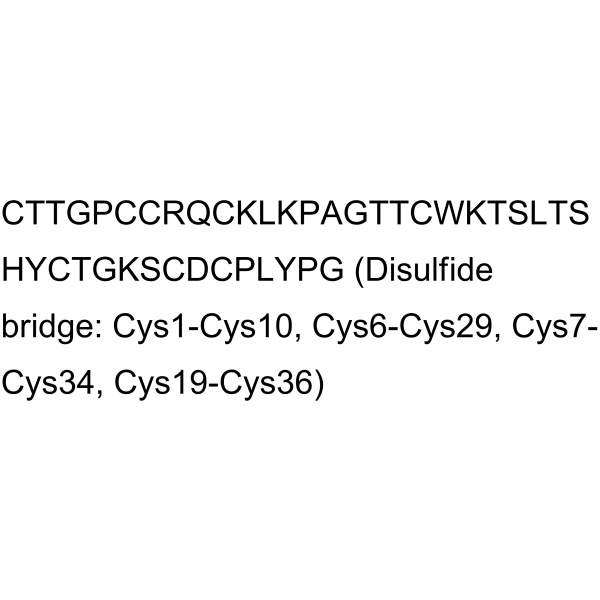
Obtustatin is a non-RGD disintegrin consisting of 41 residues. Obtustatin inhibits the adhesion of α1β1 integrin to type IV Collagen (HY-NP003), blocks α1β1 integrin signaling in endothelial cells, and suppresses FGF2-induced angiogenesis. Obtustatin inhibits tumor progression in mouse models and upregulates VEGF expression in sarcoma-bearing mice. Obtustatin can be used in research related to Lewis lung carcinoma and S-180 sarcoma .
loading...
    loading...
Cat. No.: HY-15266
CAS No.: 112827-99-3
Synonyms: PRI 2202; Impurity D of Calcipotriol
Target:  

Drug Derivative VD/VDR

Research Areas:  

Cancer

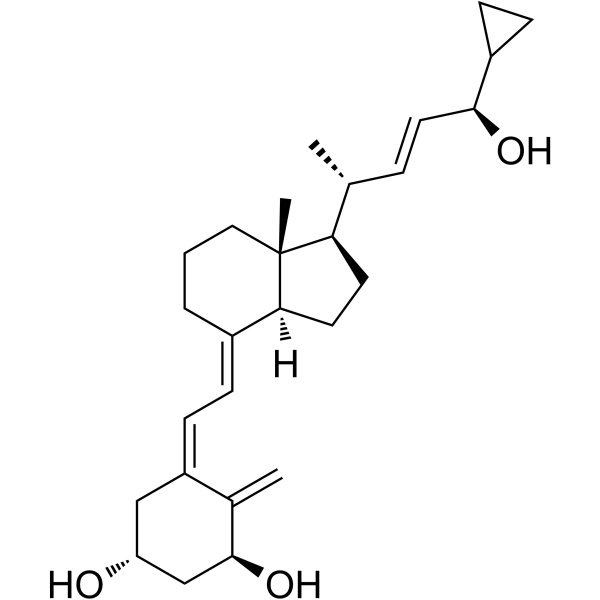
24R-Calcipotriol (PRI 2202; Impurity D of Calcipotriol), an isomer of Calcipotriol (HY-10001), is a synthetic vitamin D analog. 24R-Calcipotriol exhibits synergistic antiproliferative effects with low-dose cytostatics in in vitro. 24R-Calcipotriol produces tumor growth inhibition when combined with Cyclophosphamide (HY-17420) and Cisplatin (HY-17394) in mice models. 24R-Calcipotriol can increase serum calcium levels and reduce blood leukocyte counts . 24R-Calcipotriol can be used for the research of mammary cancer and Lewis lung cancer .
loading...
    loading...
Cat. No.: HY-W110138
CAS No.: 23833-97-8
Research Areas:  

Cancer

Chloroxoquinoline is an anticancer agent. Chloroxoquinoline damages the DNA templates of cancer cells, inducing DNA breaks and cell death, and inhibits cell invasion via down-regulating Rho/Rho kinase signaling pathway. Chloroxoquinoline enhances the radiation sensitivity of Lewis lung cancer cells and xenograft tumors in tumor-bearing mouse models but decreases efficacy after long term exposure in rat models by auto-induction effects on CYP1A and CYP3A. Chloroxoquinoline has a broad-spectrum anticancer activity, such as non-small-cell lung carcinoma (NSCLC), breast cancer and gastric cancer .
loading...
    loading...
Cat. No.: HY-165603
CAS No.: 3006860-57-4
Si5-N14 is a key component of siloxane-incorporated lipid nanoparticles (SiLNP), possessing pro-vascular repair and anti-tumor activities. In the transgenic GFP mouse model, Si5-N14 can mediate CRISPR-Cas9 editing. In the Lewis lung carcinoma (LLC) tumor-bearing mouse model, Si5-N14 can knock out the expression of Vascular Endothelial Growth Factor Receptor 2 (VEGFR2) to exert an anti-tumor effect. In a mouse model of lung injury induced by viral infection, the delivery of Fibroblast Growth Factor-2 (FGF-2) mRNA via Si5-N14 can promote vascular repair, increase blood oxygen levels, and improve lung function. Si5-N14 shows promise for research in the fields of oncology, pneumonia, and cardiovascular diseases .
loading...
    loading...
Cat. No.: HY-119169
CAS No.: 84697-22-3
Synonyms: R 46846
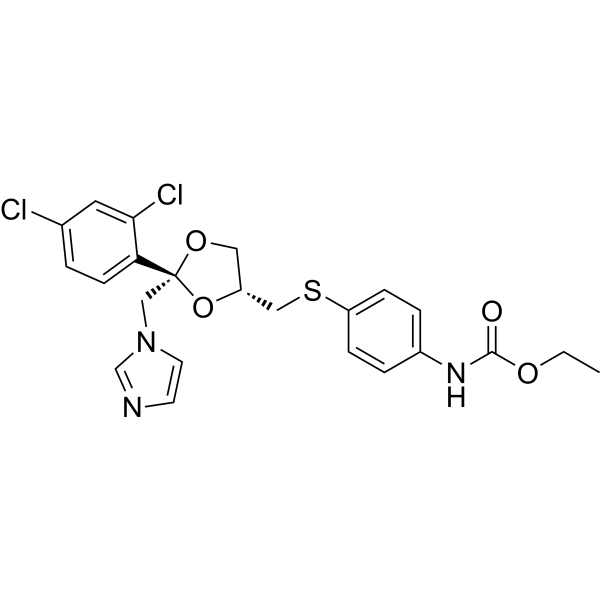
Tubulozole (R 46846) is an orally active inhibitor of tubulin polymerization with an ID50 of 0.34 μM. Tubulozole induces activation of the Chk1 kinase and phosphorylation of ERK1/2, which is required for microtubule formation. Tubulozole arrests Mitosis at the metaphase stage. Tubulozole causes cells to accumulate in the radiosensitive mitotic phase of the cell cycle. Tubulozole exerts anticancer activity against colon cancer. Tubulozole produces a radiosensitizing effect in mouse tumor models and enhances the tumor growth delay effect when combined with γ-ray irradiation. Tubulozole is used in studies related to colon cancer, fascioliasis, MO4 fibrosarcoma, and Lewis lung carcinoma .
loading...
    loading...
Cat. No.: HY-123371
CAS No.: 68160-71-4
Target:  

Others

Research Areas:  

Cancer

Ro 07-1902 is a potent antitumor synergist . Ro 07-1902 enhances the antitumor effects of CCNU (HY-13669), Chlorambucil (HY-13593) and Cyclophosphamide (HY-17420). Ro 07-1902 exhibits no single-agent cytotoxicity and does not delay tumor growth. Ro 07-1902 can be used in research related to various cancers .
loading...
    loading...
Cat. No.: HY-119169A
CAS No.: 83086-73-1
Synonyms: R 46846 hydrochloride
Tubulozole hydrochloride (R 46846 hydrochloride) is an orally active inhibitor of tubulin polymerization with an ID50 of 0.34 μM. Tubulozole hydrochloride induces activation of the Chk1 kinase and phosphorylation of ERK1/2, which is required for microtubule formation. Tubulozole hydrochloride arrests Mitosis at the metaphase stage. Tubulozole hydrochloride causes cells to accumulate in the radiosensitive mitotic phase of the cell cycle. Tubulozole hydrochloride exerts anticancer activity against colon cancer. Tubulozole hydrochloride produces a radiosensitizing effect in mouse tumor models and enhances the tumor growth delay effect when combined with γ-ray irradiation. Tubulozole hydrochloride is used in studies related to colon cancer, fascioliasis, MO4 fibrosarcoma, and Lewis lung carcinoma .
loading...
    loading...
Cat. No.: HY-159803
CAS No.: 128201-92-3
Synonyms: 6-O-(3-Ethoxypropionyl)-3',4'-O-exo-benzylidenechartreusin
Target:  

Endogenous Metabolite

Research Areas:  

Cancer

IST-622 (6-O-(3-Ethoxypropionyl)-3',4'-O-exo-benzylidenechartreusin) is an anti-tumor agent with significant growth inhibitory activity. IST-622 exhibits significant anti-tumor effects against a variety of mouse tumors such as P388 and L1210 leukemias, B16 melanoma, Lewis lung carcinoma, Colon 26 and Colon 38 adenocarcinomas, and M5076 reticulum cell sarcoma. IST-622 was orally administered and the results showed efficacy in different tumor types. In addition, IST-622 provided significant inhibitory effects against two human tumor xenograft models: large cell lung carcinoma (Lu-116) and gastric adenocarcinoma (St-4). IST-622 also exhibited significant growth inhibitory activity against P388 leukemia in vitro, with a half inhibitory concentration (IC50) more than 20 times lower than CT .
loading...
    loading...
Cat. No.: HY-182071
CAS No.: 2349329-01-5
Research Areas:  

Cancer

MG16 is a prodrug of 10-Methoxycamptothecin (HY-N0446). MG16 downregulates CDK6 and upregulates ASK1. MG16 induces cell cycle arrest and Apoptosis. MG16 exhibits anticancer activity against Lewis lung carcinoma, small cell lung cancer, and non-small cell lung cancer .
loading...
    loading...
Cat. No.: HY-181477
ERK5-IN-7 is an orally active ERK5 inhibitor with an IC50 of 403.4 nM. ERK5-IN-7 directly inhibits ERK5 kinase activity, and downregulates the phosphorylation level and total protein expression of ERK5. ERK5-IN-7 induces Apoptosis (upregulates Bax, downregulates Bcl-2, and induces Caspase-3 cleavage). ERK5-IN-7 induces ROS accumulation. ERK5-IN-7 exhibits anticancer effects against Lewis lung cancer .
loading...
    loading...

