
1. Search Result
Search Result
Results for "

SKP2 protein

" in MedChemExpress (MCE) Product Catalog:

8

Inhibitors & Agonists

1

Natural
Products

2

Recombinant Proteins

2

Antibodies

Cat. No. Product Name Target Research Areas Chemical Structure
  • HY-16661
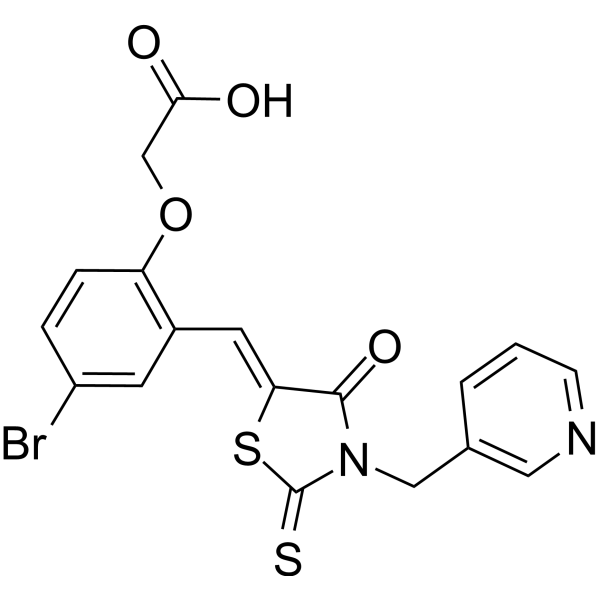
    Skp2 Inhibitor C1
    5+ Cited Publications

    SKPin C1

    E1/E2/E3 Enzyme Cancer
    Skp2 Inhibitor C1 (SKPin C1) is an S-phase kinase-related protein 2 (Skp2) inhibitor with an inhibitory effect on metastatic melanoma cells. Skp2 Inhibitor C1 slows the cell cycle, inhibits cell proliferation, and triggers apoptosis .
    Skp2 Inhibitor C1
  • HY-N12060

    Bcl-2 Family Caspase Apoptosis Autophagy Reactive Oxygen Species (ROS) Akt JNK ERK Cardiovascular Disease Neurological Disease
    Ginkgo biloba extract is a natural product that can be isolated from Ginkgo biloba leaves . Ginkgo biloba extract alleviates oxidative stress-induced neuronal apoptosis (Apoptosis) by stabilizing mitochondrial function, regulating Bcl-2 family proteins and inhibiting caspase activation. Ginkgo biloba extract alleviates testicular injury by upregulating SKP2 and inhibiting Beclin1-independent autophagy (Autophagy) . Ginkgo biloba extract alleviates various types of neuronal damage in animal models. Ginkgo biloba extract reduces behavioral sensitization in rats. Ginkgo biloba extract counteracts Aβ-induced neurotoxicity by blocking a series of Aβ-triggered events, including glucose uptake, ROS accumulation, AKT activation, mitochondrial dysfunction, JNK and ERK 1/2 pathways, and apoptosis, and also interferes with the formation of Aβ oligomers. Ginkgo biloba extract is applicable to research related to cerebral hypoperfusion, testicular injury, Alzheimer's disease, Parkinson's disease, multi-infarct dementia, stroke, traumatic brain injury and amyotrophic lateral sclerosis .
    Ginkgo biloba extract
  • HY-153937

    E1/E2/E3 Enzyme Cancer
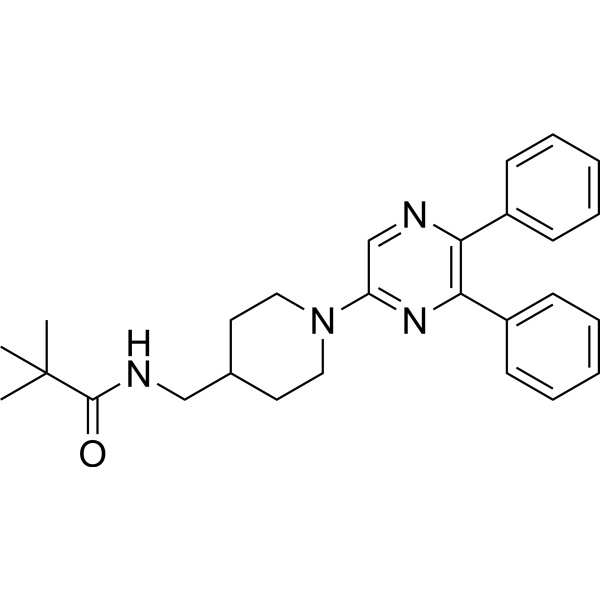
    Skp2 inhibitor 2 is a Skp2-Cks1 protein-protein interaction inhibitor with a human IC50 of 0.57 μM. Skp2 inhibitor 2 binds to Skp2 at the interaction interface to block Skp2-Cks1 complex formation. Skp2 inhibitor 2 can be used for the research of gastric cancer, non-small cell lung cancer, breast cancer, prostate cancer .
    Skp2 inhibitor 2
  • HY-135199

    E1/E2/E3 Enzyme Cancer
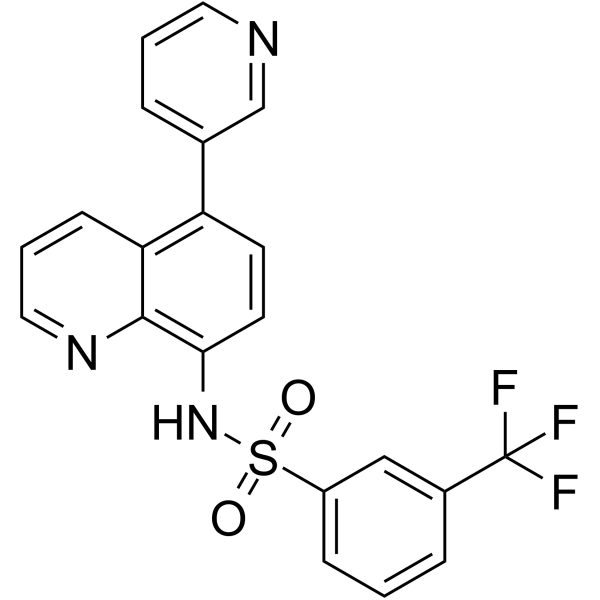
    Ubiquitination-IN-1 (compound 24) is a ubiquitination and Cksl-Skp2 protein-protein interaction (IC50=0.17 μM) inhibitor. Ubiquitination-IN-1 increases levels of p27. Ubiquitination-IN-1 has the potential for treatment disease by blocking the degradation of tumor suppressors .
    Ubiquitination-IN-1
  • HY-162938

    E1/E2/E3 Enzyme Cancer
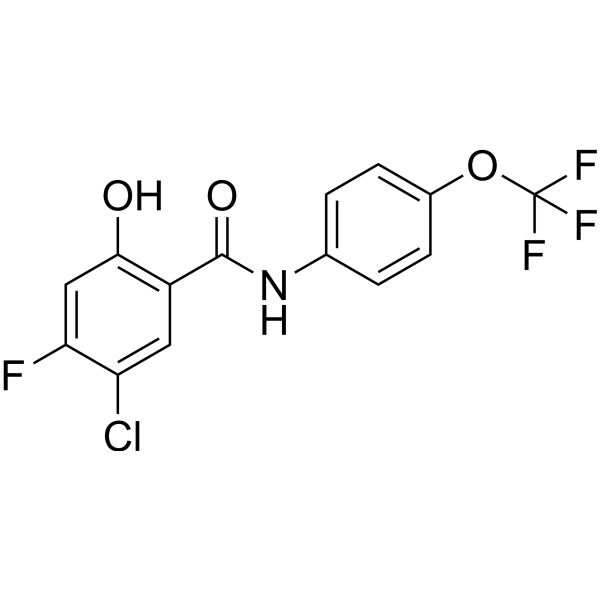
    Skp2 inhibitor 3 is an orally active inhibitor of the Skp2-Cks1 complex, with an IC50 of 4.86 μM. Skp2 inhibitor 3 reduces Skp2 protein expression while upregulating the expression of p21 and p27. Skp2 inhibitor 3 inhibits colony formation and migration of cancer cells, and induces cell cycle arrest at the S phase. Skp2 inhibitor 3 suppresses tumor growth in xenograft mice. Skp2 inhibitor 3 can be used in the research of gastric cancer and prostate cancer .
    Skp2 inhibitor 3
  • HY-174346

    E1/E2/E3 Enzyme Apoptosis DNA/RNA Synthesis Cancer
    Skp2-IN-4 is an Skp2 inhibitor with a IC50 of 0.38  μM for Skp2-Cks1 binding. Skp2-IN-4 improves anti-tumor activity, inhibits the proliferation and induces S phase arrest by targeting Skp2. Skp2-IN-4 significantly enhances Cisplatin (HY-17394) chemosensitivity by suppressing the tumor cell stemness in NCl-H1299 xenograft mice model, promising for lung cancer and esophageal cancer research .
    Skp2-IN-4
  • HY-149954

    SARS-CoV Infection
    SARS-CoV-2-IN-39 (compound 21) is a SARS-CoV-2 inhibitor with an EC50 of 1 μM. SARS-CoV-2-IN-39 against SARS-CoV-2 by inhibiting of SKP2 protein and stabilizing BECN1 .
    SARS-CoV-2-IN-39
  • HY-129108

    (9Z)-UAB-30

    Oct3/4 Microtubule/Tubulin E1/E2/E3 Enzyme Proteasome Neurological Disease Cancer
    9-cis-UAB30 is a rexinoid agonist. 9-cis-UAB30 significantly decreases the proliferation, viability, and motility of both patient-derived xenografts (PDXs). 9-cis-UAB30 induced cell-cycle arrest as demonstrated by the significant increase in the percentage of cells in G1 and a decrease in the percentage of cells in S phase by downregulating SKP2 and/or 20S proteasome activity, which leads to increased p27kip1 protein stability. 9-cis-UAB30 downregulates the abundance of stem cell marker mRNAs (Oct4, Nanog, Sox2, nestin) and upregulates the abundance of differentiation marker mRNAs (β3-tubulin, NSE, HOXC9, GAP43). 9-cis-UAB30 has no adverse effects on the central nervous system and cardiovascular system at the tested dose. 9-cis-UAB30 can be used for the study of neuroblastoma, cutaneous T-cell lymphomas, and breast cancer .
    9-cis-UAB30

Inquiry Online

Your information is safe with us. * Required Fields.

Salutation


Country or Region *

Applicant Name *


Organization Name *

Department *


Email Address *


Product Name *

Cat. No.


Requested quantity *

Phone Number *


Remarks

Inquiry Online

Inquiry Information

Product Name:
Cat. No.:
Quantity:
MCE Japan Authorized Agent:

