
9 Results for "

Triton X-100

" in MedChemExpress (MCE) Product Catalog:
Products (9)

9 Results for "Triton X-100" in MCE Product Catalog:

30
30 Publications Verification
Cat. No.: HY-Y1883
CAS No.: 9002-93-1
Research Areas:  

Infection Cancer

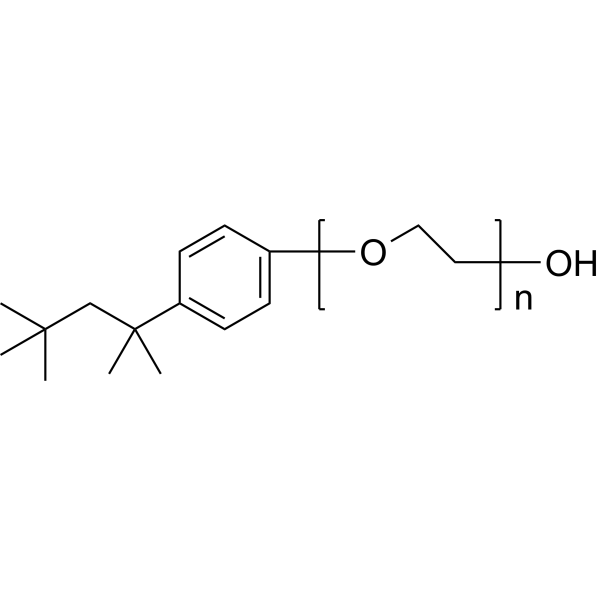
Polyethylene glycol mono(4-tert-octylphenyl) ether surfactant is a non-denaturing detergent that solubilizes lipid membranes. Polyethylene glycol mono(4-tert-octylphenyl) ether surfactant is commonly used in laboratories and is applied to vaccines at different stages of the manufacturing process. Polyethylene glycol mono(4-tert-octylphenyl) ether surfactant is listed as an excipient in certain vaccines including split virus influenza vaccines. Polyethylene glycol mono(4-tert-octylphenyl) ether surfactant is a nonionic surfactant. Polyethylene glycol mono(4-tert-octylphenyl) ether surfactant induces Apoptosis in prostate and colon cancer cell lines and reduces the infectivity of classic enveloped viruses such as WNV .
loading...
    loading...
30
30 Publications Verification
Cat. No.: HY-Y1883A
CAS No.: 9002-93-1
Research Areas:  

Infection Cancer

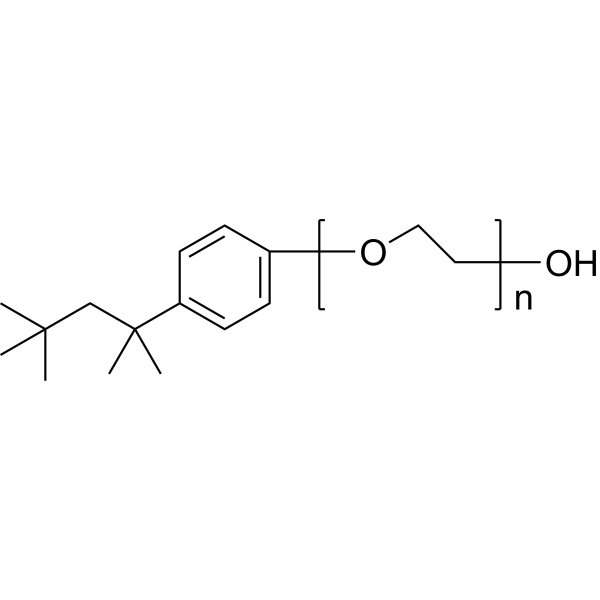
Polyethylene glycol mono(4-tert-octylphenyl) ether is a non-denaturing detergent that solubilizes lipid membranes. Polyethylene glycol mono(4-tert-octylphenyl) ether is commonly used in laboratories and is applied to vaccines at different stages of the manufacturing process. Polyethylene glycol mono(4-tert-octylphenyl) ether is listed as an excipient in certain vaccines including split virus influenza vaccines. Polyethylene glycol mono(4-tert-octylphenyl) ether is a nonionic surfactant. Polyethylene glycol mono(4-tert-octylphenyl) ether induces Apoptosis in prostate and colon cancer cell lines and reduces the infectivity of classic enveloped viruses such as WNV .
loading...
    loading...
2
2 Cited Publications
Cat. No.: HY-W134422
CAS No.: 9036-19-5
Synonyms: Polyoxyethylene octylphenol ether
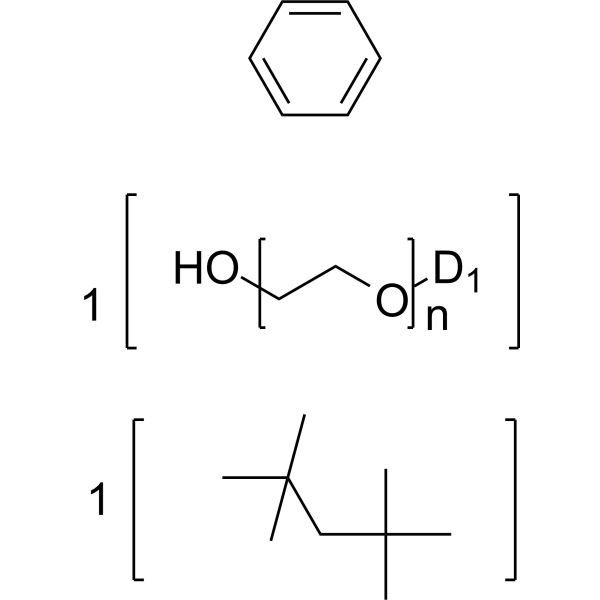
(1,1,3,3-Tetramethylbutyl)phenyl-polyethylene glycol X-114 is a surfactant. (1,1,3,3-Tetramethylbutyl)phenyl-polyethylene glycol X-114 is used to solubilize membranes and whole cells. A solution of (1,1,3,3-Tetramethylbutyl)phenyl-polyethylene glycol X-114 is homogeneous at 0 degrees C but separates in an aqueous phase and a detergent phase above 20 degrees C. (1,1,3,3-Tetramethylbutyl)phenyl-polyethylene glycol X-114 can be used in phase separation studies .
loading...
    loading...
1
1 Cited Publications
Cat. No.: HY-W127703
CAS No.: 65603-19-2
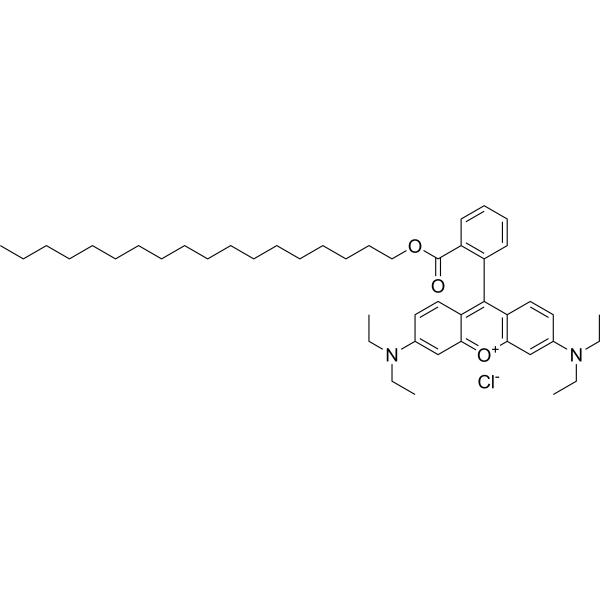
Octadecyl Rhodamine B chloride is an amphiphilic fluorescent probe with both membrane-binding ability and fluorescent properties, which easily forms aggregates in aqueous phase leading to self-quenching. Octadecyl Rhodamine B chloride can be used for cell membrane staining and further applied in membrane biology research. The maximum absorption/emission wavelengths of Octadecyl Rhodamine B chloride monomer in Triton X-100 are 565 nm/585 nm; the absorption peaks of aggregates in water are blue-shifted to 524 nm and 574 nm, with significantly quenched fluorescence .
loading...
    loading...
Cat. No.: HY-W013168
CAS No.: 1492-30-4
Synonyms: 4-Nitrophenyl hexadecanoate; p-Nitrophenyl Palmitate; pNpp
Target:  

Lipase

Research Areas:  

Others

4-Nitrophenyl palmitate (4-Nitrophenyl hexadecanoate) is a chromogenic substrate for lipases and esterases. Upon enzymatic hydrolysis, 4-Nitrophenyl palmitate releases p-nitrophenol, which can be quantified by colorimetric detection at 410 nm as a measure of enzymatic activity. 4-Nitrophenyl palmitate is used to characterize the activity of various bacterial and mammalian enzymes, including those from Burkholderia and porcine pancreatic lipase .
loading...
    loading...
Cat. No.: HY-E70110
CAS No.: 37288-54-3
Research Areas:  

Others

Endo-1,4-β-mannanase is an important catalyst that randomly cleaves the β-1,4-linkages in the main chain of mannan, releasing short-chain β-1,4-mannan and mannose. The catalytic activity of Endo-1,4-β-mannanase toward locust bean gum is enhanced by Mn 2+, Co 2+, Ca 2+, Ba 2+, Triton X-100, sodium azide and N-ethylmaleimide, completely inhibited by Hg 2+ and N-bromosuccinimide, and partially inhibited by EDTA and Cu 2+. Endo-1,4-β-mannanase can be used in studies related to plant hemicellulose degradation, biomass saccharification, elimination of anti-nutritional factors in feed, and manno-oligosaccharide prebiotics .
loading...
    loading...
Cat. No.: HY-124339
CAS No.: 2092913-64-7
JNJ525 is a TNFα inhibitor with IC50 values of 1.2 μM and 1.1 μM against TNFR1 and TNFR2, respectively. JNJ525 forms ordered aggregates and induces quaternary structural transition of TNFα, thereby blocking the protein-protein interaction between TNFα and its receptors. The inhibitory activity of JNJ525 is completely lost in the presence of 0.1% Triton X-100 .
loading...
    loading...
Cat. No.: HY-E70421
Target:  

Angiotensin Receptor

Research Areas:  

Others

Peptide ligase is an Asx-specific asparaginyl endopeptidase (AEP) ligase and cyclase that can be isolated from the pods of butterfly pea (Clitoria ternatea). Peptide ligase mediates traceless intramolecular cyclization of polypeptides. Peptide ligase mediates intermolecular ligation of polypeptides or proteins. Peptide ligase can be used to cyclize food-derived angiotensin-converting enzyme (ACE) inhibitory peptides, thereby enhancing the stability and biological activity of ACE inhibitory peptides. Peptide ligase is applicable to relevant research in the fields of food and biopharmaceuticals .
loading...
    loading...
Cat. No.: HY-183237
CAS No.: 112851-89-5
Target:  

Lipoxygenase

Research Areas:  

Metabolic Disease

Oxphaman is a pea lipoxygenase inhibitor with an IC50 of 140 nM against pea lipoxygenase. Oxphaman inhibits protamine sulfate-induced degranulation of rat peritoneal mast cells .
loading...
    loading...

