12 Results for "

active site cysteine residue

" in MedChemExpress (MCE) Product Catalog:
Products (12)

12 Results for "active site cysteine residue" in MCE Product Catalog:

5
5 Cited Publications
Cat. No.: HY-128206
CAS No.: 459420-09-8
Purity:  99.98%
Synonyms: HMPSNE
Target:  

Hippo (MST)

Research Areas:  

Metabolic Disease

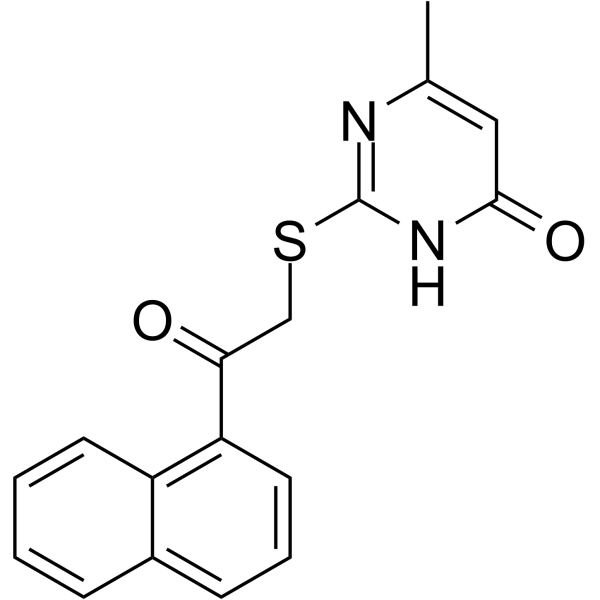
I3MT-3 (HMPSNE) is a potent, selective, and cell-membrane permeable inhibitor of 3-Mercaptopyruvate sulfurtransferase (3MST) (IC50=2.7 μM). I3MT-3 is inactive for other H2S/sulfane sulfur-producing enzymes.?I3MT-3 targets a persulfurated cysteine residue located in the active site of 3MST .
loading...
    loading...
2
2 Cited Publications
Cat. No.: HY-158301
CAS No.: 2929308-79-0
Purity:  99.94%
MY-1B is a covalent inhibitor of the RNA Methyltransferase NSUN2 (IC50: 1.3 μM). MY-1B stereoselectively ligands active-site cysteine residues (C271) of NSUN2. MY-1B can stereoselectively and covalently bind to PSME1, disrupting the proteasome regulatory complex and downregulating the presentation of specific MHC-I subtypes .
loading...
    loading...
Cat. No.: HY-12412
CAS No.: 1230628-71-3
Purity:  98.05%
Synonyms: NCGC-00183434
Target:  

Caspase

Research Areas:  

Inflammation/Immunology Cancer

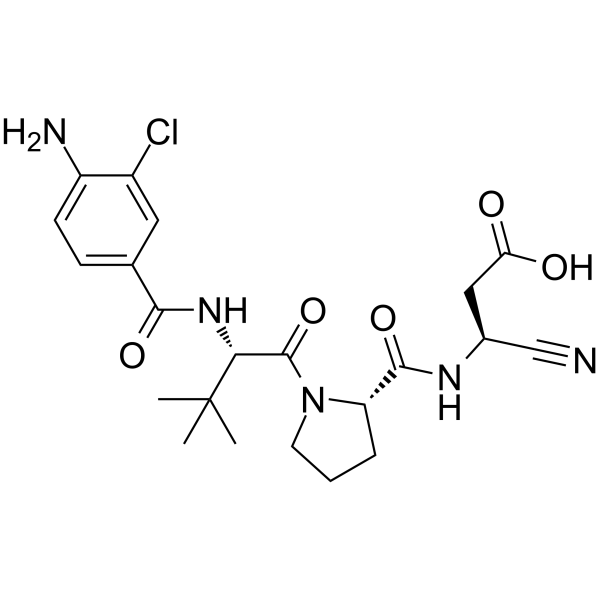
ML132 (NCGC-00183434) is a selective caspase 1 inhibitor with an IC50 value of 0.023 nM. ML132 has good stability and can be used as a caspase 1 molecular probe. ML132 is applicable to research in the fields of anticancer and anti-inflammatory studies .
loading...
    loading...
Cat. No.: HY-148254
CAS No.: 2705841-52-5
Purity:  99.78%
Target:  

Deubiquitinase

Research Areas:  

Others

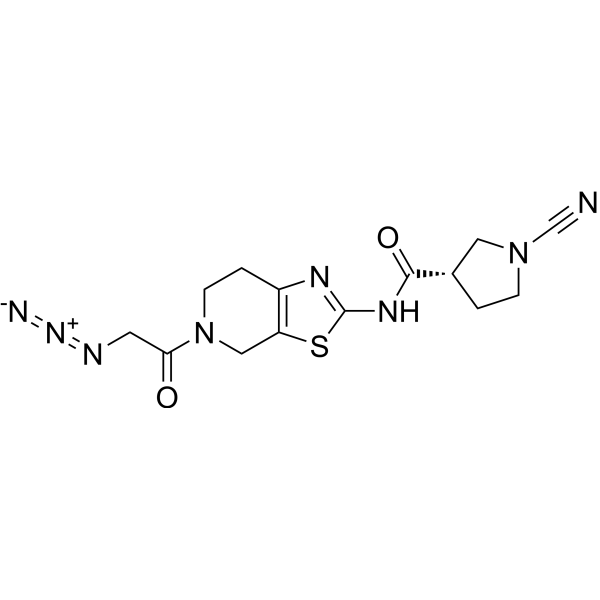
8RK64 is a UCHL1 inhibitor that covalently binds the active-site cysteine residue to form an isothiourea adduct, with selectivity over UCHL3, UCHL5, and other cysteine DUBs. 8RK64 inhibits human UCHL1 with an IC50 of 0.32 μM. 8RK64 is an azide-containing precursor usable as a two-step activity-based probe via click chemistry. 8RK64 can be used for the research of Parkinson's disease .
loading...
    loading...
Cat. No.: HY-137028
CAS No.: 136904-69-3
Synonyms: PD157432
Target:  

EGFR

Research Areas:  

Cancer

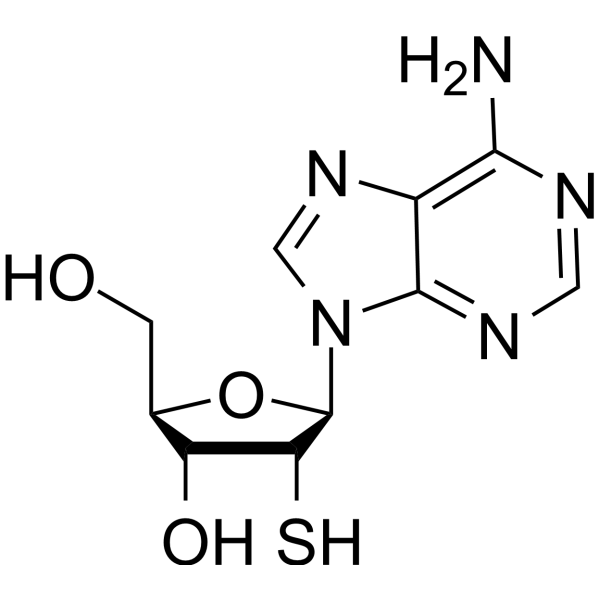
2'-Thioadenosine (PD157432) is a selective and irreversible inhibitor of ErbB-1 and ErbB-2, with an IC50 of 45 µM for ErbB-2. 2'-Thioadenosine covalently inactivates ErbB-1 via modification of a cysteine residue at the active site .
loading...
    loading...
Cat. No.: HY-158378
CAS No.: 3058726-63-6
Synonyms: R-AST-OH
Target:  

Glutaminase

Research Areas:  

Cancer

Trivalent hydroxyarsinothricn (R-AST-OH) is a covalent and irreversible kidney-type glutaminase (KGA) inhibitor. Trivalent hydroxyarsinothricn binds to the glutamine binding site and forms a covalent bond with an active site cysteine residue. Trivalent hydroxyarsinothricn selectively kills triple-negative breast cancer (TNBC) cells and is not cytotoxic to the control cell line. KGA is the enzyme that controls glutamine metabolism and is correlated with tumor malignancy .
loading...
    loading...
Cat. No.: HY-183387
CAS No.: 1348565-08-1
Target:  

Parasite Cathepsin

Research Areas:  

Infection

K11002 hydrobromide is a cysteine protease inhibitor. K11002 hydrobromide forms a covalent bond with the active site cysteine residue via Michael addition. K11002 hydrobromide inhibits the growth of Trypanosoma brucei. K11002 hydrobromide can be used in the research of African human trypanosomiasis (sleeping sickness) .
loading...
    loading...
Cat. No.: HY-P0112
CAS No.: 1027141-02-1
Target:  

Deubiquitinase

Research Areas:  

Neurological Disease Cancer

Z-VAE (OMe)-FMK is a selective inhibitor of UCHL1, with better selectivity over UCHL3 and UCHL5. Z-VAE (OMe)-FMK binds to the active site cleft, covalently modifies the active site cysteine C90 to form a thioether bond, binds to inactive UCHL1 with a misaligned catalytic triad, and acts via a two-step addition-folding/migration/displacement mechanism. Z-VAE (OMe)-FMK stabilizes interactions through hydrogen bonding with oxyanion hole residues and van der Waals interactions with surrounding residues. Z-VAE (OMe)-FMK can be used in research related to colorectal cancer, lung cancer, pancreatic cancer, and Alzheimer's disease .
loading...
    loading...
Cat. No.: HY-189048
Research Areas:  

Infection

CPN4F is a chalcone derivative with antiparasitic activity. CPN4F is an inhibitor of the cysteine protease cruzain. CPN4F forms a key hydrogen bond with the Trp-184 residue in the active site of parasitic cruzain as an electrophile, and induces oxidative stress, cell membrane degradation, and necrosis, thereby inhibiting parasite proliferation. CPN4F is used in research related to Chagas disease .
loading...
    loading...
Cat. No.: HY-L925
9,363 compounds

Cysteine proteases (CPs), a key enzyme family regulating physiological metabolism and mediating pathological processes (such as abnormal bone resorption, tumour invasion, and pathogen infection), represent a core therapeutic target for developing specific inhibitors in disease intervention. Currently reported CP inhibitors primarily achieve their inhibitory function by precisely binding to CP active pockets (e.g., S1-S4 non-primed regions or S1'-S2' primed regions) and forming covalent/non-covalent interactions with the active site cysteine residues, providing clear structural references for the development of novel inhibitors.

This compound library, designed based on the core strategy of "similarity-based known active structures", contains over 200 cysteine protease inhibitors. Leveraging AI-driven molecular screening technology, it retains the critical pharmacological and shape features of reported CP inhibitors, serving as a specialized tool for efficiently discovering novel cysteine protease inhibitors.

Cat. No.: HY-182636
CAS No.: 1895049-73-6
MT16-001 is a cell-permeable UCHL1 inhibitor with an IC50 value of 580 nM. MT16-001 also exhibits considerable inhibitory activity against USP30, and shows selectivity for other UCH family deubiquitinases (DUBs) as well as the broader proteome. MT16-001 binds covalently to the cysteine residue at the active site of UCHL1, and forms covalent interactions with ALDH2, ALDH9A1 and GATD3A in intact cells. Meanwhile, as a cytotoxic agent, it displays a steep dose-response curve in human embryonic kidney cells. MT16-001 can be used for research on various cancers, liver fibrosis and pulmonary fibrosis .
loading...
    loading...
Cat. No.: HY-LD004
14 million compounds

DEL technology enables the simultaneous screening of millions or billions of compounds in a single tube by covalently linking each small molecule with a unique DNA sequence. Traditional DEL screening primarily focuses on identifying non-covalent binding molecules, where interactions with the target are reversible. In contrast, DNA‑encoded covalent library is an ultra‑high‑throughput screening library developed on the basis of conventional DNA‑encoded library technology. It incorporates controllable electrophilic covalent warheads capable of forming irreversible covalent bonds with amino acid residues at the active sites of target proteins, including Cys, Lys, Ser, Tyr, and others. This covalent binding enhances binding affinity, prolongs residence time at the target site, and has the potential to overcome challenges associated with traditional non-covalent inhibitors, such as drug resistance or off-target effects.

Each compound in the library contains both a binding domain and an electrophilic warhead. It first recognizes and binds to the target through non covalent interactions, and then forms a stable covalent bond with key amino acid residues to achieve irreversible inhibition. This library is specifically designed for the discovery of potent, long lasting, and highly selective covalent inhibitors, particularly for undruggable targets such as kinases, GPCRs, proteases, and mutant oncoproteins. Each molecule is uniquely labeled with a DNA barcode for molecular identification and sequencing decoding.

This library is an advanced and highly diverse collection, consists of 35 independent sub-libraries with a total scaleof 14 million compounds, It incorporates over 14 experimentally validated covalent warheads capable of targeting cysteine, lysine, arginine, aspartic acid and glutamic acid. This library is constructed with diverse drug like core scaffolds and integrated controllable covalent warheads, it features structural diversity, reaction spec

  • 1

