
12 Results for "

cardiovascular disease (CVD)

" in MedChemExpress (MCE) Product Catalog:
Products (12)

12 Results for "cardiovascular disease (CVD)" in MCE Product Catalog:

9
9 Publications Verification
Cat. No.: HY-132591
CAS No.: 1639324-58-5
Purity:  99.80%
Synonyms: ALN-PCSsc
Inclisiran is a double-stranded small interfering RNA (siRNA) molecule. Inclisiran inhibits the transcription of PCSK9. Inclisiran inhibits Pyroptosis, activates PPARγ, and reduces NLRP3, cleaved caspase-1, IL-1β, and IL-18. Inclisiran has anti-inflammatory, lipid-regulating and anti-atherosclerotic activities. Inclisiran can be used in researches of hyperlipidemia and cardiovascular disease (CVD) .
loading...
    loading...
9
9 Publications Verification
Cat. No.: HY-132591A
Purity:  98.10%
Synonyms: ALN-PCSsc sodium
Inclisiran sodium is a double-stranded small interfering RNA (siRNA) molecule. Inclisiran sodium inhibits the transcription of PCSK9. Inclisiran sodium inhibits Pyroptosis, activates PPARγ, and reduces NLRP3, cleaved caspase-1, IL-1β, and IL-18. Inclisiran sodium has anti-inflammatory, lipid-regulating and anti-atherosclerotic activities. Inclisiran sodium can be used in researches of hyperlipidemia and cardiovascular disease (CVD) .
loading...
    loading...
5
5 Cited Publications
Cat. No.: HY-N0084
CAS No.: 13159-28-9
Synonyms: Betulinic aldehyde; Betunal
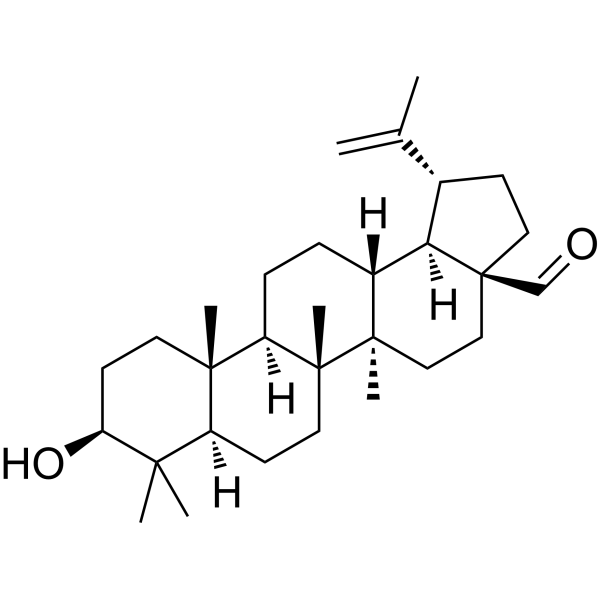
Betulinaldehyde (Betunal) Has anti-cancer and anti-staphylococcus aureus activity. Betulinaldehyde Suppressible Akt, MAPK sum STAT3 Signal path, increase self-transfer, Suppression A549 Cellular vitality, increase and transfer. Betulinaldehyde suppresses PLCγ1/Ca 2+/MMP9 signal pathway, has a key effect on vascular plasticity, and is available for cardiovascular disease (CVD) research.
loading...
    loading...
1
1 Cited Publications
Cat. No.: HY-W012977
CAS No.: 624-95-3
Synonyms: DMB; Neohexanol
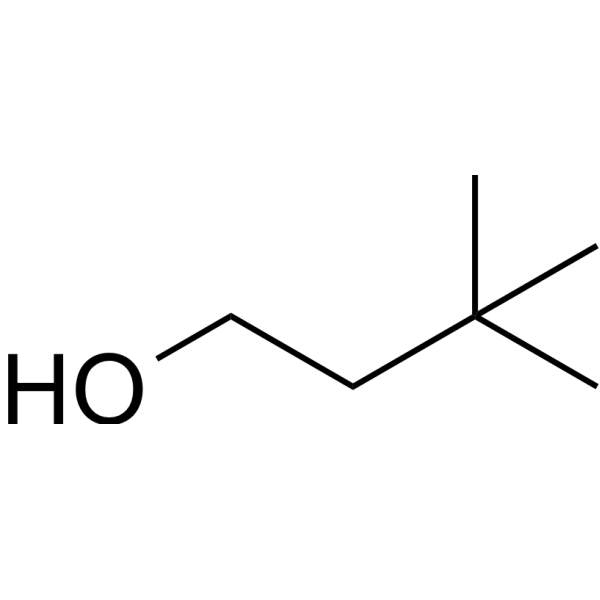
3,3-Dimethyl-1-butanol (DMB) is an orally active inhibitor of trimethylamine (TMA) and trimethylamine N-oxide (TMAO). 3,3-Dimethyl-1-butanol inhibits the signaling pathway of p65 NF-κB and TGF-β1/Smad3. 3,3-Dimethyl-1-butanol has potential applications in cardiovascular disease (CVD) .
loading...
    loading...
Cat. No.: HY-143221
Purity:  95.13%
Target:  

Drug Intermediate

Research Areas:  

Cardiovascular Disease

AS-Inclisiran sodium is the antisense of Inclisiran (HY-132591). Inclisiran is a double-stranded small interfering RNA (siRNA) molecule. Inclisiran inhibits the transcription of PCSK9. Inclisiran inhibits Pyroptosis, activates PPARγ, and reduces NLRP3, cleaved caspase-1, IL-1β, and IL-18. Inclisiran has anti-inflammatory, lipid-regulating and anti-atherosclerotic activities. Inclisiran can be used in researches of hyperlipidemia and cardiovascular disease (CVD) .
loading...
    loading...
Cat. No.: HY-W016389
CAS No.: 2443-58-5
Synonyms: 2-OHFLU
Target:  

Endogenous Metabolite

Research Areas:  

Metabolic Disease

2-Hydroxyfluorene (2-OHFLU) is a polycyclic aromatic hydrocarbon metabolite. 2-Hydroxyfluorene is positively associated with cardiovascular disease (CVD) and hyperlipidemia.
loading...
    loading...
Cat. No.: HY-N11081
CAS No.: 29065-05-2
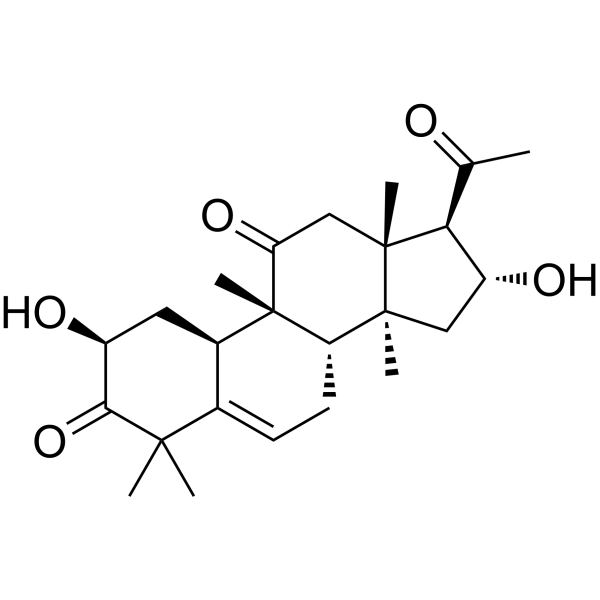
Hexanorcucurbitacin D, a cucurbitacin, is a weak ecdysteroid receptor agonist. Hexanorcucurbitacin D can be isolated from Trichosanthes cucumeroides roots. Hexanorcucurbitacin D can be used for the research of cardiovascular disease (CVD) .
loading...
    loading...
Cat. No.: HY-171465
CAS No.: 2566425-77-0
Target:  

Apolipoprotein

Research Areas:  

Cardiovascular Disease

Lp(a)-IN-6 (Compound 6) is a lipoprotein(a) (Lp(a)) inhibitor, with an IC50 of <0.314 nM. Lp(a)-IN-6 can be used for the research of cardiovascular disease (CVD) .
loading...
    loading...
Cat. No.: HY-16910G
CAS No.: 838818-26-1
WIKI4 (GMP) is WIKI4 (HY-16910) produced by using GMP guidelines. GMP small molecules work appropriately as an auxiliary reagent for cell therapy manufacture. WIKI4 is a potent tankyrase inhibitor .
loading...
    loading...
Cat. No.: HY-143314
CAS No.: 1454588-34-1
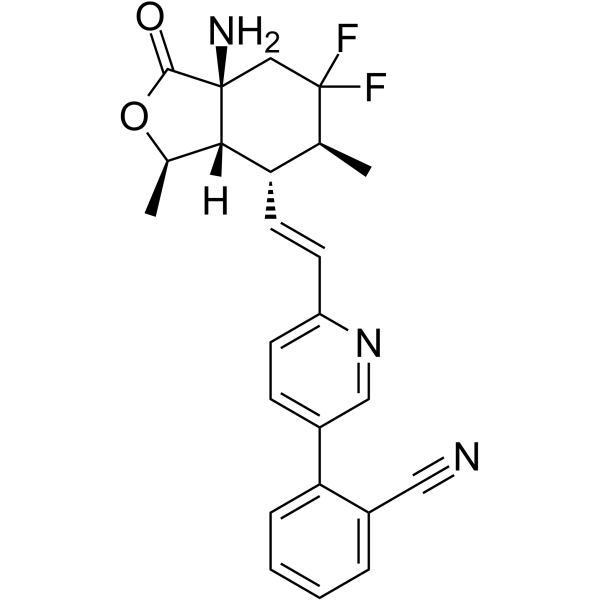
Protease-Activated Receptor-1 antagonist 2 is an orally active protease-activated receptor-1 (PAR-1) antagonist, with an IC50 value of 7 nM. Protease-Activated Receptor-1 antagonist 2 has favorable pharmacokinetic properties which is useful in the research of cardiovascular disease (CVD), such as atherosclerosis and restenosis .
loading...
    loading...
Cat. No.: HY-L046
2,468 compounds

Cardiovascular diseases (CVDs) are a group of disorders of the heart and blood vessels which include coronary heart disease, cerebrovascular disease, peripheral arterial disease, rheumatic heart disease, etc. CVDs are the number 1 cause of death globally. Smoking, unhealthy nutrition, aging population, lack of physical activity, arterial hypertension, or diabetes can promote cardiovascular disease like myocardial infarction or stroke. It is multifactorial and encompasses a multitude of mechanisms, such as eNOS uncoupling, reactive oxygen species formation, chronic inflammatory disorders and abnormal calcium homeostasis. Antioxidant, anti-inflammatory and anti-diabetes agents may reduce the cardiovascular disease risk.

MCE supplies a unique collection of 2,468 compounds with confirmed anti-cardiovascular activity. These compounds mainly target metabolic enzyme, membrane transporter, ion channel, inflammation related signaling pathways. MCE Anti-Cardiovascular Disease Compound Library can be used for cardiovascular diseases related research and high throughput and high content screening for new drugs.

Cat. No.: HY-W012977R
CAS No.: 624-95-3
Synonyms: DMB (Standard); Neohexanol (Standard)
3,3-Dimethyl-1-butanol (Standard) is the analytical standard of 3,3-Dimethyl-1-butanol (HY-W012977). This product is intended for research and analytical applications. 3,3-Dimethyl-1-butanol (DMB) is an orally active inhibitor of trimethylamine (TMA) and trimethylamine N-oxide (TMAO). 3,3-Dimethyl-1-butanol inhibits the signaling pathway of p65 NF-κB and TGF-β1/Smad3. 3,3-Dimethyl-1-butanol has potential applications in cardiovascular disease (CVD) .
loading...
    loading...
  • 1

