
11 Results for "

catalytic domain enzyme

" in MedChemExpress (MCE) Product Catalog:
Products (11)

11 Results for "catalytic domain enzyme" in MCE Product Catalog:

1
1 Cited Publications
Cat. No.: HY-122886
CAS No.: 2305045-76-3
Purity:  98.00%
Target:  

Deubiquitinase

Research Areas:  

Cancer

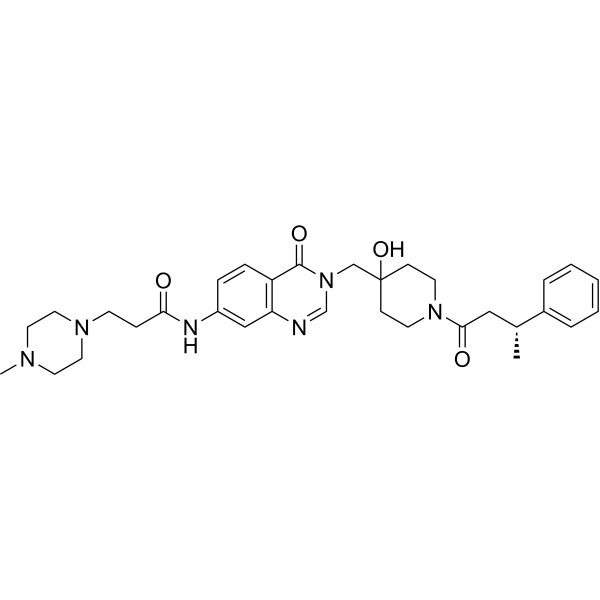
XL 188 is a potent and selective USP7 inhibitor with IC50 values of 90 nM and 193 nM for USP7 full-length and catalytic domain enzyme, respectively. XL 188 can be used in research of cancer .
loading...
    loading...
Cat. No.: HY-N3103
CAS No.: 7362-39-2
Synonyms: Ethyl (E)-p-hydroxycinnamate; Ethyl trans-4-hydroxycinnamate
p-Coumaric Acid Ethyl Ester (Ethyl (E)-p-hydroxycinnamate; Ethyl trans-4-hydroxycinnamate) is a non-competitive, reversible inhibitor of tyrosinase (IC50=4.89 μg/mL, Ki=1.83 μg/mL), which can quench the intrinsic fluorescence of the enzyme. p-Coumaric Acid Ethyl Ester changes the binding affinity of L-tyrosine by inducing conformational changes in the catalytic domain of tyrosinase, and does not bind to the copper ion of the enzyme. p-Coumaric Acid Ethyl Ester is used in the development of medicines, cosmetics and fruit preservation products using pollen .
loading...
    loading...
Cat. No.: HY-N10159
CAS No.: 60941-76-6
1-Benzyl-I3C is a NEDD4-1 inhibitor with significant anticancer activity. 1-Benzyl-I3C can directly inhibit the ubiquitination activity of NEDD4-1 with an IC50 of 12.3μM, which is significantly better than its precursor compound I3C of 284μM. 1-Benzyl-I3C and its analogs showed good effects in inhibiting the proliferation of human melanoma cells, which is roughly related to their potency as NEDD4-1 enzyme inhibitors. By combining in vitro ubiquitination experiments and thermal stability analysis, 1-Benzyl-I3C was shown to be able to bind to the catalytic HECT domain of NEDD4-1 .
loading...
    loading...
Cat. No.: HY-162094
CAS No.: 3027135-80-1
Research Areas:  

Infection

CMX410 is an orally active and selective Mycobacterium tuberculosis Pks13 acyltransferase domain inhibitor and anti-bacterial agent. CMX410 reacts with the catalytic serine of the Pks13-AT domain to form a stable β-lactam ring, disables the enzyme’s active site, reduces trehalose monomycolate and trehalose dimycolate levels, triggers cell lysis, and reduces intracellular bacterial burden. CMX410 can be used for the research of tuberculosis .
loading...
    loading...
Cat. No.: HY-18938A
CAS No.: 1448428-05-4
Synonyms: GS-4997 hydrochloride
Target:  

Apoptosis MAP3K

Research Areas:  

Cancer

Selonsertib hydrochloride (GS-4997 hydrochloride) is an orally bioavailable enzyme inhibitor with potential anti-inflammatory, anti-tumor and anti-fibrotic activities. Selonsertib hydrochloride blocks ASK1 phosphorylation and activation by binding to the catalytic kinase domain. Selonsertib hydrochloride prevents the production of inflammatory cytokines and reduces the expression of genes associated with fibrosis. Selonsertib hydrochloride inhibits excessive apoptosis and limits cell proliferation .
loading...
    loading...
Cat. No.: HY-182615
CAS No.: 145209-39-8
Target:  

Cholinesterase (ChE)

Research Areas:  

Neurological Disease

Cymserine is a blood-brain barrier-permeable butyrylcholinesterase (BuChE) inhibitor with an IC50 value of 56.43 nM and a Ki of 38 nM. Cymserine binds to the catalytic domain of BuChE in a concentration-dependent manner to form a stable carbamylated enzyme complex, and exhibits BuChE selectivity over acetylcholinesterase due to its structural compatibility with the larger acyl-binding pocket of BuChE. Cymserine can be used in the research of Alzheimer's disease .
loading...
    loading...
Cat. No.: HY-402216
CAS No.: 95-38-5
Research Areas:  

Endocrinology

N-b-Hydroxyethyl oleyl imidazoline is a selective enzyme inhibitor targeting DIO, with an IC50 of 3.9 μM against human DIO3. N-b-Hydroxyethyl oleyl imidazoline binds to the catalytic domain of deiodinase and blocks the deiodination catalytic reaction of thyroid hormone molecules. N-b-Hydroxyethyl oleyl imidazoline can be used in studies related to the functional regulation of thyroid deiodinases .
loading...
    loading...
Cat. No.: HY-P79457
Purity:  ≥ 95%, as determined by reducing SDS-PAGE.
Synonyms: USP2; Ubiquitin Specific Peptidase 2; UBP41; Ubiquitin-Specific-Processing Protease 2; Ubiquitin Carboxyl-Terminal Hydrolase 2; 41 KDa Ubiquitin-Specific Protease; Deubiquitinating enzyme 2; Ubiquitin Thioesterase 2; Ubiquitin Specific Protease 12; Ubiqui
Species:  
Human
Source:  
E. coli
loading...
    loading...
Cat. No.: HY-184485
Research Areas:  

Infection

MB-32 is a potent and selective allosteric inhibitor of human angiotensin-converting enzyme 2 (hACE2) with a Kd value of 7.078 μM. MB-32 binds to a non-catalytic surface pocket on the N-terminal helix of ACE2, disrupts the interaction between ACE2 and the receptor-binding domain of SARS-CoV-2 spike protein through allosteric action, and preserves the enzymatic activity of ACE2 across different species. MB-32 achieves high concentrations in the airway via intranasal administration, with no detected cardiovascular toxicity. MB-32 can be used for research on coronavirus disease 2019 .
loading...
    loading...
Cat. No.: HY-P701349
Purity:  ≥ 90%, as determined by reducing SDS-PAGE.
Synonyms: USP2; Ubiquitin Specific Peptidase 2; UBP41; Ubiquitin-Specific-Processing Protease 2; Ubiquitin Carboxyl-Terminal Hydrolase 2; 41 KDa Ubiquitin-Specific Protease; Deubiquitinating enzyme 2; Ubiquitin Thioesterase 2; Ubiquitin Specific Protease 12; Ubiquitin Specific Protease 2; Ubiquitin Specific Protease 9; USP9
Species:  
Human
Source:  
E. coli
loading...
    loading...
Cat. No.: HY-W1143867
CAS No.: 2226-71-3
4’-Phosphopantetheine is an orally active coenzyme A (CoA) precursor. 4’-Phosphopantetheine is membrane-permeable and acts as a CoA precursor, a prosthetic group, and a reactive oxygen species (ROS) inhibitor. 4’-Phosphopantetheine binds covalently to rat liver fatty acid synthase, modifies the conserved serine residue in the PKS/NRPS carrier protein domain, and serves as a substrate for CoA synthase and PPAT. 4’-Phosphopantetheine undergoes non-catalytic exchange on rat liver fatty acid synthase, with a faster turnover rate than that of the enzyme complex, and restores intracellular CoA levels in cells with impaired de novo biosynthesis. 4’-Phosphopantetheine rescues phenotypes induced by CoA deficiency, normalizes PKAN-related biomarkers, restores mitochondrial enzyme activity, and alleviates vascular endothelial damage. 4’-Phosphopantetheine shows biological stability in serum, acts as a prosthetic group and degradation product of ACP, and inhibits the formation of atherosclerotic plaques. 4’-Phosphopantetheine can be used in the research of brain iron accumulation neurodegenerative diseases, pantothenate kinase-associated neurodegeneration, CoASY protein-associated neurodegenerative diseases, coronary heart disease, and atherosclerosis .
loading...
    loading...
  • 1

