






1. Search Result
Search Result
Pathways Recommended: Metabolic Enzyme/Protease
Results for "

glycolytic enzyme

" in MedChemExpress (MCE) Product Catalog:

21

Inhibitors & Agonists

2

Screening Libraries

1

Antibodies

Cat. No. Product Name Target Research Areas Chemical Structure
  • HY-12025
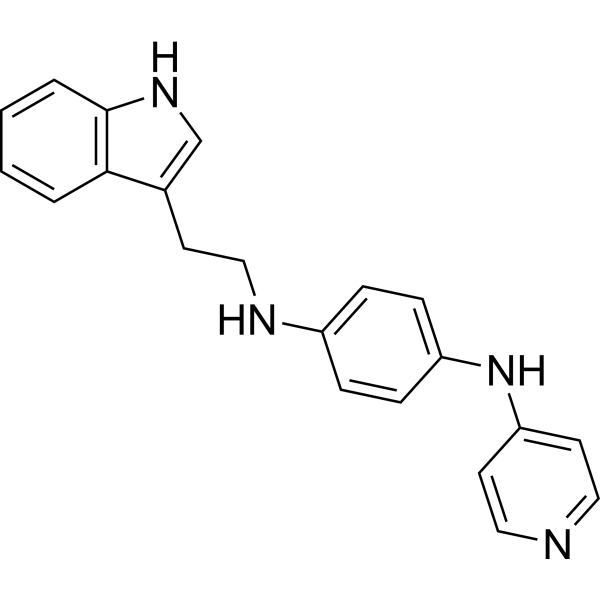
    Serdemetan
    3 Publications Verification

    JNJ-26854165

    MDM-2/p53 E1/E2/E3 Enzyme Apoptosis Cancer
    Serdemetan (JNJ-26854165) is a potent anticancer agent with radiosensitizing activity. Serdemetan exhibits antiproliferative activity in various p53 wild-type tumor cells. Serdemetan also antagonizes the Mdm2-HIF1α axis leading to decreased levels of glycolytic enzymes .
    Serdemetan
  • HY-P2806

    PK; Fluorokinase

    Endogenous Metabolite Metabolic Disease Cancer
    Pyruvate Kinase, Microorganism (PK) is a glycolytic enzyme that catalyzes the conversion of phosphoenolpyruvate and ADP to pyruvate and ATP .
    Pyruvate Kinase, Microorganism
  • HY-P2726

    Fructose-diphosphate aldolase

    Fructose-1,6-bisphosphate aldolase Endogenous Metabolite Metabolic Disease
    Aldolase, Rabbit muscle (Fructose-diphosphate aldolase) is a glycolytic enzyme and glucose availability sensor. Aldolase, Rabbit muscle catalyzes the reversible carbon-carbon cleavage of fructose-1,6-bisphosphate to produce dihydroxyacetone phosphate and glyceraldehyde 3-phosphate. Aldolase, Rabbit muscle is an essential component for v-ATPase activity. Aldolase, Rabbit muscle participates in processes such as gluconeogenesis, the Calvin cycle and glycolysis .
    Aldolase, Rabbit muscle
  • HY-P2776

    Endogenous Metabolite Metabolic Disease
    Hexokinase (ScHEX1) (EC 2.7.1.1) is a glycolytic enzyme hexokinase that is inhibited by n-acetylglucosamine. Inhibition of Hexokinase (ScHEX1) by n-acetylglucosamine leads to its separation from the mitochondrial outer membrane, resulting in activation of NLRP3 inflammasome .
    Hexokinase, microorganism
  • HY-170404

    Phosphatase Metabolic Disease
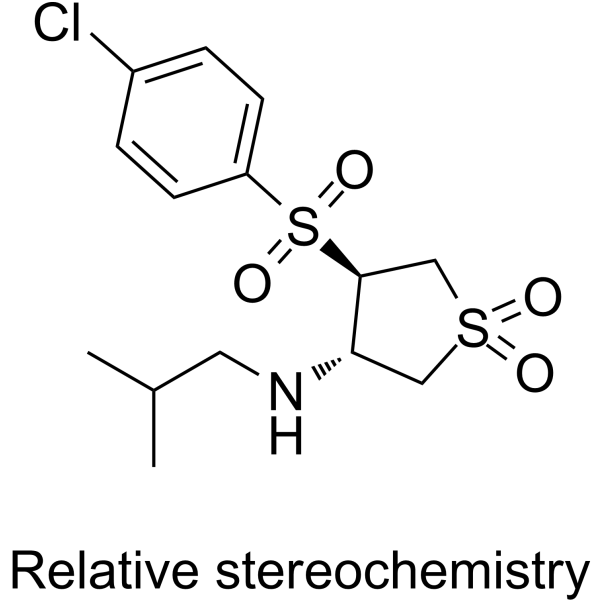
    KF-52 is a phosphofructokinase-1 (PFK1) inhibitor with an IC50 value of 2.1 μM. KF-52 significantly increases the ratio of oxygen consumption rate (OCR) to extracellular acidification rate (ECAR). KF-52 is applicable to research related to mitochondrial dysfunction .
    KF-52
  • HY-128788

    DNA/RNA Synthesis SARS-CoV Endogenous Metabolite Flavivirus Lactate Dehydrogenase Infection
    ddhCTP is an endogenously produced pyrimidine base analog with a Kd of 17.0 nM for LLDH and an IC50 of 55.8 μM for GAPDH. By inhibiting key metabolic enzymes such as GAPDH, ddhCTP reduces glycolytic flux and shifts metabolic flow toward the pentose phosphate pathway, thereby regulating the redox balance of cells. As a competitive CTP analog, ddhCTP terminates RNA synthesis by flavivirus RdRps and SARS-CoV-2 RdRp, and inhibits Zika virus replication in vivo. ddhCTP can be used in studies related to viral infections, COVID-19 and Zika virus infections.
    ddhCTP
  • HY-P2765

    GPDH; α-Glycerophosphate dehydrogenase; Glycerol phosphate dehydrogenase

    Endogenous Metabolite Metabolic Disease
    Glycerol-3-phosphate dehydrogenase, rabbit muscle (GPDH) is an enzyme that catalyzes the reversible redox conversion of dihydroxyacetone phosphate to sn-glycerol 3-phosphate. Glycerol-3-phosphate dehydrogenase is a glycolytic enzyme and is responsible for the re-oxidation of NADH to NAD + and energy supply .
    Glycerol-3-phosphate dehydrogenase, rabbit muscle
  • HY-134205A
    CBR-470-1
    3 Publications Verification

    Keap1-Nrf2 Neurological Disease Metabolic Disease
    CBR-470-1 is an inhibitor of the glycolytic enzyme phosphoglycerate kinase 1 (PGK1). CBR-470-1 is also a non-covalent Nrf2 activator. CBR-470-1 protects SH-SY5Y neuronal cells against MPP +-induced cytotoxicity through activation of the Keap1-Nrf2 cascade .
    CBR-470-1
  • HY-P2862

    Biochemical Assay Reagents Others
    Enolase is a glycolytic enzyme present in the cell wall of S. cerevisiae. Enolase exhibits specific affinity to imported tRNA and can facilitate formation of preMsk1p-tRNA complex. Enolase can be overproduced in tumor cells where rate of glycolysis is increased. Enolase depletion can lead to tRNA inhibition in vivo .
    Enolase, S.cerevisiae
  • HY-P2918

    GPI; Phosphoglucose Isomerase

    Endogenous Metabolite Metabolic Disease Cancer
    Phosphoglucose Isomerase, Rabbit muscle (GPI), i.e., phosphoglucose isomerase/phosphoglucoisomerase (PGI) or phosphohexose isomerase (PHI), is often used in biochemical studies. Glucose 6-phosphate isomeras is a highly conserved glycolytic and dimeric enzyme. Glucose 6-phosphate isomeras catalyzes the reversible isomerization of glucose-6-phosphate to fructose-6-phosphate .
    Phosphoglucose Isomerase, Rabbit muscle
  • HY-P2822

    PGK

    Endogenous Metabolite Infection Endocrinology Cancer
    Phosphoglycerate kinase, yeast (PGK), namely phosphoglycerate kinase, is a glycolytic enzyme commonly used in biochemical research. Phosphoglycerate kinase can catalyze the reversible transfer of phosphate groups from 1,3-bisphosphoglycerate (1,3-BPG) to ADP to generate 3-phosphoglycerate (3-PG) and ATP. At the same time, it can also participate in gluconeogenesis, catalyzing the opposite reaction to produce 1,3BPGA and ADP. Phosphoglycerate kinase is involved in energy metabolism, interaction with nucleic acid, tumor progression, cell death and virus replication and other related processes .
    Phosphoglycerate kinase, yeast
  • HY-P2765A

    GPDH, microorganism; α-Glycerophosphate dehydrogenase, microorganism; Glycerol phosphate dehydrogenase, microorganism

    Endogenous Metabolite Metabolic Disease
    Glycerol-3-phosphate dehydrogenase, microorganism (GPDH, microorganism) is an enzyme that catalyzes the reversible redox conversion of dihydroxyacetone phosphate to sn-glycerol 3-phosphate.Glycerol-3-phosphate dehydrogenase is a glycolytic enzyme and is responsible for the re-oxidation of NADH to NAD + and energy supply .
    Glycerol-3-phosphate dehydrogenase, microorganism
  • HY-P2819

    PFK1

    Phosphatase Metabolic Disease
    Phosphofructokinase 1 (PFK1) is a major regulatory enzyme targeting glycolytic pathway. Phosphofructokinase 1 catalyzes the phosphorylation of fructose-6-phosphate (F6P) to fructose-1,6-bisphosphate (F1,6BP) to regulate glycolytic flux. Phosphofructokinase 1 is promising for research of cancer metabolic reprogramming (e.g., hypoxia adaptation, oxidative stress resistance) and metabolic syndromes .
    Phosphofructokinase 1
  • HY-169061

    Histone Methyltransferase Aminotransferases (Transaminases) Lactate Dehydrogenase Cancer
    WQQ-345 is an orally active BCAT1 inhibitor with an IC50 values of 10.8 mM. WQQ-345 reduces cellular α-KG levels, upregulating H3K27me3 expression, decreasing glycolytic enzyme expression, and impairing glycolysis activity. WQQ-345 reduces colony formation, suppresses growth of BCAT1-high TKI-resistant lung cancer cells. WQQ-345 exerts in vitro and in vivo antitumor activity. WQQ-345 can be used for the research of TKI-resistant non-small cell lung cancer and TKI-resistant lung cancer .
    WQQ-345
  • HY-P2918A

    Endogenous Metabolite Metabolic Disease
    Phosphoglucose isomerase, bacillus stearothermophilus is a highly conserved glycolytic and dimeric enzyme. Phosphoglucose isomerase, bacillus stearothermophilus catalyzes the reversible isomerization of glucose-6-phosphate to fructose-6-phosphate .
    Phosphoglucose isomerase, bacillus stearothermophilus
  • HY-P2918B

    Endogenous Metabolite Metabolic Disease
    Phosphoglucose isomerase, bacillus stearothermophilus is a highly conserved glycolytic and dimeric enzyme. Phosphoglucose isomerase, bacillus stearothermophilus catalyzes the reversible isomerization of glucose-6-phosphate to fructose-6-phosphate .
    Phosphoglucose isomerase, Baker's Yeast
  • HY-138877A

    Phosphatase Cancer
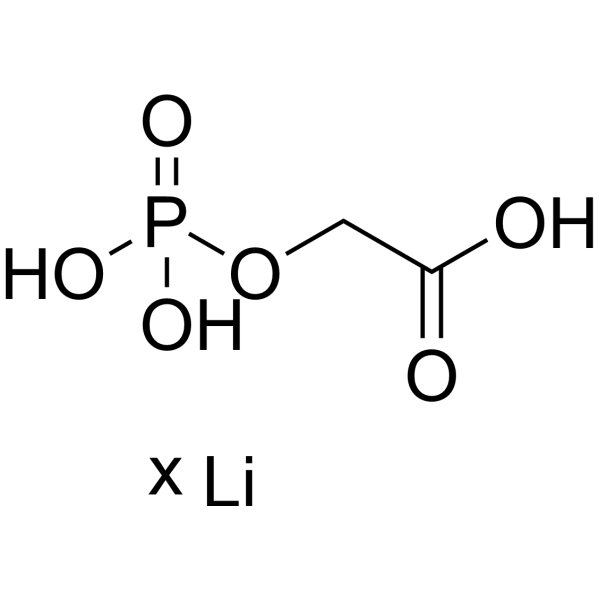
    Phosphoglycolic acid (lithium) is a competitive inhibitor of phosphoglycerate mutase (PGAM)-B, an enzyme of the glycolytic pathway. Phosphoglycolic acid increases basal and fMLF-induced levels of G6P in intact neutrophils. Phosphoglycolic acid thereby increases upstream intermediates in neutrophils, thereby amplifying the respiratory oxidative burst .
    Phosphoglycolic acid lithium
  • HY-P2862B

    Biochemical Assay Reagents Others
    α-Enolase, Human is one of three enolase isoenzymes and a glycolytic enzyme expressed in most tissues. This protein plays a key role in anaerobic metabolism under hypoxic conditions and may act as a cell surface plasminogen receptor during tissue invasion.
    α-Enolase, Human
  • HY-E71030

    Biochemical Assay Reagents Fructose-1,6-bisphosphate aldolase Others
    Aldolase A, Human (EC 4.1.2.13) is a glycolytic enzyme that catalyzes the reversible conversion of fructose-1,6-bisphosphate to glyceraldehyde 3-phosphate and dihydroxyacetone phosphate. Aldolase A, Human (EC 4.1.2.13) , fused to His-tag at N-terminus, was expressed in E.coli.
    Aldolase A, Human
  • HY-E70976

    Endogenous Metabolite Metabolic Disease
    3-Phosphoglyceric Phosphokinase, Baker's yeast (S. cerevisiae) (EC 2.7.2.3) is an enzyme that catalyzes the reversible transfer of a phosphate group from 1,3-bisphosphoglyceRate (1,3-BPG) to ADP producing 3-phosphoglyceRate (3-PG) and ATP. 3-Phosphoglyceric Phosphokinase, Baker's yeast (S. cerevisiae) (EC 2.7.2.3) is a transferase. 3-Phosphoglyceric Phosphokinase is a major enzyme used in glycolysis, in the first ATP-geneRating step of the glycolytic pathway. In gluconeogenesis, the reaction catalyzed by 3-Phosphoglyceric Phosphokinase proceeds in the opposite direction, geneRating ADP and 1,3-BPG.
    3-Phosphoglyceric Phosphokinase, Baker's yeast (S. cerevisiae)
  • HY-128788A

    DNA/RNA Synthesis SARS-CoV Endogenous Metabolite Flavivirus Lactate Dehydrogenase Infection
    ddhCTP trisodium solution (100 mM) is an endogenously produced pyrimidine base analog with a Kd of 17.0 nM for LLDH and an IC50 of 55.8 μM for GAPDH. By inhibiting key metabolic enzymes such as GAPDH, ddhCTP trisodium reduces glycolytic flux and shifts metabolic flow toward the pentose phosphate pathway, thereby regulating the redox balance of cells. As a competitive CTP analog, ddhCTP trisodium terminates RNA synthesis by flavivirus RdRps and SARS-CoV-2 RdRp, and inhibits Zika virus replication in vivo. ddhCTP trisodium can be used in studies related to viral infections, COVID-19 and Zika virus infections .
    ddhCTP trisodium solution (100 mM)

Inquiry Online

Your information is safe with us. * Required Fields.

Salutation


Country or Region *

Applicant Name *


Organization Name *

Department *


Email Address *


Product Name *

Cat. No.


Requested quantity *

Phone Number *


Remarks

Inquiry Online

Inquiry Information

Product Name:
Cat. No.:
Quantity:
MCE Japan Authorized Agent:

