1. Search Result
Search Result
Results for "

green leaves

" in MedChemExpress (MCE) Product Catalog:

12

Inhibitors & Agonists

9

Natural
Products

3

Isotope-Labeled Compounds

Cat. No. Product Name Target Research Areas Chemical Structure
  • HY-15121
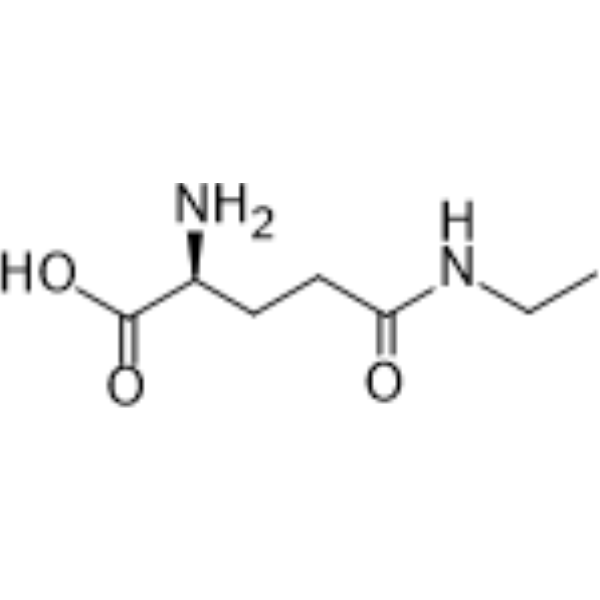
    L-Theanine
    5 Publications Verification

    L-Glutamic Acid γ-ethyl amide; Nγ-Ethyl-L-glutamine

    Apoptosis Endogenous Metabolite Reactive Oxygen Species (ROS) Neurological Disease Cancer
    L-Theanine (L-Glutamic Acid γ-ethyl amide) is a non-protein amino acid contained in green tea leaves, which blocks the binding of L-glutamic acid to glutamate receptors in the brain, and with neuroprotective, anticancer and anti-oxidative activities. L-Theanine can pass through the blood–brain barrier and is orally active .
    L-Theanine
  • HY-118828A

    (9S,13R)-12-OPDA

    Lipoxygenase Others
    9S,13R)-12-Oxo phytodienoic acid is the isomerization of 12-oxo PDA (HY-118828). (9S,13R)-12-Oxo phytodienoic acid is a lipoxygenase metabolite in the leaves of green plants .
    (9S,13R)-12-Oxo phytodienoic acid
  • HY-15121S

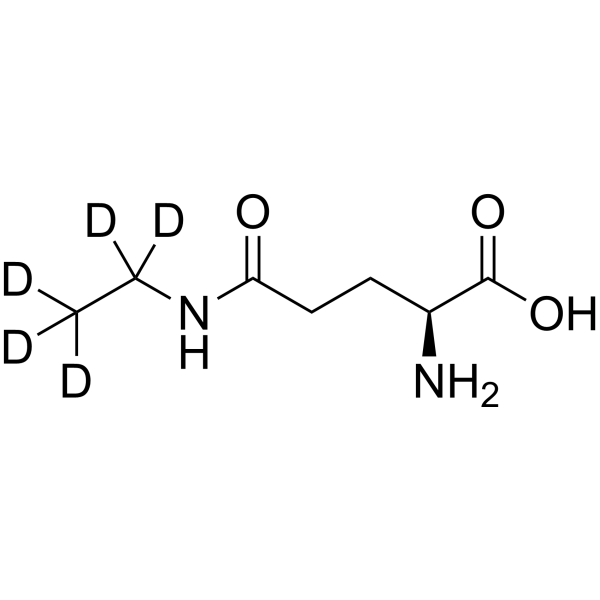
    L-Glutamic Acid γ-ethyl amide-d5; Nγ-Ethyl-L-glutamine-d5

    Apoptosis Endogenous Metabolite Neurological Disease
    L-Theanine-d5 is the deuterium labeled L-Theanine. L-Theanine (L-Glutamic Acid γ-ethyl amide)is a non-protein amino acid contained in green tea leaves, which blocks the binding of L-glutamic acid to glutamate receptors in the brain, and with neuroprotective and anti-oxidative activities. L-Theanine causes anti-stress effects via the inhibition of cortical neuron excitation by oral intake .
    L-Theanine-d5
  • HY-15121R

    L-Glutamic Acid γ-ethyl amide (Standard); Nγ-Ethyl-L-glutamine (Standard)

    Reference Standards Apoptosis Endogenous Metabolite Reactive Oxygen Species (ROS) Neurological Disease Cancer
    L-Theanine (Standard) is the analytical standard of L-Theanine. This product is intended for research and analytical applications. L-Theanine (L-Glutamic Acid γ-ethyl amide) is a non-protein amino acid contained in green tea leaves, which blocks the binding of L-glutamic acid to glutamate receptors in the brain, and with neuroprotective, anticancer and anti-oxidative activities. L-Theanine can pass through the blood–brain barrier and is orally active .
    L-Theanine (Standard)
  • HY-N9585

    Others Cancer
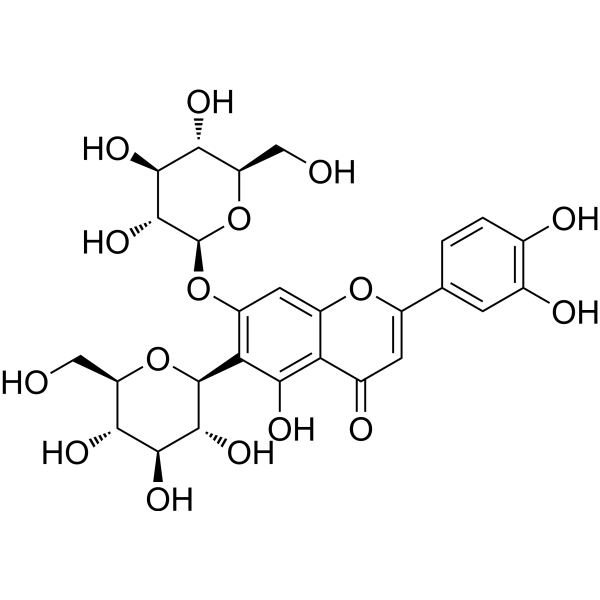
    Lutonarin is a antioxidant agent that can be isolated from green barley leaves. Lutonarin inhibits malonaldehyde formation from all lipids when in combination with Saponarin (HY-N5083) .
    Lutonarin
  • HY-65008

    Others Others
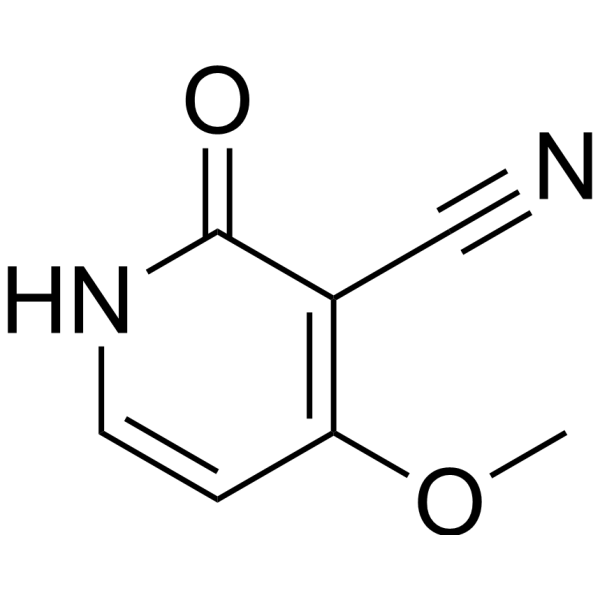
    N-Demethylricinine is a ricinine, can be interconverted with ricinine in senescent and green castor plant leaves. Ricinine, is a α-pyridone alkaloid biosynthetically related to the pyridine nucleotide cycle. The alkaloid catabolism of ricinine is associated with aging process .
    N-Demethylricinine
  • HY-15121S1

    L-Glutamic Acid γ-ethyl amide-13C2,15N2; Nγ-Ethyl-L-glutamine-13C2,15N2

    DNA/RNA Synthesis Others
    L-Theanine- 13C2, 15N2 (L-Glutamic Acid γ-ethyl amide- 13C2, 15N2) is the 13C- and 15N-labeled L-Theanine (HY-15121). L-Theanine (L-Glutamic Acid γ-ethyl amide) is a non-protein amino acid contained in green tea leaves, which blocks the binding of L-glutamic acid to glutamate receptors in the brain, and with neuroprotective, anticancer and anti-oxidative activities. L-Theanine can pass through the blood–brain barrier and is orally active.
    L-Theanine-13C2,15N2
  • HY-118828AS

    (9S,13R)-12-OPDA-d5

    Isotope-Labeled Compounds Others
    (9S,13R)-12-OPDA-d5 ((9S,13R)-12-OPDA-d5) is an isotopic label of (9S,13R)-12-oxyphytodienoic acid. (9S,13R)-12-Oxophytodienoic acid is an isomer of 12-oxoPDA (HY-118828). (9S,13R)-12-Oxo phytodienoic Acid is a lipoxygenase metabolite in green plant leaves .
    (9S,13R)-12-Oxo phytodienoic acid-d5
  • HY-N12493

    Others Others
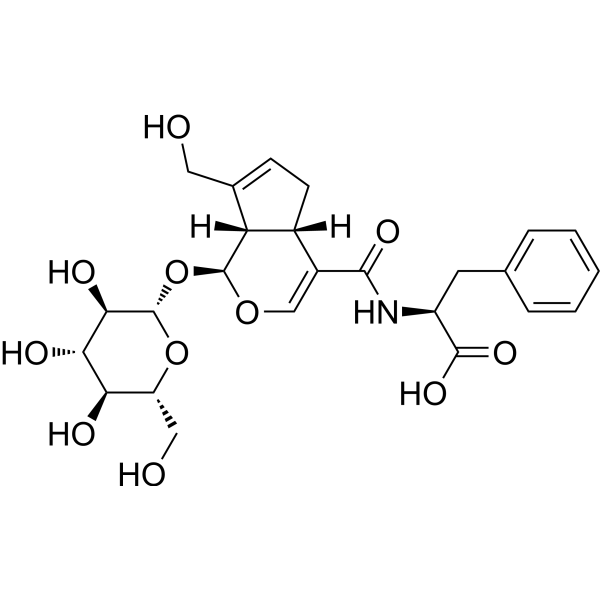
    Eucomoside B (compound b) ia a natural product isolated from Green Leaves of Eucommia ulmoides .
    Eucomoside B
  • HY-W747972

    Drug Intermediate Infection
    Hydrosorbaldehyde is a green leaf volatile and also the main contributor to the fresh, grassy aroma of tea leaves. Hydrosorbaldehyde undergoes irreversible conversion to (E)-2-hexenal via (Z)-3:(E)-2-hexenal isomerase (CsHI). Hydrosorbaldehyde plays a key role in protecting plants against biotic stresses (such as pathogens and insects) and acting as a signaling chemical .
    Hydrosorbaldehyde
  • HY-N18193

    Drug Metabolite Others
    Prunasinamide is a catabolite of Prunasin (HY-N1548) and can be found in senescent leaves of Prunus laurocerasus. Prunasinamide can be generated from Prunasin via the Radziszewski reaction .
    Prunasinamide
  • HY-W747972A

    Drug Intermediate Infection
    (Z)-3-Hexenal is an isomer of Hydrosorbaldehyde (HY-W747972). (Z)-3-Hexenal is a green leaf volatile and also the main contributor to the fresh, grassy aroma of tea leaves. (Z)-3-Hexenal undergoes irreversible conversion to (E)-2-hexenal via (Z)-3:(E)-2-hexenal isomerase (CsHI). (Z)-3-Hexenal plays a key role in protecting plants against biotic stresses (such as pathogens and insects) and acting as a signaling chemical .
    (Z)-3-Hexenal

Inquiry Online

Your information is safe with us. * Required Fields.

Salutation


Country or Region *

Applicant Name *


Organization Name *

Department *


Email Address *


Product Name *

Cat. No.


Requested quantity *

Phone Number *


Remarks

Inquiry Online

Inquiry Information

Product Name:
Cat. No.:
Quantity:
MCE Japan Authorized Agent:

