6 Results for "

hepatic lipid content

" in MedChemExpress (MCE) Product Catalog:
Products (6)

6 Results for "hepatic lipid content" in MCE Product Catalog:

Cat. No.: HY-17445
CAS No.: 331741-94-7
Synonyms: BMS-298585
Target:  

PPAR

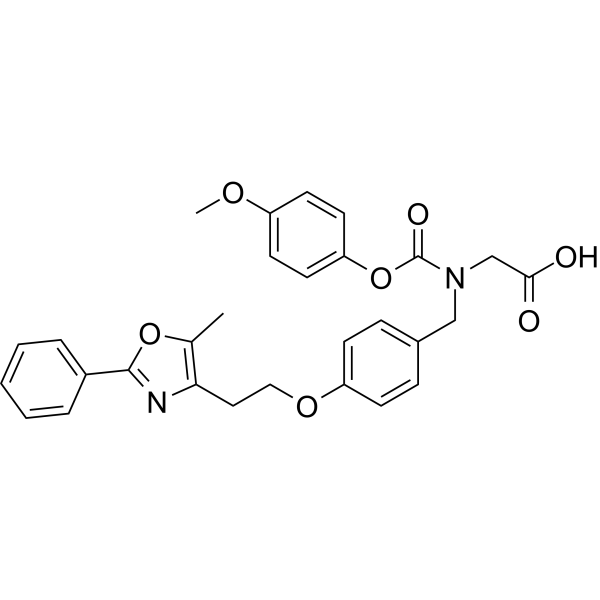
Muraglitazar (BMS-298585) is an orally active non-thiazolidinedione oxybenzylglycine dual-target PPARα/PPARγ agonist, with an IC50 of 0.25 μM and an EC50 of 0.32 μM against human PPARα, and an IC50 of 0.19 μM and an EC50 of 0.11 μM against human PPARγ. Muraglitazar regulates lipid homeostasis, enhances peripheral insulin sensitivity, and improves β-cell function. Muraglitazar reduces levels of blood glucose, insulin, triglycerides and free fatty acids, normalizes adiponectin and corticosterone levels, promotes cholesterol efflux, reduces hepatic lipid content, regulates body weight, prevents hyperglycemia, and improves glucose tolerance. Muraglitazar can be used in research related to type 2 diabetes and dyslipidemia .
loading...
    loading...
Cat. No.: HY-P11358
CAS No.: 159718-10-2
IRW is an orally active tripeptide produced from egg white with angiotensin converting enzyme (ACE) inhibitory properties. IRW can prevent high-fat diet (HFD)-induced Non-alcoholic fatty liver disease (NAFLD) by modulating hepatic lipid metabolism and increasing mitochondrial content. IRW decreases hepatic triglyceride content and lipid droplet size. IRW increases the hepatic mitochondrial complexes and citrate synthase activity, phosphorylation of 5’-AMP-activated protein kinase and microsomal triglyceride transfer protein abundance. IRW increases phosphorylated acetyl CoA carboxylase and mitochondrial complexes, IRW can be used for the research of inflammation .
loading...
    loading...
Cat. No.: HY-174858
Target:  

PROTACs ASK1 p38 MAPK

Research Areas:  

Inflammation/Immunology

dASK1-VHL is an ASK1 PROTAC degrader that recruits VHL. dASK1-VHL induces ubiquitination and proteasomal degradation of ASK1 by forming a ternary complex, and inhibits the downstream p38 MAPK signaling pathway. dASK1-VHL can be used in studies of metabolic dysfunction-associated steatohepatitis .
loading...
    loading...
Cat. No.: HY-106417
CAS No.: 128620-82-6
Synonyms: SA 3443
Limazocic (SA 3443) is an orally active hepatoprotective agent. Limazocic can inhibit increases in serum transaminase, alkaline phosphatase activity and hepatic lipids, hydroxyproline content induced by CCl4. Limazocic can decrease the degree of hepatic necrosis, fibrosis and steatosis. Limazocic can be used for the research of chronic liver injuries .
loading...
    loading...
Cat. No.: HY-135876
CAS No.: 29873-99-2
Synonyms: (-)-γ-Elemene
γ-Elemene ((-)-γ-Elemene) is a lipid-lowering agent. γ-Elemene increases superoxide dismutase (SOD). γ-Elemene reduces the expression of adhesion molecules (VCAM-1, ICAM-1) in cells damaged by H2O2. γ-Elemene regulates lipid peroxidation. γ-Elemene protects cells from peroxidative damage induced by high fat and H2O2. γ-Elemene decreases lipid content. γ-Elemene can be used in the research of atherosclerosis .
loading...
    loading...
Cat. No.: HY-N20719
CAS No.: 3162-56-9
Vulgarin is an orally active, naturally occurring eudesmane sesquiterpene with multiple biological activities including anti-inflammatory and antioxidant properties. Vulgarin targets and inhibits HMGB1, NF-κB and iNOS, while regulating key genes involved in hepatic gluconeogenesis; it also blocks inflammatory signaling pathways and inhibits the production and release of pro-inflammatory cytokines such as TNF-α and IL-1β. Vulgarin effectively alleviates pancreatic oxidative stress by reducing lipid peroxidation levels and restoring antioxidant enzyme activity. Vulgarin reverses abnormally elevated serum pancreatic enzyme levels, preserves the integrity of pancreatic acinar cells, and reduces pancreatic edema, hemorrhage and inflammatory infiltration. Vulgarin remodels the function of pancreatic endocrine cells, restores insulin content in β cells, and downregulates glucagon levels in α cells and somatostatin levels in δ cells. Vulgarin can be used in studies related to pancreatic injury and diabetes .
loading...
    loading...

