1. Search Result
Search Result
Results for "

ligand dissociation

" in MedChemExpress (MCE) Product Catalog:

13

Inhibitors & Agonists

1

Fluorescent Dyes

4

Peptides

Cat. No. Product Name Target Research Areas Chemical Structure
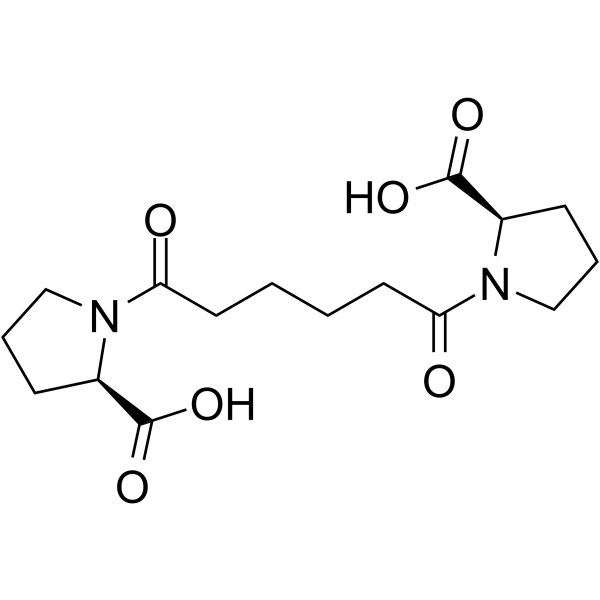
  • HY-101861

    CPHPC; Ro63-8695; GSK2315698

    Amyloid-β Neurological Disease
    Miridesap is a ligand for serum amyloid P component (SAP) and intends to inhibit and dissociate SAP binding to amyloid fibrils and tangles.
    Miridesap
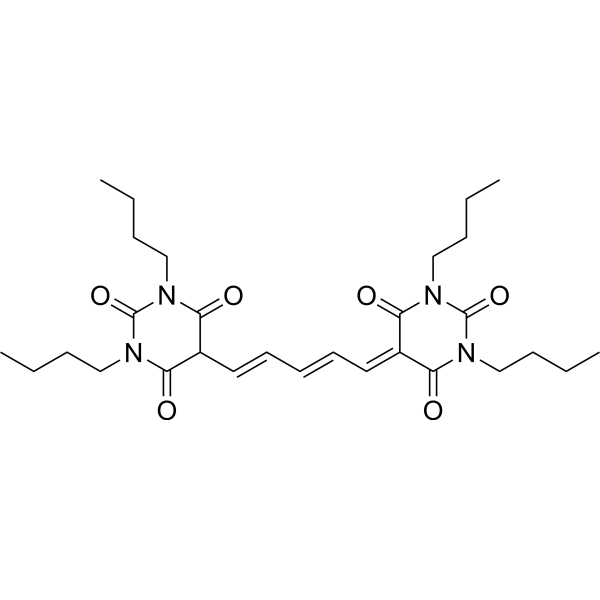
  • HY-D1092

    Fluorescent Dye Neurological Disease
    DiBaC4(5) is a fluorescent voltage-sensitive dye that can be used to monitor the transmembrane potentials when Papain-dissociated retinal cells from adult zebrafish were exposed to GABAergic ligands. DiBaC4(5) is a potential-sensitive fluorescence dye .
    DiBAC4(5)
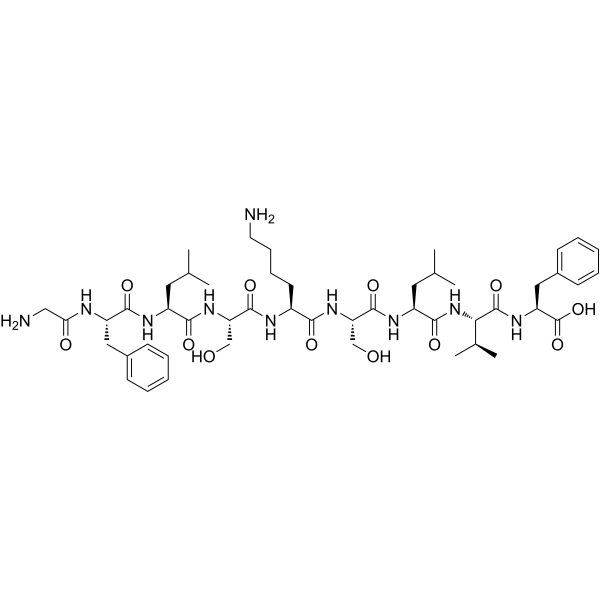
  • HY-P10086
    TREM-1 inhibitory peptide GF9
    1 Publications Verification

    Human TREM-1(213-221)

    TREM receptor TNF Receptor Interleukin Related c-Fms Neurological Disease Inflammation/Immunology Cancer
    TREM-1 inhibitory peptide GF9 (Human TREM-1 (213-221)) is a TREM-1 inhibitor. TREM-1 inhibitory peptide GF9 blocks the TREM-1 signaling pathway via a ligand-independent mechanism, spontaneously inserts into the cell membrane to dissociate TREM-1 from DAP-12, and functions through the Signaling Chain Homooligomerization (SCHOOL) model. TREM-1 inhibitory peptide GF9 reduces the levels of TNFα, IL-1β, IL-6, and M-CSF. TREM-1 inhibitory peptide GF9 inhibits tumor growth, prolongs the survival of mice with pancreatic cancer models, ameliorates collagen-induced arthritis, and exerts protective effects on bone and cartilage simultaneously. TREM-1 inhibitory peptide GF9 can be used in research related to arthritis, pancreatic cancer, retinopathy, alcoholic liver disease, and liver cancer .
    TREM-1 inhibitory peptide GF9
  • HY-156906

    MDM-2/p53 Cancer
    UNC3474 is a small molecule ligand, binding with 53BP1. UNC3474 binds the aromatic methyl-lysine binding cage of 53BP1 TT, with a dissociation constant (Kd) of 1.0 ± 0.3 μM. UNC3474 inhibits the recruitment of 53BP1 to DSBs by stabilizing a pre-existing autoinhibited state of 53BP1 in cells .
    UNC3474
  • HY-168440

    Ligands for Target Protein for PROTAC Aurora Kinase CDK Cancer
    Aurora-A ligand 1 is a high-affinity and specific Aurora-A inhibitor with a dissociation constant (Kd) value of 0.85 nM. Aurora-A ligand 1 can serve as a ligand for target protein (Ligands for Target Protein for PROTAC) for the development of PROTAC Aurora-A degraders with antitumor activity. Aurora-A ligand 1 can be used for the synthesis of HLB-0532259 (HY-168439). HLB-0532259 shows anti-tumor activity against neuroblastoma .
    Aurora-A ligand 1
  • HY-173291

    Tau Protein Neurological Disease
    Tau ligand-1 (Compound 75) is a ligand for aggregated tau protein that can penetrate the blood-brain barrier . In tissues from patients with Alzheimer's disease, progressive supranuclear palsy, corticobasal degeneration, and Pick's disease, Tau ligand-1 exhibits high affinity for aggregated tau protein, with equilibrium dissociation constant (KD) values ranging from 1 to 3.8 nM . Tau ligand-1 can serve as a potential positron emission tomography (PET) tracer and holds promise for application in positron emission tomography imaging studies of tau-related diseases in the central nervous system .
    Tau ligand-1
  • HY-P10495

    Transmembrane Glycoprotein Others Cancer
    GPR110 peptide agonist P12 is a peptide that acts as a GPR110 agonist. GPR110 peptide agonist P12 can significantly enhance the initial rate of GPR110 stimulated G protein GTPγS binding. GPR110 peptide agonist P12 mimics the action of natural ligands, causing the extracellular domain (ECD) of the GPR110 to dissociate from the seven transmembrane domains (7TM), exposing the β-strand-13/stalk region at the N-terminus of the 7TM domain, which acts as an agonist to activate G protein signaling. GPR110 peptide agonist P12 can be used in the study of developmental disorders and cancers related to GPR110 .
    GPR110 peptide agonist P12
  • HY-113646

    FKBP Others
    Shield-2 is an efficient stabilizing ligand binding to the FKBP (F36V) protein with a dissociation constant of 29 nM. Shield-2 binds tightly to the FKBP mutants destabilizing domains and prevents degradation, thus providing small molecule regulation over intracellular protein levels .
    Shield-2
  • HY-14863

    CTA-018

    VD/VDR Cytochrome P450 Others Endocrinology
    Lunacalcipol (CTA-018), as a vitamin D analogue, has a dual role in the pathogenesis of Chronic Kidney Disease (CKD), as an agonist of vitamin D receptor and an antagonist of cytochrome P450 enzyme 24-hydroxylase. Lunacalcipol binds to VDR and regulates transcriptional activity of VDR by influencing ligand binding affinity, ligand-dependent coactivator recruitment or inhibitory factor dissociation, efficiency of ligand entry into target cells, tissue specificity and different metabolism of ligand. Lunacalcipol can be used in the study of CKD, especially Secondary Hyperparathyroidism (sHPT) .
    Lunacalcipol
  • HY-180554

    Synaptic Vesicle Proteins Neurological Disease
    UCB1244283 is a synaptic vesicle glycoprotein 2A (SV2A) allosteric modulator. UCB1244283 binds to a secondary ligand-binding site in SV2A and enhances orthosteric ligand engagement when the orthosteric site is occupied, by stabilizing the occluded state and slowing ligand dissociation. UCB1244283 shows a clear protective effect against both tonic and clonic convulsions in sound-sensitive mice. UCB1244283 can be used for epilepsy research .
    UCB1244283
  • HY-101861R

    CPHPC (Standard); Ro63-8695 (Standard); GSK2315698 (Standard)

    Amyloid-β Reference Standards Neurological Disease
    Miridesap (Standard) is the analytical standard of Miridesap (HY-101861). This product is intended for research and analytical applications. Miridesap is a ligand for serum amyloid P component (SAP) and intends to inhibit and dissociate SAP binding to amyloid fibrils and tangles.
    Miridesap (Standard)
  • HY-183984

    G-quadruplex Cancer
    G-quadruplex ligand 6 is a G-quadruplex ligand targeting the c-MYC promoter with anti-tumor activity. G-quadruplex ligand 6 forms a non-covalent complex with Pu22, a G-quadruplex model of the c-MYC promoter, with a microscopic dissociation constant Kd of 0.202 μM. G-quadruplex ligand 6 selectively inhibits tumor cell proliferation, blocks the binding of transcription factors by stabilizing the G-quadruplex in the c-MYC promoter, and thereby regulates the expression of proto-oncogenes. G-quadruplex ligand 6 can be used in the research of pancreatic cancer, non-small cell lung cancer, colorectal cancer, and triple-negative breast cancer .
    G-quadruplex ligand 6
  • HY-W686762

    Dopamine Receptor Adenylate Cyclase Neurological Disease
    m,p-Dimethyl PPE is a D4 dopamine receptor ligand. m,p-Dimethyl PPE promotes GDP/GTP exchange of the G protein α-subunit, dissociates the receptor-G protein complex, stabilizes the low-affinity receptor state, and inhibits adenylate cyclase activity. m,p-Dimethyl PPE inhibits Forskolin (HY-15371)-induced melatonin synthesis in retinal photoreceptor cells and reduces the efficacy of full agonists when used in combination. m,p-Dimethyl PPE can be used in studies related to attention-deficit hyperactivity disorder .
    m,p-Dimethyl PPE

Inquiry Online

Your information is safe with us. * Required Fields.

Salutation


Country or Region *

Applicant Name *


Organization Name *

Department *


Email Address *


Product Name *

Cat. No.


Requested quantity *

Phone Number *


Remarks

Inquiry Online

Inquiry Information

Product Name:
Cat. No.:
Quantity:
MCE Japan Authorized Agent:

