1. Search Result
Search Result
Results for "

microtubule-targeting agent

" in MedChemExpress (MCE) Product Catalog:

14

Inhibitors & Agonists

2

Natural
Products

1

Isotope-Labeled Compounds

Cat. No. Product Name Target Research Areas Chemical Structure
  • HY-13442
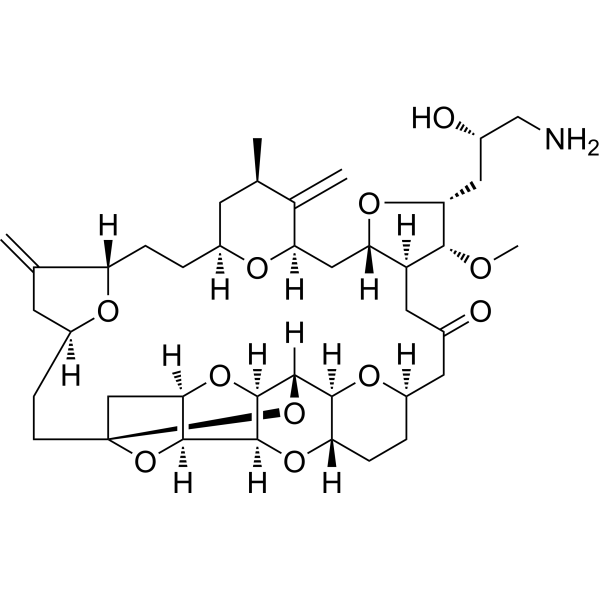
    Eribulin
    5+ Cited Publications

    B1939; E7389; ER-086526

    Microtubule/Tubulin Apoptosis ADC Payload Cancer
    Eribulin (E7389) is a microtubule targeting agent that is used for the research of metastatic breast cancer. Eribulin inhibits the proliferation of cancer cells by binding microtubule proteins and microtubules.
    Eribulin
  • HY-N2146
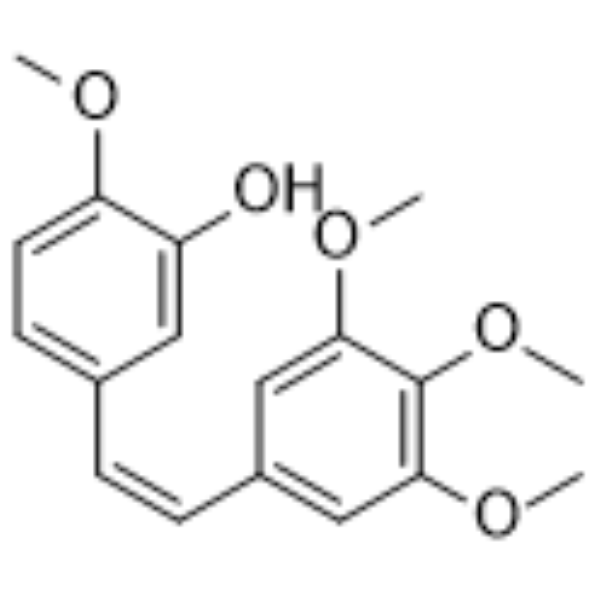
    Combretastatin A4
    4 Publications Verification

    CRC 87-09

    Microtubule/Tubulin Cancer
    Combretastatin A4 is a microtubule-targeting agent that binds β-tubulin with Kd of 0.4 μM.
    Combretastatin A4
  • HY-173522

    Kinesin Microtubule/Tubulin Cancer
    KIF2C-IN-1 is a cell-penetrating, selective KIF2C inhibitor with fluorescent properties (Ex/Em = 410/510 nm). KIF2C-IN-1 exhibits notable cytotoxicity and weak inhibitory effects on KIF2A/B. KIF2C-IN-1 prohibits the dissociation of KIF2C from microtubules. KIF2C-IN-1 inhibiting KIF2C reverses cross-resistance to microtubule-targeting agents. KIF2C-IN-1 reduces tumorigenesis in chemoresistant triple-negative breast cancer (TNBC) model in mice with the combination of Paclitaxel (HY-B0015) .
    KIF2C-IN-1
  • HY-127079

    Microtubule/Tubulin Cancer
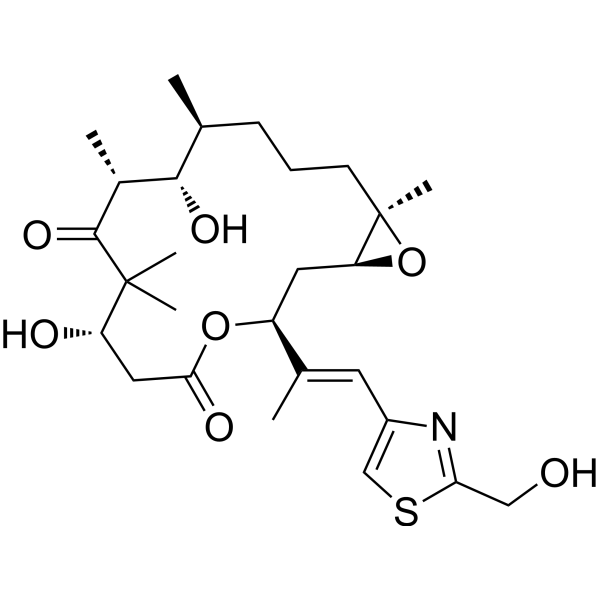
    Epothilone F is a 16-membered macrolide microtubule-targeting agent. Epothilone F exhibits significant anticancer activity, and it particularly exerts effective inhibitory effects on paclitaxel-resistant cancer cells. Epothilone F inhibits the proliferation of breast cancer cells, non-small cell lung cancer cells and drug-resistant ovarian cancer cells, and it has been widely used in cancer-related research .
    Epothilone F
  • HY-13442AS

    Microtubule/Tubulin Apoptosis Cancer
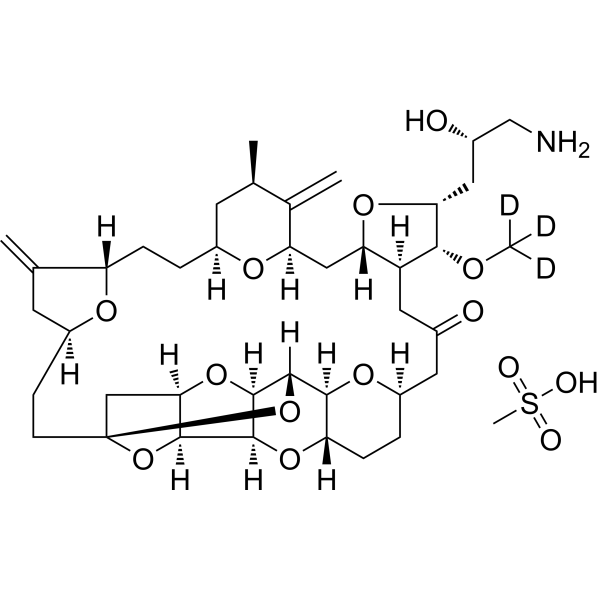
    Eribulin-d3 (mesylate) is a deuterium labeled Eribulin mesylate. Eribulin mesylate is a microtubule targeting agent that is used for the research of cancer .
    Eribulin-d3 mesylate
  • HY-19916

    BAL-101553

    Microtubule/Tubulin Checkpoint Kinase (Chk) Cancer
    Lisavanbulin (BAL-101553) is the prodrug of the microtubule targeting agent Avanbulin (BAL 27862) (HY-106008). Lisavanbulin is a BBB-penetrant and orally active antitumor agent, especially in tumors that express high levels of end-binding protein 1. Lisavanbulin has ability to target tumor cell proliferation and affects the tumor microenvironment by reducing tumor microvasculature. Lisavanbulin is also a spindle assembly checkpoint activator. Lisavanbulin induces cell cycle arrest and subsequent death or aberrant chromosome segregation. Lisavanbulin can be studied in research for diffuse large B cell lymphoma (DLBCL) and glioblastoma .
    Lisavanbulin
  • HY-19916A

    BAL-101553 dihydrochloride

    Microtubule/Tubulin Checkpoint Kinase (Chk) Cancer
    Lisavanbulin (BAL-101553) dihydrochloride is the prodrug of the microtubule targeting agent Avanbulin (BAL 27862) (HY-106008). Lisavanbulin dihydrochloride exhibits antitumor activity, especially in tumors that express high levels of end-binding protein 1. Lisavanbulin dihydrochloride has ability to target tumor cell proliferation and affects the tumor microenvironment by reducing tumor microvasculature. Lisavanbulin dihydrochloride is also a spindle assembly checkpoint activator. Lisavanbulin dihydrochloride induces cell cycle arrest and subsequent death or aberrant chromosome segregation. Lisavanbulin dihydrochloride can be studied in research for diffuse large B cell lymphoma (DLBCL) and glioblastoma .
    Lisavanbulin dihydrochloride
  • HY-N2146R

    CRC 87-09 (Standard)

    Reference Standards Microtubule/Tubulin Cancer
    Combretastatin A4 is a microtubule-targeting agent that binds β-tubulin with Kd of 0.4 μM.
    Combretastatin A4 (Standard)
  • HY-163737

    Microtubule/Tubulin Cancer
    ST-401, a microtubule-targeting agent (MTA), is a brain-penetrant microtubule (MT) assembly inhibitor. ST-401 disrupts microtubule (MT) function through gentle and reverisible reduction in MT assembly that triggers mitotic delay and cell death in interphase. ST-401 shows a potent antitumor activity .
    ST-401
  • HY-177549

    Drug Derivative ADC Payload Microtubule/Tubulin Apoptosis Cancer
    Fmoc-PEG6-VCP-Eribulin is the derivative of Eribulin (HY-13442). Eribulin (E7389) is a microtubule targeting agent that is used for the research of metastatic breast cancer. Eribulin inhibits the proliferation of cancer cells by binding microtubule proteins and microtubules .
    Fmoc-PEG6-VCP-Eribulin
  • HY-124624

    Microtubule/Tubulin Apoptosis Cancer
    PBOX-15 is a microtubule targeting agent. PBOX-15 induces apoptosis by promoting tubulin depolymerization in tumor cells .
    PBOX-15
  • HY-178325

    Microtubule/Tubulin Apoptosis Cancer
    Tubulin-IN-57 is a Tubulin inhibitor. Tubulin-IN-57 is a potent antiproliferative agent that inhibits clonogenic formation, migration, and invasion of ovarian cancer cells. Tubulin-IN-57 inhibits tubulin polymerization, which in turn induces G2/M arrest and apoptosis in SKOV3 cells. Tubulin-IN-57 demonstrates potent antitumor activity without observable toxicity in an SKOV3 xenograft model. Y60S can be used for the study of ovarian cancer .
    Tubulin-IN-57
  • HY-146392

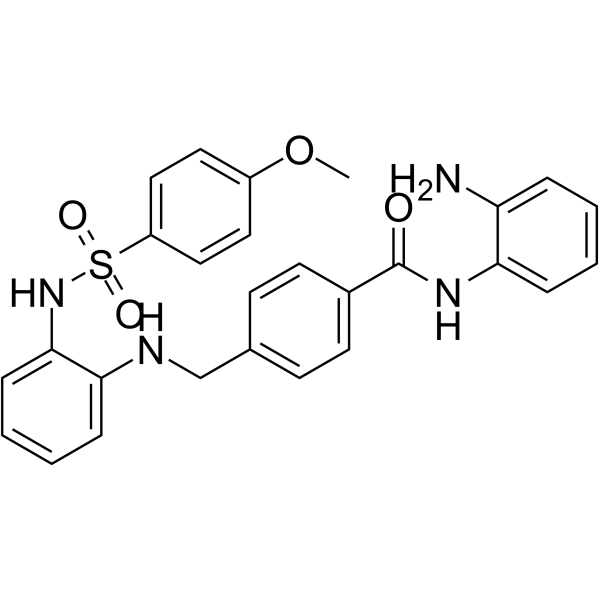
    HDAC Microtubule/Tubulin Apoptosis Cancer
    HDAC-IN-39 (compound 16c) is a potent HDAC inhibitor, with IC50 values of 1.07 μM (HDAC1), 1.47 μM (HDAC2), and 2.27 μM (HDAC3), respectively. HDAC-IN-39 also significantly inhibits microtubule polymerization. HDAC-IN-39 induces cell cycle arrest at the G2/M phase. HDAC-IN-39 displays promising anticancer activity against resistant cancer cells .
    HDAC-IN-39
  • HY-120120

    Microtubule/Tubulin Cancer
    DZ-2384 is a potent microtubule-targeting agent. DZ-2384 increases the rescue frequency and preserves the microtubule network in nonmitotic cells and primary neurons. DZ-2384 acts synergistically with anti-CTLA-4 immunotherapy in Taxane-sensitive and Taxane-resistant xenograft murine models of triple-negative breast cancer (TNBC). DZ-2384 exhibits potent antitumor activity in adult acute lymphocytic leukemia (ALL) models. DZ-2384 can be used for cancer research, such as TNBC and ALL [1][2].
    DZ-2384

Inquiry Online

Your information is safe with us. * Required Fields.

Salutation


Country or Region *

Applicant Name *


Organization Name *

Department *


Email Address *


Product Name *

Cat. No.


Requested quantity *

Phone Number *


Remarks

Inquiry Online

Inquiry Information

Product Name:
Cat. No.:
Quantity:
MCE Japan Authorized Agent:

