1. Search Result
Search Result
Results for "

rabbit eyes

" in MedChemExpress (MCE) Product Catalog:

15

Inhibitors & Agonists

2

Biochemical Assay Reagents

1

Natural
Products

1

Isotope-Labeled Compounds

5

Oligonucleotides

Cat. No. Product Name Target Research Areas Chemical Structure
  • HY-W088065

    Environmental Pollutants DNA/RNA Synthesis Others
    Sodium formate acts as a key promoter for heterogeneous nucleation of ZIF crystals and thin film synthesis. It is also recognized as a GRAS substance by the FDA, and serves as a cosmetic preservative and food additive. Sodium formate has low acute oral toxicity (acute oral LD50=7410 mg/kg and acute intravenous LD50=807 mg/kg in mice), with no heritable or carcinogenic effects, but exhibits embryonic developmental toxicity and teratogenicity at high concentrations. Sodium formate may cause moderate irritation to rabbit eyes, is relatively safe to the skin, and does not induce tumor formation in rats in vivo. Sodium formate is rapidly absorbed and oxidized to carbon dioxide in vivo, and forms DNA adducts in specific metabolic deficiency models or upon high-dose exposure .
    Sodium formate
  • HY-17357

    AHR 9434; AL 6515

    COX Prostaglandin Receptor Neurological Disease Inflammation/Immunology Endocrinology Cancer
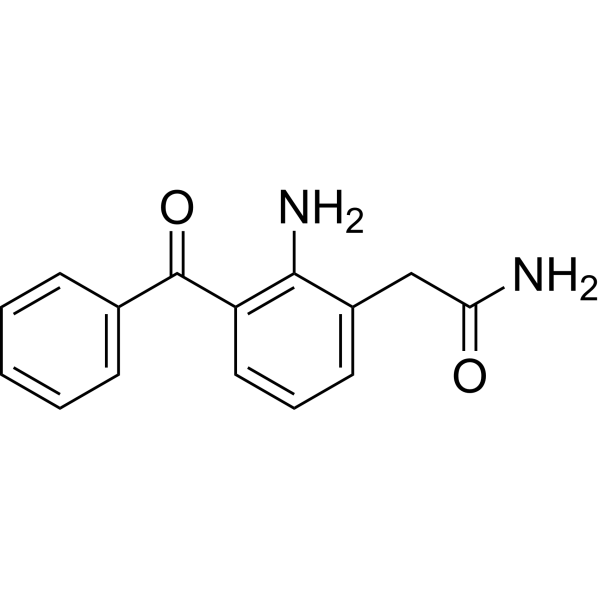
    Nepafenac (AHR 9434; AL 6515), a nonsteroidal anti-inflammatory agent, is a topically administered COX-2 inhibitor with an IC50 of 0.12 μM. Nepafenac exhibits only weak COX-1 inhibitory activity (IC50 = 64.3 μM). Nepafenac possesses unique prodrug properties, which enable it to rapidly convert into the active metabolite Amfenac (HY-17479) in the ocular tissues, thereby achieving high concentrations in the retina and choroid. Nepafenac reduces inflammation and pain by inhibiting the activity of cyclooxygenase (COX) enzymes and thereby decreasing the production of prostaglandin PGE. Nepafenac can delay the metastasis of uveal melanoma (UM) in rabbit eyes. Nepafenac is mainly used for pain management and inflammation control after ophthalmic surgeries .
    Nepafenac
  • HY-Y0850U3

    Polyvinyl alcohol (Mw 125000, 98-99% hydrolyzed, ~2800 polymerization); Poly(Ethenol) (Mw 125000, 98-99% hydrolyzed, ~2800 polymerization)

    Biochemical Assay Reagents Others
    PVA (Polyvinyl alcohol) (Mw 125000, 98-99% hydrolyzed, ~2800 polymerization) is a water-soluble, biodegradable, biocompatible and non-immunogenic polymer. PVA (Mw 125000, 98-99% hydrolyzed, ~2800 polymerization) causes no irritation to rabbit eyes, no skin sensitization in guinea pigs, promotes the proliferation of human skin keratinocytes, and reduces the loss of corneal endothelial cells. The LD50 of PVA (Mw 125000, 98-99% hydrolyzed, ~2800 polymerization) in rats and dogs is greater than 10 g/kg. PVA (Mw 125000, 98-99% hydrolyzed, ~2800 polymerization) is hardly absorbed by the digestive system, causes no adverse effects upon long-term oral administration, and shows no mutagenicity or carcinogenicity. However, repeated intravenous or portal vein injection of PVA (Mw 125000, 98-99% hydrolyzed, ~2800 polymerization) may induce pathological changes such as glomerular lesions, anemia, hypertension or liver fibrosis in rats or dogs. Crosslinked nanofibers prepared by modifying PVA (Mw 125000, 98-99% hydrolyzed, ~2800 polymerization) can be used in studies related to wound dressings and other applications .
    PVA (Mw 125000, 98-99% hydrolyzed, ~2800 polymerization)
  • HY-W013762

    Environmental Pollutants Biochemical Assay Reagents Others
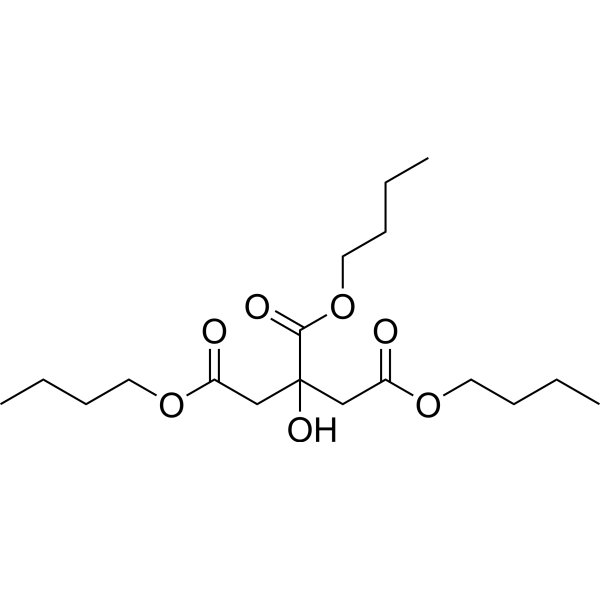
    Tributyl citrate is a low-toxicity and orally active citrate ester with no genotoxicity or skin sensitizing activity. Tributyl citrate also acts as a plasticizer, solvent, FDA-approved indirect food additive, and topical anesthetic, among other uses. Tributyl citrate induces a needle-prick insensitivity response that lasts for more than 2 hours, and a 5% suspension of it temporarily eliminates the corneal reflex in rabbits. Tributyl citrate causes no significant systemic toxicity in rats and cats at most tested doses, and only may cause growth retardation and gastrointestinal reactions such as diarrhea and nausea at high doses or with repeated oral administration .
    Tributyl citrate
  • HY-17357S

    AHR-9434-d5; AL-6515-d5

    Isotope-Labeled Compounds COX Prostaglandin Receptor Neurological Disease Inflammation/Immunology Endocrinology Cancer
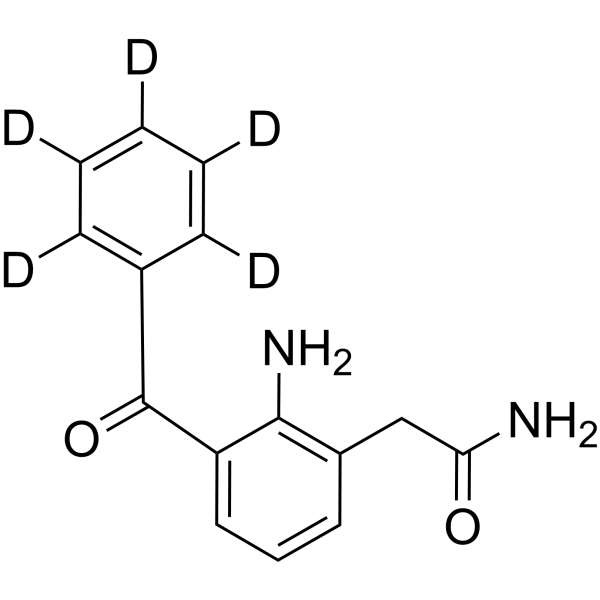
    Nepafenac-d5 (AHR-9434-d5; AL-6515-d5) is the deuterium labeled Nepafenac (HY-17357). Nepafenac, a nonsteroidal anti-inflammatory agent, is a topically administered COX-2 inhibitor with an IC50 of 0.12 μM. Nepafenac exhibits only weak COX-1 inhibitory activity (IC50 = 64.3 μM). Nepafenac possesses unique prodrug properties, which enable it to rapidly convert into the active metabolite Amfenac (HY-17479) in the ocular tissues, thereby achieving high concentrations in the retina and choroid. Nepafenac reduces inflammation and pain by inhibiting the activity of cyclooxygenase (COX) enzymes and thereby decreasing the production of prostaglandin PGE. Nepafenac can delay the metastasis of uveal melanoma (UM) in rabbit eyes. Nepafenac is mainly used for pain management and inflammation control after ophthalmic surgeries.
    Nepafenac-d5
  • HY-158821A

    TGF-beta/Smad Neurological Disease
    ISTH0036 sodium is a phosphorothioate LNA-modified antisense oligonucleotide gapmer that selectively targets and downregulates TGF-β2 mRNA. ISTH0036 sodium suppresses TGF-β2 expression, reduces choroidal neovascularization and vascular leakage, inhibits fibrosis, blocks epithelial-to-mesenchymal transition, and inhibits angiogenesis while promoting bleb survival. ISTH0036 sodium exhibits long-lasting, dose-dependent ocular tissue distribution and target engagement in rabbit and non-human primate eyes. ISTH0036 sodium can be used for the study of various ocular disorders, such as glaucoma and neovascular retinal diseases .
    ISTH0036 sodium
  • HY-158821

    TGF-beta/Smad Neurological Disease
    ISTH0036 is a phosphorothioate LNA-modified antisense oligonucleotide gapmer that selectively targets and downregulates TGF-β2 mRNA. ISTH0036 suppresses TGF-β2 expression, reduces choroidal neovascularization and vascular leakage, inhibits fibrosis, blocks epithelial-to-mesenchymal transition, and inhibits angiogenesis while promoting bleb survival. ISTH0036 exhibits long-lasting, dose-dependent ocular tissue distribution and target engagement in rabbit and non-human primate eyes. ISTH0036 can be used for the study of various ocular disorders, such as glaucoma and neovascular retinal diseases .
    ISTH0036
  • HY-121902

    Adrenergic Receptor Others
    Butidrine is a compound with intraocular pressure-lowering activity that is less effective than some other beta-adrenergic receptor blockers in reducing intraocular pressure in rabbit eyes.
    Butidrine
  • HY-119063

    Carbonic Anhydrase Others
    L-645151 is a carbonic anhydrase inhibitor with ocular penetration and hypotensive activity. L-645151 lowers the elevated intraocular pressure (IOP) of o-chymotripsinized (o-CT) rabbit eyes. L-645151 is promising for research of an ocular hypotensive agent .
    L-645151
  • HY-17357R

    AHR 9434 (Standard); AL 6515 (Standard)

    Reference Standards COX Prostaglandin Receptor Neurological Disease Inflammation/Immunology Endocrinology Cancer
    Nepafenac (AHR 9434; AL 6515) (Standard) is the analytical standard of Nepafenac (HY-17357). This product is intended for research and analytical applications. Nepafenac, a nonsteroidal anti-inflammatory agent, is a topically administered COX-2 inhibitor with an IC50 of 0.12 μM. Nepafenac exhibits only weak COX-1 inhibitory activity (IC50 = 64.3 μM). Nepafenac possesses unique prodrug properties, which enable it to rapidly convert into the active metabolite Amfenac (HY-17479) in the ocular tissues, thereby achieving high concentrations in the retina and choroid. Nepafenac reduces inflammation and pain by inhibiting the activity of cyclooxygenase (COX) enzymes and thereby decreasing the production of prostaglandin PGE. Nepafenac can delay the metastasis of uveal melanoma (UM) in rabbit eyes. Nepafenac is mainly used for pain management and inflammation control after ophthalmic surgeries.
    Nepafenac (Standard)
  • HY-180696

    Nucleoside Antimetabolite/Analog Neurological Disease
    Adenosine tetraphosphate is a natural nucleotide present in many biological systems. Adenosine tetraphosphate produces a reduction in the intraocular pressure in normotensive rabbit eyes .
    Adenosine tetraphosphate
  • HY-W566406

    Carbonic Anhydrase Neurological Disease
    Aminozolamide is a carbonic anhydrase inhibitor. Aminozolamide regulates intraocular pressure by inhibiting carbonic anhydrase activity. Aminozolamide exerts local ocular effects, exhibits good retention in the ciliary body of rabbit eyes, and prevents rapid elimination from the eye. Aminozolamide is applicable to the research of ocular hypertension .
    Aminozolamide
  • HY-158821B

    TGF-beta/Smad Neurological Disease
    ISTH0036 sodium scrambled negative control is the sequence scrambled negative control of ISTH0036 sodium (HY-158821A). ISTH0036 sodium is a phosphorothioate LNA-modified antisense oligonucleotide gapmer that selectively targets and downregulates TGF-β2 mRNA. ISTH0036 sodium suppresses TGF-β2 expression, reduces choroidal neovascularization and vascular leakage, inhibits fibrosis, blocks epithelial-to-mesenchymal transition, and inhibits angiogenesis while promoting bleb survival. ISTH0036 sodium exhibits long-lasting, dose-dependent ocular tissue distribution and target engagement in rabbit and non-human primate eyes. ISTH0036 sodium can be used for the study of various ocular disorders, such as glaucoma and neovascular retinal diseases.
    ISTH0036 sodium scrambled negative control
  • HY-158821D

    Fluorescent Dye TGF-beta/Smad Neurological Disease
    Cy3 labled ISTH0036 sodium is a Cy3 labled ISTH0036 sodium (HY-158821A). ISTH0036 sodium is a phosphorothioate LNA-modified antisense oligonucleotide gapmer that selectively targets and downregulates TGF-β2 mRNA. ISTH0036 sodium suppresses TGF-β2 expression, reduces choroidal neovascularization and vascular leakage, inhibits fibrosis, blocks epithelial-to-mesenchymal transition, and inhibits angiogenesis while promoting bleb survival. ISTH0036 sodium exhibits long-lasting, dose-dependent ocular tissue distribution and target engagement in rabbit and non-human primate eyes. ISTH0036 sodium can be used for the study of various ocular disorders, such as glaucoma and neovascular retinal diseases.
    Cy3 labled ISTH0036 sodium
  • HY-158821C

    Fluorescent Dye TGF-beta/Smad Neurological Disease
    FAM labled ISTH0036 sodiumis a FAM labled ISTH0036 sodium (HY-158821A). ISTH0036 sodium is a phosphorothioate LNA-modified antisense oligonucleotide gapmer that selectively targets and downregulates TGF-β2 mRNA. ISTH0036 sodium suppresses TGF-β2 expression, reduces choroidal neovascularization and vascular leakage, inhibits fibrosis, blocks epithelial-to-mesenchymal transition, and inhibits angiogenesis while promoting bleb survival. ISTH0036 sodium exhibits long-lasting, dose-dependent ocular tissue distribution and target engagement in rabbit and non-human primate eyes. ISTH0036 sodium can be used for the study of various ocular disorders, such as glaucoma and neovascular retinal diseases.
    FAM labled ISTH0036 sodium

Inquiry Online

Your information is safe with us. * Required Fields.

Salutation


Country or Region *

Applicant Name *


Organization Name *

Department *


Email Address *


Product Name *

Cat. No.


Requested quantity *

Phone Number *


Remarks

Inquiry Online

Inquiry Information

Product Name:
Cat. No.:
Quantity:
MCE Japan Authorized Agent:

