11 Results for "

skin permeation

" in MedChemExpress (MCE) Product Catalog:
Products (11)

11 Results for "skin permeation" in MCE Product Catalog:

Cat. No.: HY-W141881
CAS No.: 97-78-9
Research Areas:  

Infection

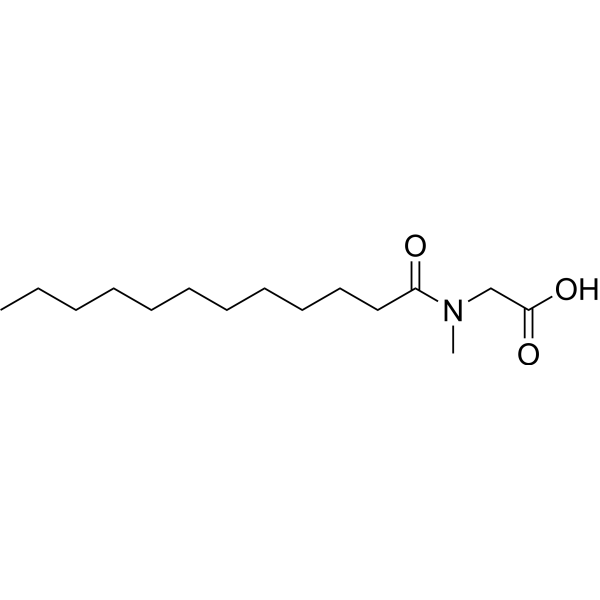
N-lauroylsarcosine is an anionic surfactant. N-lauroylsarcosine has antiviral activity against HSV-2 strain 333 and HSV-1 strain F. N-lauroylsarcosine synergistically increases skin permeability with 25-50% ethanol. N-lauroylsarcosine can be used to study HSV-2 infection .
loading...
    loading...
Cat. No.: HY-W040996R
CAS No.: 5333-42-6
Research Areas:  

Others

2-Octyldodecanol (Standard) is the analytical standard of 2-Octyldodecanol. This product is intended for research and analytical applications. 2-Octyldodecanol can enhance the skin permeation of formoterol fumarate (HY-B0010) .
loading...
    loading...
Cat. No.: HY-W040996
CAS No.: 5333-42-6
Research Areas:  

Others

2-Octyldodecanol can enhance the skin permeation of formoterol fumarate (HY-B0010) .
loading...
    loading...
Cat. No.: HY-122056
CAS No.: 39036-04-9
Synonyms: L-α-Diheptanoyllecithin; 12-Diheptanoyl-sn-glycero-3-PC
Research Areas:  

Others

1,2-Diheptanoyl-SN-glycero-3-phosphocholine (L-α-Diheptanoyllecithin; 12-Diheptanoyl-sn-glycero-3-PC) is a short-chain phospholipid. 11,2-Diheptanoyl-SN-glycero-3-phosphocholine forms bimolecular micelles with long-chain phospholipids, and these micelles undergo adsorption and spontaneous fusion to generate supported lipid bilayers. 1,2-Diheptanoyl-SN-glycero-3-phosphocholine enhances the transdermal penetration of hydrophilic low-molecular-weight compounds via micellar pretreatment of the skin of hairless mice. 1,2-Diheptanoyl-SN-glycero-3-phosphocholine can be used in studies of membrane biology, structural biology and transdermal drug delivery .
loading...
    loading...
Cat. No.: HY-W250316
CAS No.: 37318-31-3
Synonyms: Sucrose Stearate, Type II, USP
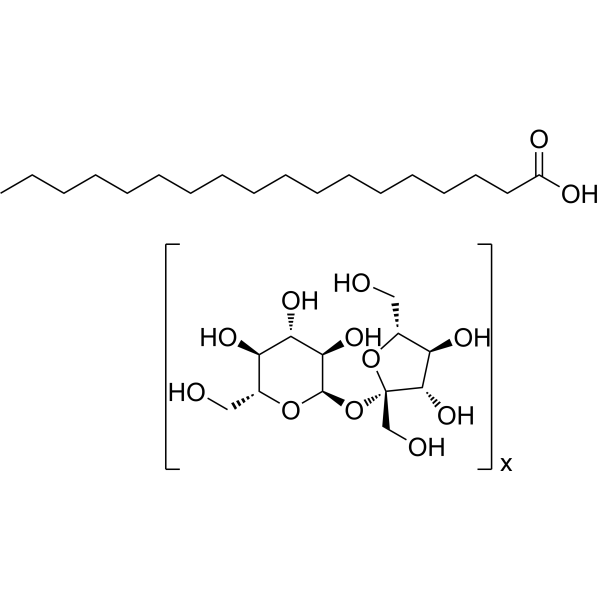
Alpha-d-Glucopyranoside, beta-d-fructofuranosyl, octadecanoate (Sucrose Stearate, Type II, USP) is a non-ionic surfactant. Alpha-d-Glucopyranoside, beta-d-fructofuranosyl, octadecanoate enhances the skin permeability of formulations .
loading...
    loading...
Cat. No.: HY-119151
CAS No.: 859209-84-0
Research Areas:  

Infection

GS-9191 is the prodrug of the nucleotide analog PMEG. GS-9191 is a topical agent to permeate skin and be metabolized to the active nucleoside triphosphate analog in the epithelial layer. GS-9191 inhibits NA synthesis, arrests cell in S phase, and induces cell apoptosis. GS-9191 can be used for research of human papillomaviruses (HPV) infection .
loading...
    loading...
Cat. No.: HY-125533
CAS No.: 1404289-52-6
Target:  

Bacterial

Research Areas:  

Infection

TXA497 is a potent local topical bactericide. TXA497 exerts its bactericidal effect by interfering with the polymerization kinetics of the bacterial cell division protein FtsZ, rather than inhibiting it. TXA497 shows strong activity against various Staphylococcus aureus strains, including MRSA and MSSA, with an MIC value ranging from 1.0 to 2.0 μg/mL. TXA497 skin deposition is concentration-dependent in its formulation, consistent with Fick's first law. TXA497 has limited systemic permeability through the lipid pathway of the stratum corneum and is easily absorbed through this route. TXA497 can be used for research on topical bactericidal agents .
loading...
    loading...
Cat. No.: HY-W893751
CAS No.: 2708274-72-8
Research Areas:  

Metabolic Disease

PMO-G is a spherical-shape polymeric micelles. PMO-G has skin permeation. PMO-G can result in up to a 50-fold higher level of dystrophin in abdominal muscles of mdx mice. PMO-G can be studied in research on Duchenne muscular dystrophy .
loading...
    loading...
Cat. No.: HY-W761985
CAS No.: 65907-30-4
Target:  

Insecticide

Research Areas:  

Inflammation/Immunology

Furathiocarb is a carbamate pro-insecticide and a contact allergen. Furathiocarb is commonly used in studies related to contact allergy. Furathiocarb induces significant proliferation of MHC II-positive B cells in auricular lymph node cells and induces the production of Th1 cytokines (such as IL-2, TNF-γ and IFN-γ). However, Furathiocarb does not induce respiratory allergy in mice. After absorption through the abdominal skin of isolated rats, Furathiocarb is completely metabolized into carbofuran, and its permeation amount increases with time and dosage. The skin permeation rates of both emulsifiable concentrate (EC) and wettable powder (WP) formulations of Furathiocarb are higher than that of Furathiocarb itself, with no significant difference between the two formulations .
loading...
    loading...
Cat. No.: HY-W415753
CAS No.: 90058-29-0
Synonyms: VUFB-15754
Alaptide, a spirocyclic synthetic dipeptide and a derivative of melanocyte-stimulating hormone release-inhibiting factor (MIF), is a transdermal permeation modifier. Alaptide loaded on nanofibrous membranes accelerates the healing of skin incisions, particularly the healing of skin burns. Alaptide is a nootropic agent, that influences the dopaminergic system and increases homovanillic acid level in the striatum of rat models. Alaptide can be used for wound healing with large damaged areas and neurological diseases research .
loading...
    loading...
Cat. No.: HY-178721
CAS No.: 2768690-22-6
Lithocholic amide-C2-N(didecane) (Compound LC10) is a Lithocholic acid (HY-B0172) analogue. Lithocholic amide-C2-N(didecane) can form lipid nanoparticles spontaneously in the aqueous milieu, permeate through the skin, penetrate the deeper dermal layers, and exert anti-inflammatory effects against psoriasis-like chronic skin inflammations. Lithocholic amide-C2-N(didecane) can inhibit abnormal proliferation of keratinocytes, downregulate the mRNA expression of the psoriasis-associated receptor EphA2 and reduce serum levels of multiple pro-inflammatory factors such as IL-1α, IL-1β, and IFN-γ by inhibiting activation of the Th17/Th2 inflammatory pathway .
loading...
    loading...
  • 1

